
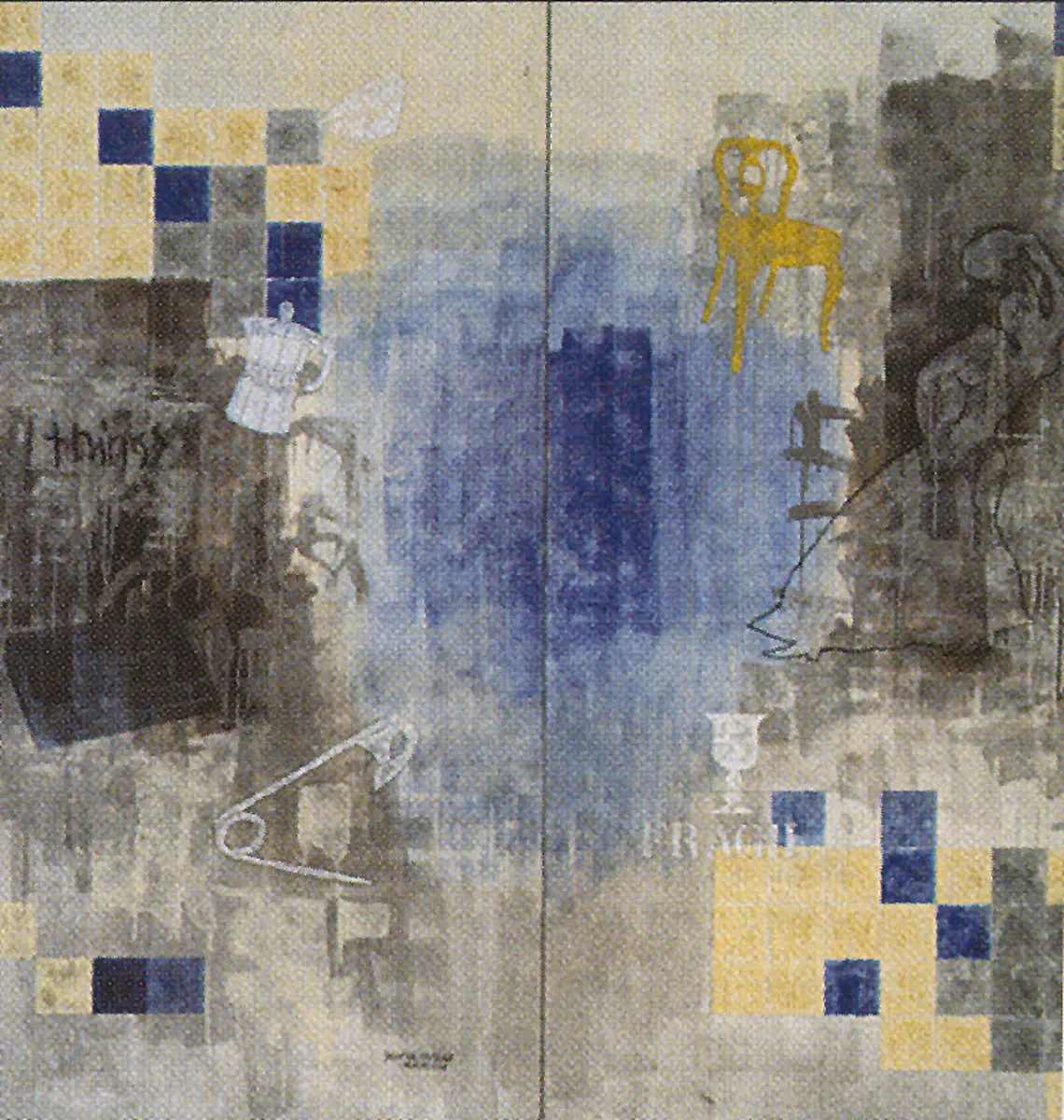
A coffeemaker, a goblet, a fan, a drawing triangle, and a chair harmoniously share a pictorial space designed for a woman's rest. This work, titled Desnudo en reposo (Resting Nude), also includes a group of numbers, along with the words frágil (fragile) and things (the latter in English), fragments of a piece of cloth with a green-and-cream checkered pattern, and letters, all of them identifying, ultimately, Jason Galarraga's most recent plastic proposition.
The show, titled Cosas (Things), displays in Sala Alternativa's two spaces a range of objects usually considered iconic of modernity, recovered from a past esthetic period and highlighted anew with the support of viewers so that they, as the artist has said, can 'put together their own work of art.'
The show presents ten acrylic on canvas paintings in medium and large format. As far as form and color, the creative process in each and every one of these pieces seems to insistently respond to simple constants; objects are repeated, as are the soft shades, vertical strokes, symmetry, spatial order, and words—or, to be precise, the word 'cosa' ('thing'), both in English and French.
Painting, the great Viennese critic Ernest Gombrich has said, cannot be entirely explained with words. 'But words,' he added, 'sometimes constitute useful indicators, they help clarify any miscomprehension, and they can allow us at least a glance at the situation in which artists find themselves.'
Thus Galarraga's cosas, be they symbols or tenuous linguistic signs, incarnate the beginning and the end of a creative (and re-creative) process that the human eye perceives and appreciates as an authentic work of art. A postmodern work of art, indeed, if one remembers compositions such as Desnudo picassiano (Picassoan Nude), or elements as simple as that piece of cloth daring to intervene in the color planes to evoke the notion of collage.
Paintings such as Mesa con guitarra (Table with Guitar), mixed technique on canvas, reveal other pictorial keys of Galarraga's work, such as the emergence of barely delineated figures made with oil crayons, or the esthetic dialog established between symmetrical color coatings which, among other things, balance the space and offer contrasts and multiple textures.
Applied with a rolling brush, grays, browns, and creams occupy their own space on the canvas, always maintaining the idea of spatial order as if parts of a large pictorial scenario where the object 'just as it is' recites the monologue of a daily life built of bottle openers, juice makers (like the one designed by Philip Stark), ashtrays, cups, stairs, bicycles, and vehicles.
Cosas has been equally appreciated in Miami, USA, and Puebla, Mexico. Here, Galarraga—who received the 3rd Palette D'or Prize at the XXIII International Painting Fest in France—tempts to publicize, in the least commercial sense of the word, a disciplined, urban aesthetic that recuperates symbols as expressive units within the format. Cosas also attests to this 51-year-old Caracas-based artist and graphic designer's desire to distill the image and clarify the message that a true work of art, without noise or interference, wants to communicate.
In Défense D'afficher (Post No Bills), his previous show, also at Sala Alternativa, Galarraga looked at urban messages, graffiti, and protests printed on numerous posters and walls. The artist, who graduated from the Neuman Studio in Caracas, has also been featured in numerous group shows, among them Solidarity and Integration of Latin America and the Caribbean (Museo de Arte Contemporáneo Sofía Imber, Caracas, 1999), the Guadalajara Art Fair (Mexico, 1998), the International Contemporary Art Fair Arco (Spain, 1997), and Grand et jeunes D'aujourd'hui at the Champs Elyseés' Grand Palace (Paris, 1990).
PABLO VILLAMIZAR