
Fotos de otros (Others' Photographs) is the new series that Julio Grinblatt showed, along with his already-known series Pasillos (Hallways), at the Museo de Arte Moderno de Buenos Aires (MAMBA) between December and January. To put it simply, the series is about what the title literally proposes. We're talking about photographs registering scenes in which other photographers are in the process of shooting a picture. The title alludes to an author stripped from his object. The series' fiction tells us that the images we are seeing are not Grinblatt's photos as an author, but as the one who appropriates someone else's object, a witness who is intercepting the other's desire.
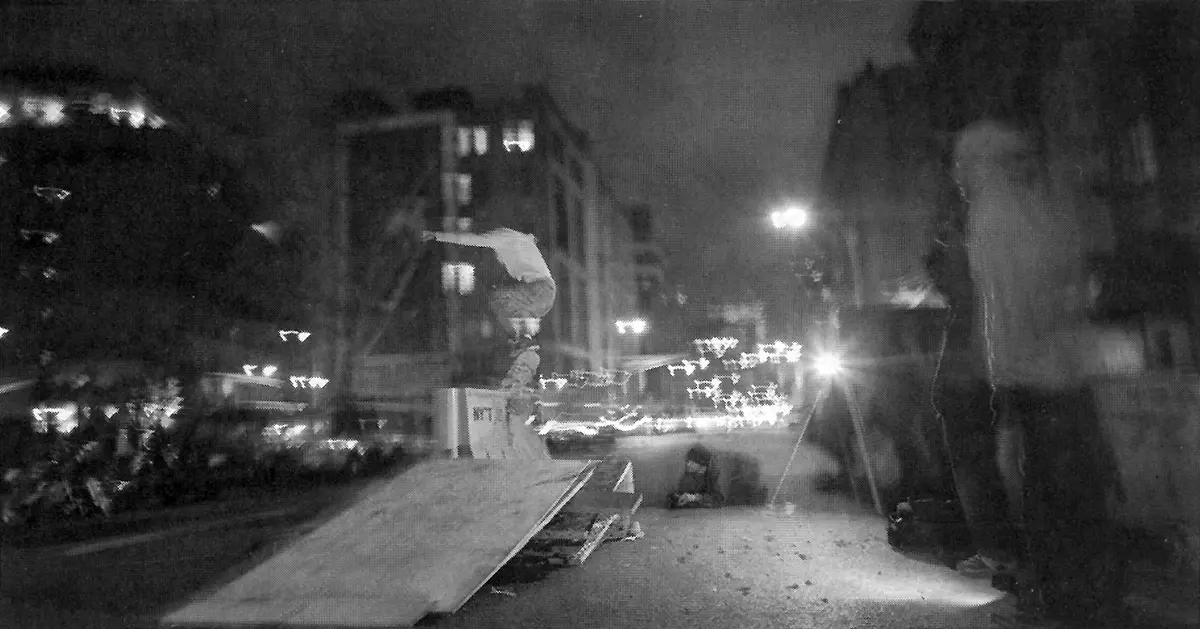
The photos have other important characteristics besides this basic premise. As with Pasillos, where Grinblatt undertook the empty geometry of New York's passages and hallways as a distanced, non-participating observer, in this new series the photographer has placed himself once more outside the scene. These photos were taken at night, or at least in places where the artist (not Grinblatt, but the one captured by him) is forced to use a flash. This technical detail is not anecdotal; while Grinblatt awaits with an open shutter for a relatively long time, his colleague's flash, the final image, presents two different temporal areas as two different definition zones. On the one hand, the surprising dark zone created by a myriad of luminous, fanciful shapes, lines, dots, and double or triple images, becomes the ghost-like traits behind the general scene (distorted by Grinblatt's long exposure). On the other, we have the scene captured by Grinblatt's colleague, a scene that seems to belong to a different reality. Bathed by the blinding whiteness, the scene is fixed in a rigor mortis that is also a pose. Grinblatt captures these images—be they a group of youngsters in a bar, a couple posing in the city, or a model—at the precise moment when the other photographer captures them. They are well-defined as if they were fragments of a dream we playfully remember while it begins to exit our conscience.
The scenes vary. There are families, tourists, skaters jumping for their friends' cameras, party groups, models, celebrities trapped by the fans' or paparazzi' flashes, and campaigning politicians. The whole series points toward a certain anthropological depth. It's obvious that there's an intention to cover paradigmatic situations in which reality is stopped in order to be represented. Seen under this light, the series can be interpreted as critical towards photography as the central technique for creating the spectacular. And not because Grinblatt is simply showing the instants of that process, but because of his artificial alienation (the fact that he places himself, as in a program, as the photographer without an object, the one who is only after his colleagues' flashes) lets him do something else—expose the photographic act as an agreement, a pact, between the photographer and a subject who's hiding its spectacular nature. Once installed in the museum, the series emanates a particular sort of obscenity that has to do, I think, with the fact that ultimately Grinblatt's breaks the pact with his camera. The photos reveal, in all their horror, the moment in which reality (and in some cases, intimacy) is exposed to become an image. Whatever has not been robbed by Grinblatt, the darkness overflowing into the other's photograph now is almost an abstraction. In other words: The world is divided between that landscape of evanescent excesses and the spectacle's clear and funereal grimace.
INÉS KATZENSTEIN