
As she herself said apropos her Woven Water (1994) exhibit, María Fernanda Cardoso's work is "formalist and beautiful" and it makes reference to the "dominion that humans have over animals." In this fashion, from a contemporary vantage point, inside her works arises a conflict; it's one that has been confronting Western World since some time back: the toil between nature and culture. In this respect, it would be opportune to quote "Turismo ascéptico" (Aseptic Tourism), an article written by Carolina Ponce de León. She writes that Cardoso's work generates a dialectical association between culture and nature by using appropriation and recodification, and also by using formal resources such as repetition and the creation of simple formal structures that provide the object with a cultural load. And referring particularly to the artist's "plastic flower gardens,"1 she finds that inside the flowers nature is locked in a cultural order, subverting modern art's action toward "naturalizing" culture by giving autonomy to the artistic object. Cardoso, on the other hand, "culturizes nature."
The exhibit held at the Galería Diners in late January can continue being read along those lines. The show is partly composed of a series of "drawings" or "designs" made with butterfly wings of different colors and shapes. In other pieces, she uses their antennae and tongues—linear elements that remind us of the delicate traces inherent in drawing. Sometimes they coil, forming spirals and circles; other times, they uncoil to create short lines. Both shapes become repetitive formal units inside a circular shape, keeping that way a structure that Cardoso has used in previous works. In order to show them, the artist built a sort of flat box, or better said, a slightly three-dimensional surface made up of two acrylic sheets. An opaque white acrylic was used as the back of the box. The artist carved the surface with a buffer, creating a subtle cavity with blurred borders. This surface holds the designs, and the upper portion, made of transparent acrylic, has been placed over it in such a fashion that it wouldn't crush them while keeping them visible and protected from the elements. Sometimes the different pieces are presented as a single unit; in other instances, they are placed as couples, triptychs, or groups of four or more. The butterfly is not completely present in each piece; it appears fragmented, its parts acting out as abstract shapes. In only one, we see a full body: a butterfly with slightly metalized black and grey wings that contrast with the dark, velvety body splattered with tones of red.
In a public lecture, María Fernanda Cardoso spoke about the motivations and procedures behind her work, which for some years now has centered around the research and observation of nature. Through her conversations, it becomes clear that present-day artists move through interdisciplinary methods, allowing languages that were previously seen as mutually exclusive (for example, science and art) to become allies and produce a work of art. In Cardoso's work, her research has taken her to consult natural science books, where she has access, through the knowledge and gaze of scientists, to the topic holding her interest. For this specific exhibit, research starts with a curiosity about butterfly behavior. Butterflies defend themselves from other species through mimetic action, disguising their presence with vegetal elements such as leaves and tree bark. According to the artist, this action grants a metaphorical element to her work, which is related to the costume, to the physical transformation that people undergo daily to define their social roles. This research, which places her close to scientific observation, has the ultimate objective of getting closer to the butterflies she herself has raised in her studio. This way, the observation of science creates an alliance with a purely formal and visual issue that refers to the shapes and colors of these insects, reminding us of the shapes of Art Nouveau and Art Deco—nature-inspired styles that frequently resorted to repetition in order to achieve their designs.
Departing from the sources that Cardoso resorts to, and given the characteristics of her work, many possible readings arise while we move through the two white, neutral halls in the gallery. These delicate works remind us of entomologist boxes. Impassioned and fascinated by butterflies and other insects, the entomologist desiccates and pins them down with a needle inside a bell glass jar. Above all, they resemble exquisite drawings that are somehow related to Kandinsky's laws and values of games and composition lessons. According to the Russian artist during his Bauhaus days, such laws and values "which are based on color and rhythm, on the dot, the line, and the plane" are grounded in the "laws of nature." With today's knowledge, natural laws can be related to the theory of chaos or fractal geometry, a concept that becomes of great importance for Cardoso at the moment of ordering her elements in space.
Curiously enough, in a lesson dedicated to the line, Kandinsky introduces a random note: "Assimilation (mimicry). Recent investigations have shown that mimicry goes beyond the practical purposes of camouflage." This thought is resolved later when he states that the internal and external beauty of both natural and artificial objects goes beyond any practical purpose since it is an end in itself—another point connecting to the formal and metaphorical intentions Cardoso spoke about in her lecture. She also talked about how her current search is related to her fascination with butterflies in mid-flight and their full display of beauty.
Threading ideas from here and there in Cardoso's work, we can finish by saying that in these works—using appropriation of natural elements, and in this particular case, of butterfly body parts, and using as well formal resources that become articulate through the repetition of a "pattern" (the wings, tongues, or antennae)—we find simple formal structures with which Cardoso "culturizes nature" at the moment in which the butterflies mimicize with the drawing, displaying beautiful color exercises and returning us to the old and conflictive relationship between art (culture) and nature.
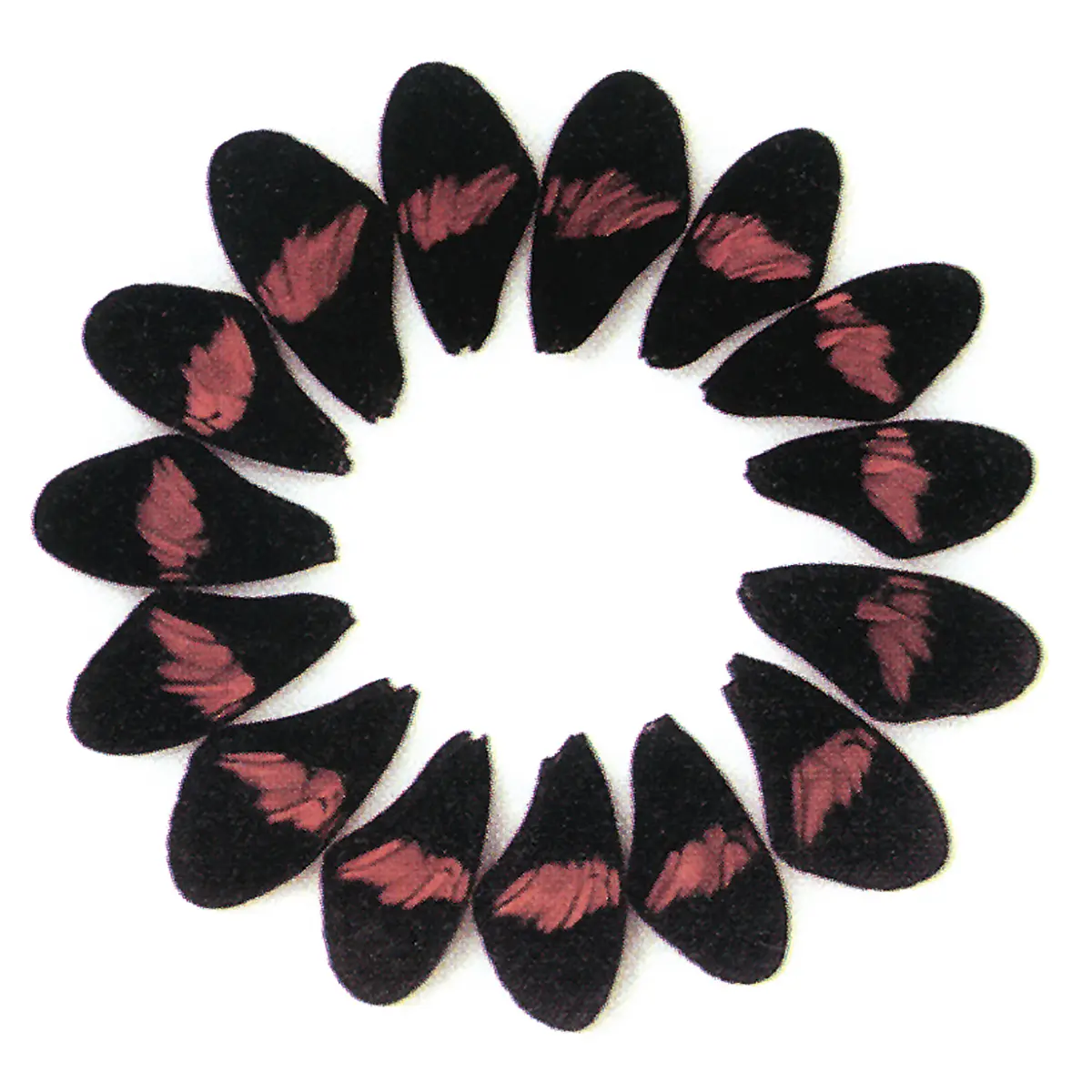
And to return to this antagonic relationship in a time where preoccupation with ecology is the order of the day, we do not know what is the work's position regarding the conflict. The artist herself has said that her work is "predatory," and that it has an artistic objective. Her interest lies in this contradiction; her butterfly works imply a sacrifice that won't satisfy the basic need for food. On the other hand, it is through the laborious research related to science, and the prolonged act of observing, ordering, and artistically, decoratively, and delicately presenting her work, it is that she plunges into the legendary fascination that animals hold over humans.
NOTE
1. Apropos these gardens, María Fernanda Cardoso made a beautiful installation from red plastic roses that she placed on a niche on the wall above the staircase. It was an homage to Ellen Riegner de Casas, the gallery's director, who died a few days before the exhibit opened. The work was donated by the artist to become part of the gallery's collection.
MARTA RODRÍGUEZ