
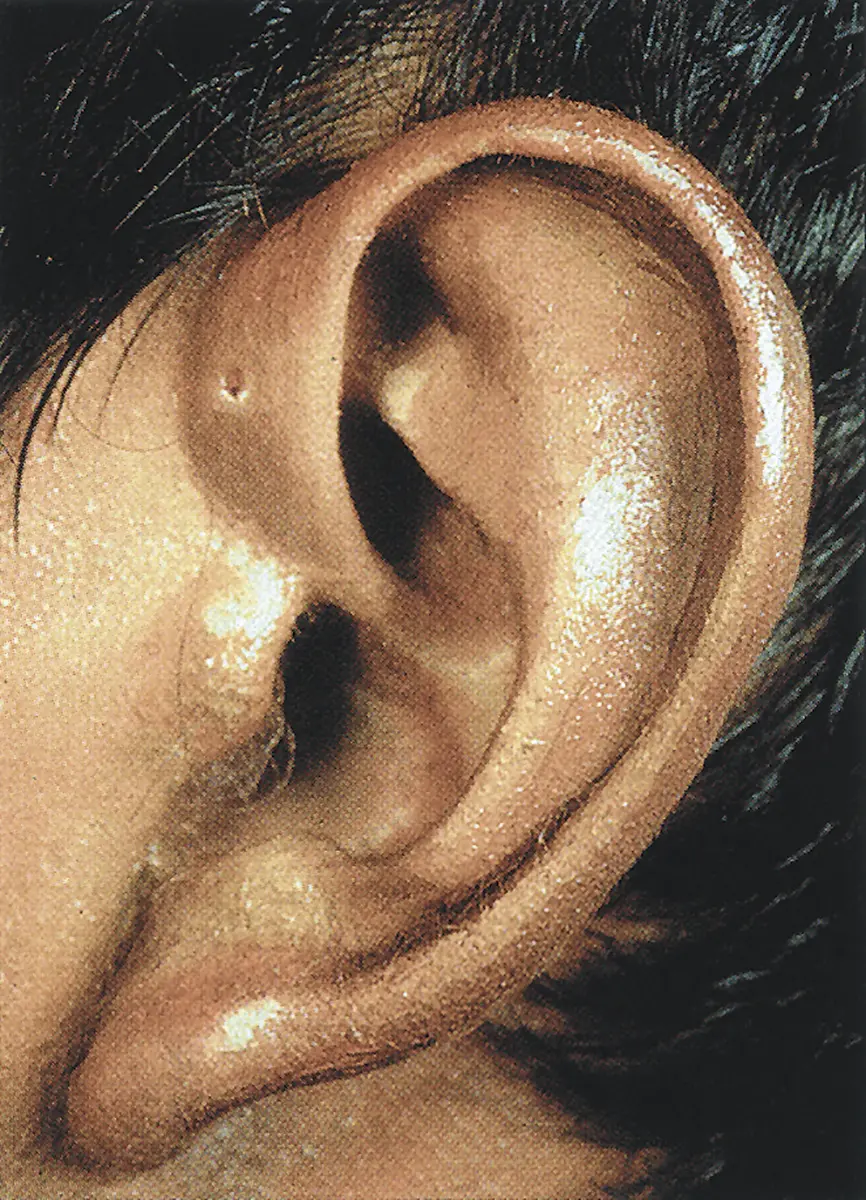
Mónica Castillo has long confronted us with the fine line between what is "real" and what is artifice. Her new work further challenges the distinction. Three Painted Men, 1999-2000 exemplifies the project. Three color photographs portray close-ups of male body parts, one of a hand, the other a bearded mouth, and the third an ear. The ear, mouth, and hand have all been enhanced with flesh-toned pigments, complicating our reading of the print, such that each photo suggests, at once, a painting with a seamless surface and a photograph of a manipulated subject. The hand is thickly coated in shiny flesh-toned paint, the creases of the fingers coated in deeper brown, and the fingernails painted pale pink with a line of white along the tips. The lips in the middle photograph are enhanced with flesh-toned pigment and dark brown creases of paint. Evidence of the added pigment appears beneath the mouth where begins the black and white beard. The print at the right portrays a man's left ear surrounded by short black hair. The ear is covered in palpably thick, flesh-toned pigment, including white highlights to suggest light's reflection. Together the three photographs depict the physical attributes of a man whose appearance has been enhanced. We are to acknowledge these manipulations but be seduced by them, as well.
Castillo literally registers the process of creating the painted appearance of a figure in her video Pictorial Effects I, II, III (2000-2001). Shown within a curtained space, one sees a ballerina wearing a nude-toned leotard performing classical ballet moves while yellow, brown, and flesh-toned paints spill over her body from cans strapped to her wrists, waist, and ankles. Although she begins her short performance immaculately clean, after two or three arabesques her head, torso, and appendages become shrouded in pigment. The sounds of sloshing paint pouring over her body punctuated by the tap of her wooden toe shoes during her dance, draw the viewer into both the mechanics of the ballet and of the painting process.
Adjacent to the video screen a lightbox presents a Duratrans color print, Dancer's Self-Portrait (2001), of the same ballerina shown only where the paint coats her body. Areas of her torso and face, for example, left untouched by pigment reveal the backdrop behind and no trace of her lithe form. It is a haunting portrayal demonstrating the dancer's indefinite presence unless covered in paint, suggesting perhaps, that we too, are only visible when hidden beneath clothing or makeup.
The most extraordinary pieces in the exhibition are Tableau Vivant I (1999-2000) and Vitrine (2000). The former portrays the intimate perspective of a lush, tropical garden. A person, evident from his calves and feet, walks through a surreal environment of leaves, colorful butterflies, snails, moist soil, and the venomous, cara de angel insect that lurks in Mexico City gardens. It is a scene so vivid that one slowly realizes it is fictional, an oasis created in Castillo's studio that seduces the viewer by juxtaposing actual leaves and bugs with versions painted to enhance their effect and bewilder the viewer.
In Vitrine (2000), the Mexican artist literally creates the plants she captures on film. The petals, leaves, stamens, pistols, and stems of lilies are exhibited on board enclosed under glass-like biology specimens. They appear to be conceived with fastidiously applied, dense but malleable pigment that captures the blossoms in exacting detail. What we do not realize is that the actual flowers have been dissected and painstakingly covered in paint, so that within each painted blossom exists the actual lily. In effect, she deconstructs and then convincingly re-constructs the blossom in palpable pigments.
Castillo's work has always caught the viewer off guard, and these new pieces are no exception. Long after one sees this exhibition one ponders the means by which appearance is created, and the distinction between the impression created in pigment and the actual object portrayed.
MARY SCHNEIDER ENRÍQUEZ