
Fernando Pradilla Gallery opened recently with the avocation of showing and promoting young Latin American art that, for varying circumstances, has not had the chance to travel beyond the region's borders. This is a valiant gamble, particularly in economic terms, in an environment not always receptive to "outside" proposals—an environment where contemporary art practically has no space in the gallery circuit.
In this context, and at first glance, what is most surprising in Mónica van Asperen's show is its "modernism," its "minimalism": a series of glossy color photographs printed on 100 x 150 cm aluminum sheets, distributed around the gallery's walls. Besides the photographs, there are two installations realized with balloons and needles and occupying two other walls in their entirety.
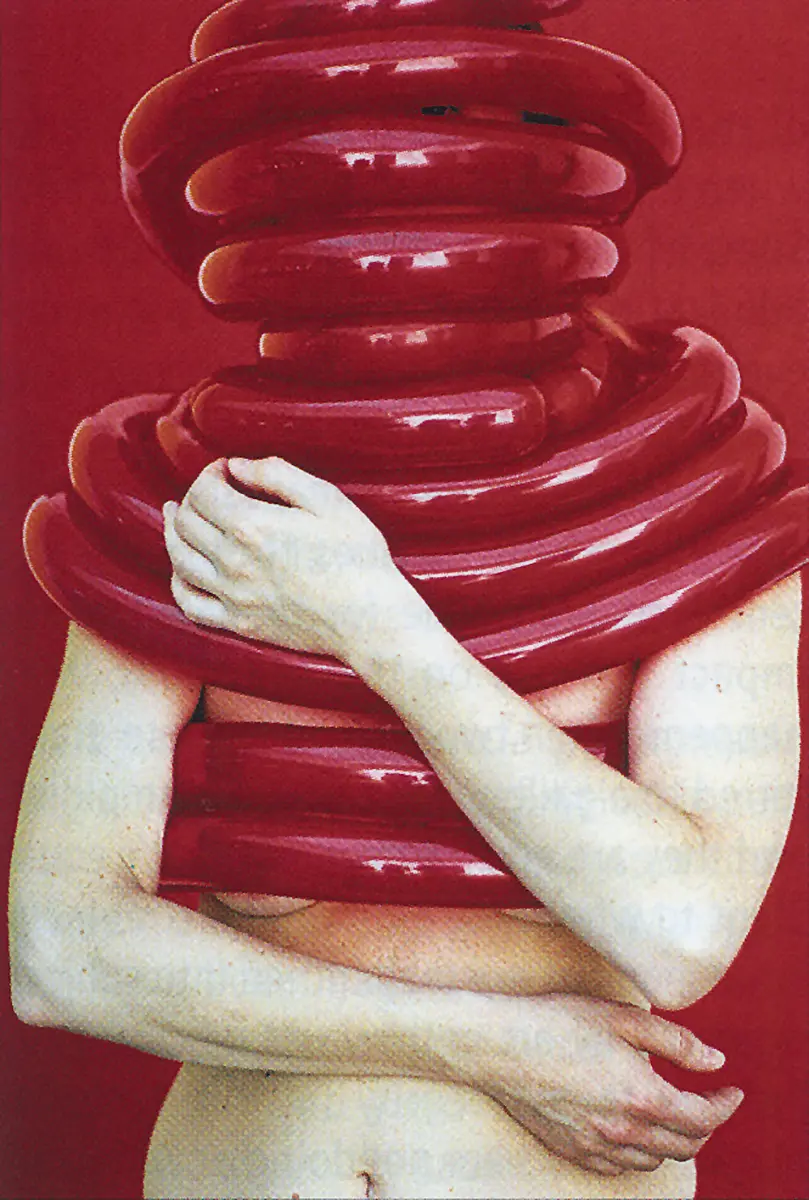
The recurring motif in all the pieces is a number of elongated latex balloons in different colors. In the photographs, these balloons serve as clothing and a prison for nude bodies that are barely glimpsed through the translucence created by the inflated plastic. In the installations, the balloons are arranged as elongated strips, intermittently inflated, and affixed to the wall by large steel needles. Taken as a whole, these pieces oscillate between resembling some sort of giant music sheet and a landscape that, vaguely, puts one in mind of a hospital's aseptic environment (the latter perhaps due to the use, in one of the installations, of intensely red balloons that in their elongation seems to allude to the vials used to store blood samples).
In the photographs, the shining balloons also serve to sterilize the bodies they cover; instead of the skin's imperfections, with their textures and their complexions, we find a smooth, shining, colorful covering that adapts in the shape of rings to each body's proportions and shape, so that it is, in a way, personalized.
In that sense, these pieces may relate to van Asperen's previous work in fashion design; in their current context, however, the results are uneven. The virtue of constructions upon walls is the very paradox her installations pose: those inflated balloons held in place by oversized needles create a tension that is perceptual as well as physical, not exempt from irony. Ultimately, if the balloons were punctured, air would be all that came out. The idea of "contained air" is also insinuated by the photographs: those bodies are "embraced" by their own exhaled breath, or perhaps by that of others. But in this case, the plastic, the artificial sensation of the balloons, and the recourse to maximum aesthetization through the interplay of the background color and the balloons themselves, all refer to a playful situation that is much more contemporary. They even refer to prophylactic sexuality. In any case, the photographs end up being more pop, and as such, more harmless.
Van Asperen's pieces at Fernando Pradilla seem to exist from their glossy surface out; behind is the air that gives their shape.
ISSA MARÍA BENÍTEZ DUEÑAS