
Víctor Vázquez is a practitioner of a certain brand of figurative photography that has taken root across Latin America. Among its other leading proponents are Luis González Palma, Gerardo Suter, Mario Cravo Neto, Marta María Pérez Bravo, and, to a large extent, Miguel Río Branco. The symbolic figuration pursued by these artists, at its very best, pictures the human body in a visually arresting and viscerally immediate manner, which can resonate with allusions to art and history, and startle with a revelatory beauty. The weaknesses of the enterprise, however, include a dependence on visual and emblematic cliché, an artificial and forced primitivism, and an insistent and disingenuous exoticism that, together, generally overwhelm any ostensible content. Bodies in these photographs seem disproportionately naked, young, female, unwashed, and passively inviting to the viewer's gaze. The subjects tend to be darker, less European, and, when applicable (in González Palma and Río Branco, for example), of an appreciably lower socioeconomic caste than the photographer. (Pérez Bravo neatly sidesteps this issue by basing her practice on self-portraiture.) Symbolic accessories adorning these bodies favor items such as dirt, masks, and dead animals, meant to reference pre-Columbian, indigenous, or syncretic Afro-American cultures—a veritable hagiography of victimization—but in reality far more expressive of a tortured relationship to the ritual, abjection, and scourging of the body inherent to the artists' native Catholicism. Despite (or because of) these failings, the photographs of many of these artists have enjoyed great popular and commercial success, at home, as well as abroad. Nevertheless, nearly all of these photographers, cognizant, perhaps, of their difficult position, have tried with varying degrees of effectiveness to transcend the limitations of their static-image-making by expanding their project into the mediums of sculpture, installation, and video.
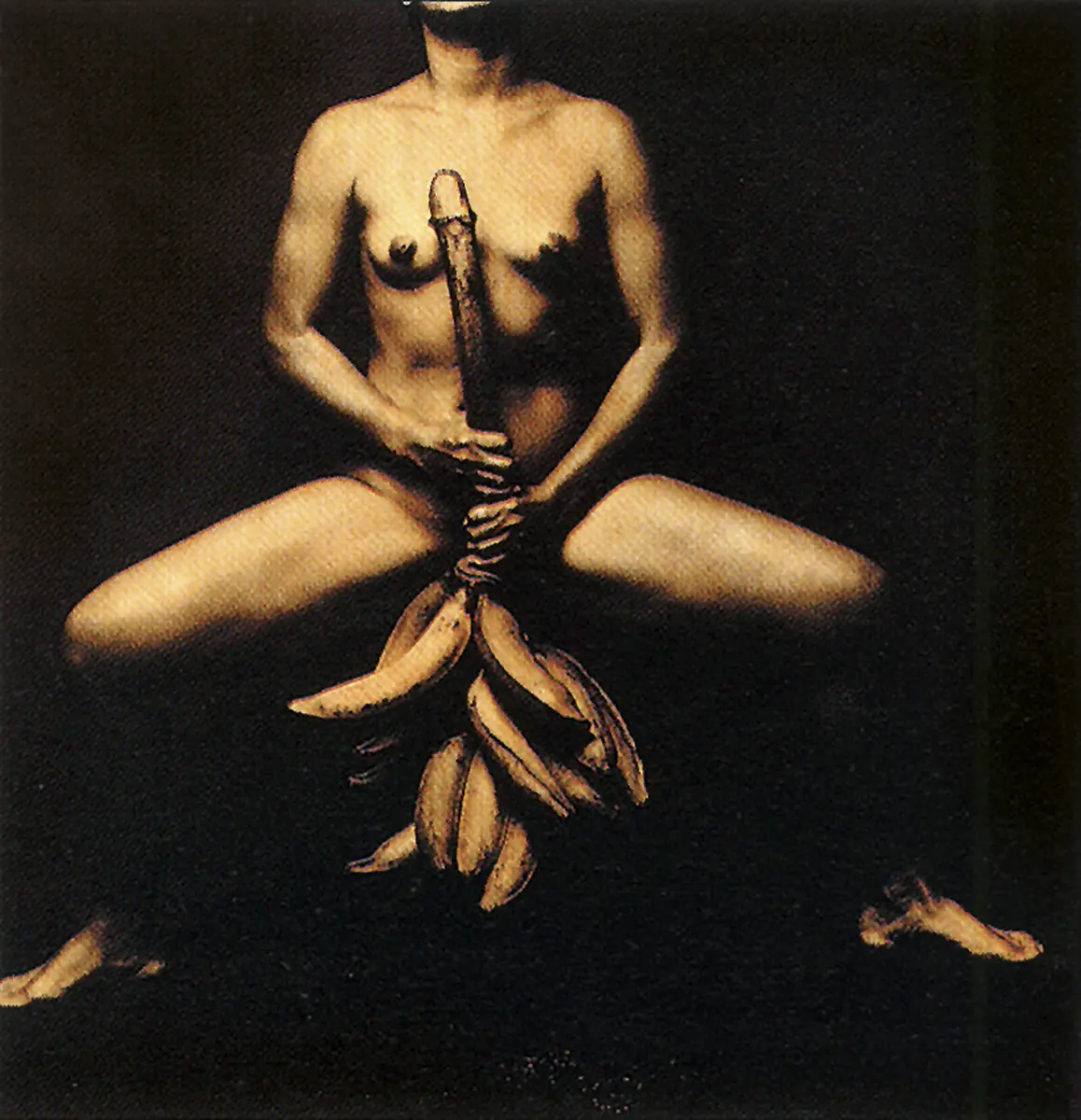
Vázquez has essayed all of these, yet his recent exhibition in Philadelphia relied almost entirely on the impact of large (48 x 48 inches) photographs. A few of the pictures feature sculptural elements in their framing, and all are treated in a more or less painterly fashion, hand-toned with wax to golden sepia. The painting of the images serves immediately to remove them from the purely transcriptive function of photography and place them into the realm of the metaphoric. Vázquez is a latter-day pictorialist, his bronzed figures isolated and glowing from within the velvety depths of black and empty backgrounds. The power of his images depends on the semiotic suppleness of their subjects, and how well they operate as poetic signs. El Ave María (1998), is a bust-length portrait of a pretty young woman, naked save for a white head wrap and a necklace of strung chicken heads and feet. With eyes demurely closed, but lips apparently painted, she is intended as both nun and Santería initiate—a case overstated by a rosary attached to the frame—but the picture struggles to overcome its slightly leaden literality, skirting a kind of macabre kitsch. Another young woman lies nude and supine, a twiggy branch decorated with feathers held above her crotch, in Falling Feathers (1996), an image pieced together from several photographs à la the Starn Twins.
Better are images simpler and more direct, such as Untitled (1998), which pictures a woman bent at the waist, a large bone held tightly in gritted teeth. Her features are less blandly attractive, and consequently more convincing than those of Vázquez's other models. Double exposure imparts the illusion of movement; feet tap agitatedly, fists clench and unclench, head shakes, grimacing. A real feeling of an unstable psychic state derives from a reduction of means and the barest symbolism. Our Daily Bread (1998) shows a naked woman squatting, head cropped by the top of the photograph, legs akimbo, and clutching the most phallic branch of bananas with both hands. A pendulous bunch of large bananas hangs from between her legs while the bare shaft with knobbed end rises, tumescent, to nestle between her breasts. Earthy sexuality is evoked by a minimum of elements and buoyed by a slyly blatant humor that may be read as a tongue-in-cheek parody of stereotypes of the tropical. Sparest of the artist's images, Falling Hands (1994), depicts two arms hanging from the top edge of the photograph, which cuts them off just below the elbow. They seem to rest on, and in, and almost embrace, the soft black expanse between them. The detached limbs, with subtle torsion, faintly recall the arms of Christ in Renaissance Depositions or the disconnected body parts of ex-votos. Devoid of overt symbolism, engaging allusion only gently, as if in passing, the image resonates with an unforced and softly tragic spirituality. With the lightest touch, Vázquez makes the strongest mark.
JOSEPH R. WOLIN