
There is no doubt that works of art send messages to viewers and make us feel sensations, just like dance music does to our feet and body. The work of Wilbert Piscoya (Peru, 1968) does this to our senses when we enter a gallery. We sense feelings of tranquility and order immediately. This happens because his paintings are symmetrical, balanced, and carefully arranged with elaborate geometrical calculations. Upon closer inspection, we find texture and pebbles in the paintings that emulate rock and wall paintings from the archaic periods of the Inca, Chibcha, or Azteca cultures from approximately 8000 BC to 1000 BC. The young artist uses sand, sawdust, and handmade paper to create texture that has characterized his work over the years. Piscoya's intention is to include in his work the ancient Latin American cultures from the human point of view and not their uniqueness. The themes of his paintings are legends, myths, rituals, and dances.
Piscoya's technique and compositions have won him several prizes including the first prize in the Hispanic American Young Painters Award in Spain (1993), second prize at the Johnnie Walker contest (1996), and a scholarship to the School of Art in Ottawa, Canada (1997). He has also received prizes from UNESCO in Paris and OEA in Washington D.C.
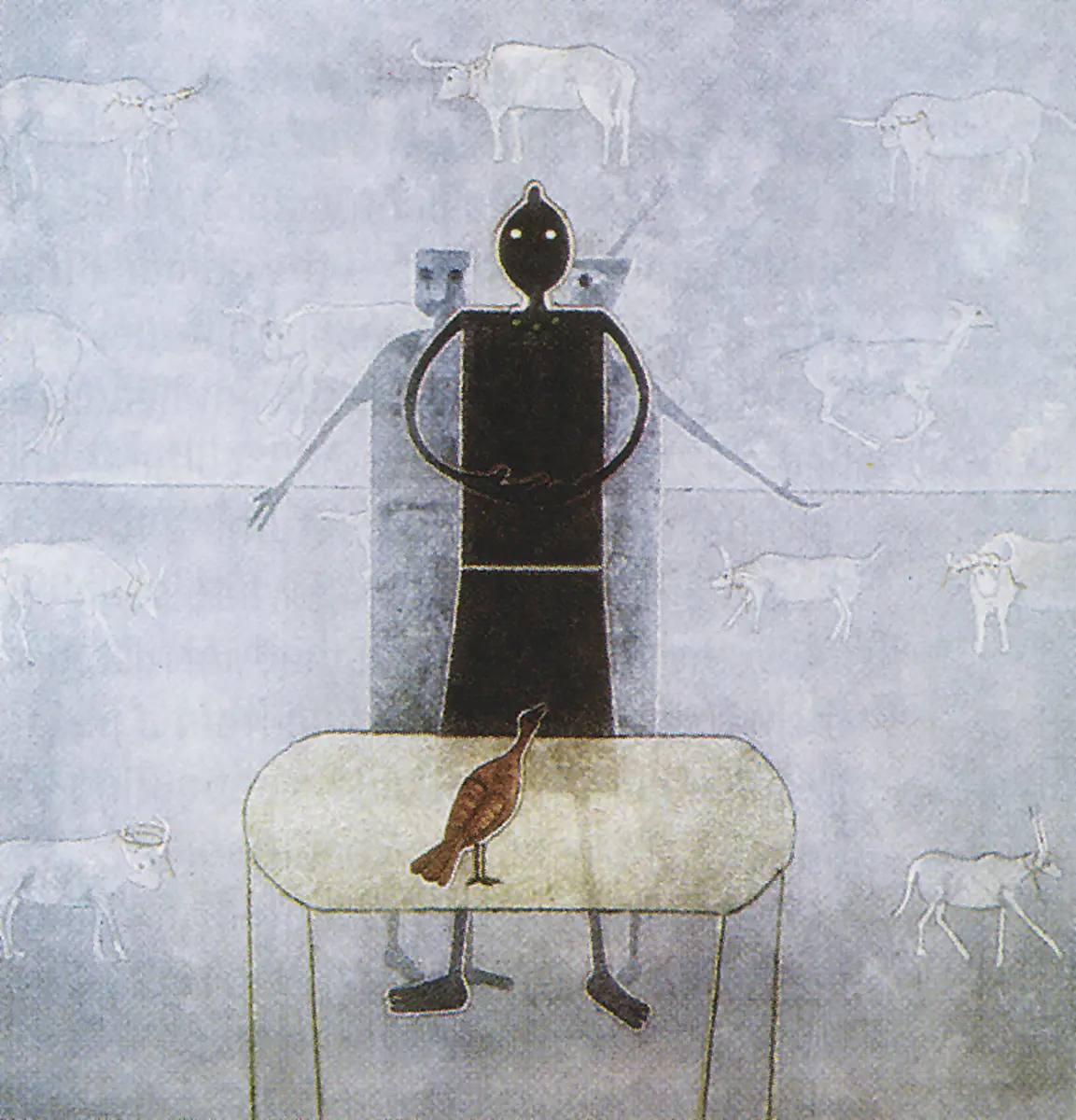
He uses an economy of brushstrokes to convey his message as it was done in the archaic period, particularly with his use of human silhouettes as subjects. Despite the limitations of the subjects, his paintings are not static. In fact, movement by the figures is suggested and anticipation that something is going to happen is apparent.
Piscoya's paintings use animal imagery around the main subjects to suggest rock or cave paintings. They are done with light colors giving the main image room to breathe. The subjects of the paintings are centered with precision creating symmetry and balance. On the left side of the Magical Couple are icons of ritualistic nature in fragmented patterns: a ritual chest piece, a mask, and a wooden glass. On the lower part of the piece (in a segmented part), there lies a feathered snake atop a table, surrounded by hunters with spears-clubs signifying fertility and life and is. According to Carl Jung author of Man and His Symbols, the representation of the animal has a "double" symbolic meaning in which the couple attempts to empower themselves with what the real animal represents to them. In essence, what happens in the representation will happen in real life. The main subject of the painting is a couple holding hands. The man's right-hand points to the mask, insinuating that the pair will prepare for a ritual. The people behind the couple are ready to prepare them for the ceremony. The woman has a baby in her tummy, indicating pregnancy, and thereby suggesting the reason for the ritual. The drawing of the baby seems a bit odd but is so well executed that it becomes part of the story in a natural way.
Piscoya is self-taught in anthropology, archaeology, and philosophy and he applies this knowledge to convey his ideas on the canvas. He uses color to his advantage to convey the mood of the painting to the viewer. It is known that warm colors can make us feel warmer because bright colors can slightly increase our circulation and body temperature. In Personages with Masks, the different hues of yellow and orange dominate the painting, creating a sense of warmth with the masked musicians. Cool colors do the reverse, making us feel cooler, thus creating a sense of calm. In Marvelous Reality, we sense the tranquility of the night, because the hues of blue predominate the painting. This painting evokes the sense of sweet soft sounds of the three musicians playing the flutes. In other pieces the subject of the paintings denotes birds treated with care, indicating the artist's love for animals, as well as sending a message to the viewer for animal protection. Piscoya's work is based on color, technique, geometrical balance, and making the themes of his paintings humane and universal. With this show, the artist showed maturity, and we are eagerly awaiting new paintings from him in the future.
AUGUSTO CHIMPEN