
Ana Patricia Palacios lives in a constant state of displacement. The cities of Medellín, Bogotá, and Paris have witnessed the birth and development of her oeuvre; Medellín and Bogotá are her points of departure, and Paris is the habitat of her rigor and discipline. Now we find her at Casas Riegner Gallery, in Miami's Design District. In the gallery's wide spaces, her show comprises several paintings in small and medium formats, dominated by a simplicity of drawing and a subtlety of pigmentation. Leaving behind her imaginary cartographies, a product of her research in the National Library of Paris, the artist turns now towards interior landscapes, towards the ontogenetic search for herself.
Palacios' current work meditates on femininity and identity. The artist, as a woman, becomes her research subject. Her artistic gaze turns telescopic and scrutinizing. Palacios projects small female figurines, drawn with simplicity and without detail as if cut out against large empty spaces. These characters are strangely serene, immersed in the laissez-faire of the quotidian, and they appear devoid of pose and pomposity; female figures are always duplicated by their visual twin, about a dialectic of alterity as part of the female condition. Each scene interrogates the I and the Other (mirror-like), the latter being nothing but the unfolding I of contemporary women.
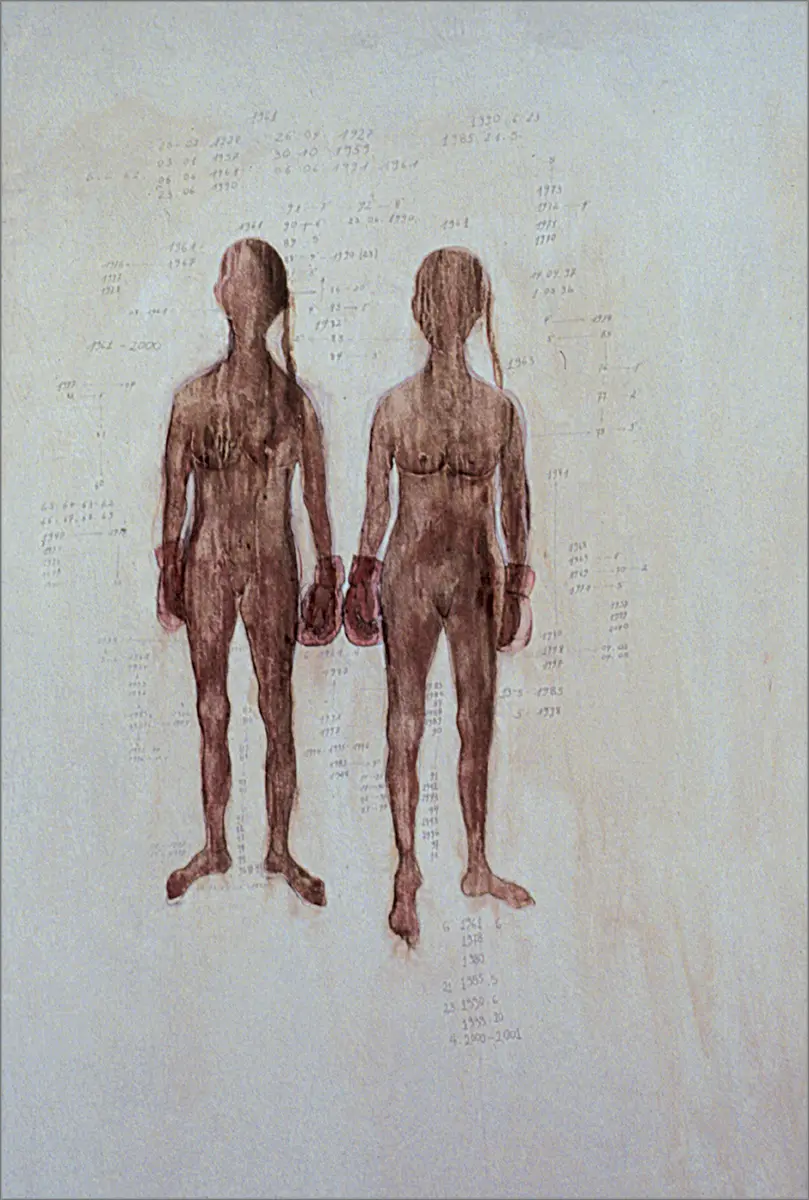
These works are a serial representation of a single theme. Specular, reiterative images showing female faces in profile, faceless nudes with shaven heads, unfazed and timeless effigies installed in the frozen instant of their unquestionable presence.
With them, Palacios creates an ethnocentric, visual, and phenomenological discourse toward a definition of female identity. Her work recuperates an interior memory: it captures pieces of the past, visual falsehoods of remembrance, which are intermingled and reinvented in fiction. Her paintings are discontinuous, segmented scenes of a personal diary; a deconstructed, non-narrated diary in visual parables, whose self-referentiality straddles unity and duality.
The artist identifies a feminine chronology wherein she organizes qualities and attributes. In her paintings, we find babies, little girls, pubescent pre-teens, and teenagers, whose presence demarcates significant stages; playing with dolls, sitting on benches, and wearing ponytails, they denote life's cycles. We also find androgynous beings dressed as males, represented by the artist as mature in age, for whom "female attributes are not dominant."(*)
Nudity is a constant here. The carnal connotations of the red skin emphasize the nakedness of these beings in the process of identity. In nudity, the body appears devoid of ornaments. "The body and the skin are the communicating vessels of this work," Palacios has said. (*)
This group of works comprises succedaneous metaphors: floral motifs, pots with waning withering flowers in vermilion shades, are like bloodstains or dead heads. "Flowers and women are the same," Palacios says. (*) Perhaps through irony or nostalgia, a waning genre of contemporary practices is recuperated. Those mannequins, busts, and silhouetted upper bodies that appear framed by dates that are significant to the artist or covered by moss (denoting the passage of time), ring to mind, besides Greco-Latin statues, the cut-up clothes of an old-time paper doll (the antecessor of Barbie) girls played with in a 50s childhood (for those who remember them). The series A puño limpio (With Bare Fists), from where the show takes its title, presents two women exporting boxing gloves, thus emphasizing the power of hands and the glove, finished in a powerful red. "A new ornament? They posit the battle for a space that's also social," the artist says.
In some works, the background is composed of repetitive writing, which institutes semantic referents "the written word" for the same problem. The double, in the dialectic of identity, is articulated through different constellations: "double identité, duality, dualité, evenness, parity, twins, fac-simile ... two plus two equals one ... mirror, miroir, genetique, kinship, dual identity, pairs, duplicate, repetition, clones, dolls, in pairs, couple, photocopies, mirror, mirror, deux, two...": these are epicenters of similitude. "One plus one equals two" expresses, with simplicity, the artist's philosophy. (*)
Palacios' works break with standards and permeate genres; painting and drawing interbreed and become indistinct; the linearity of drawing and the use of graphite is emphasized against the emptiness of the backgrounds. A decontextualized, paradigmatic sign is given pride of place as it proliferates in rhizomes and loops within the metanarrative of women and their passage through life. The subtle earth tones in ink stains, gestural strokes, and "drippings" produce erasures on the body; one way of augmenting an oblique gaze upon the feminine.
NOTE
(*) Interview in Casas Riegner, Miami, January 2002.
MILAGROS BELLO