
The ten panels exhibited at Lina Davidov Gallery (from an initial series of sixteen) are the result of a 40-year search in the conceptual and the aesthetic realms, a search that makes this Argentine artist, settled in France for several decades now, at once a careful theoretician and an accomplished practitioner. For one of the initiators of what is known as fractal art and one of the founders of Grupo 13 in Argentina, back in the 1960s, the artistic questioning of transformations in the world (of the world's problems) allows for the construction and deconstruction of opposite concepts; since long ago, 'opposition' has become the foundational matrix of his work. Art and anti-art, painting and concept, modern and contemporary, handcrafted and mass-produced—these are bridges from one concept to the next, from one history to the next, from one timeframe to the next, and they make it possible for the artist to conceptualize and experiment, materializing the limits of the contradiction between modernity and tradition. More recently, computers have opened the likelihood of integrating a new metaphorical dimension to his practical inquiries. The informational paradigms of the 0 and the 1 traverse, underline, and pop up in his work, pointing to what the artist dubs 'the informational chaos of every entity in the world'.
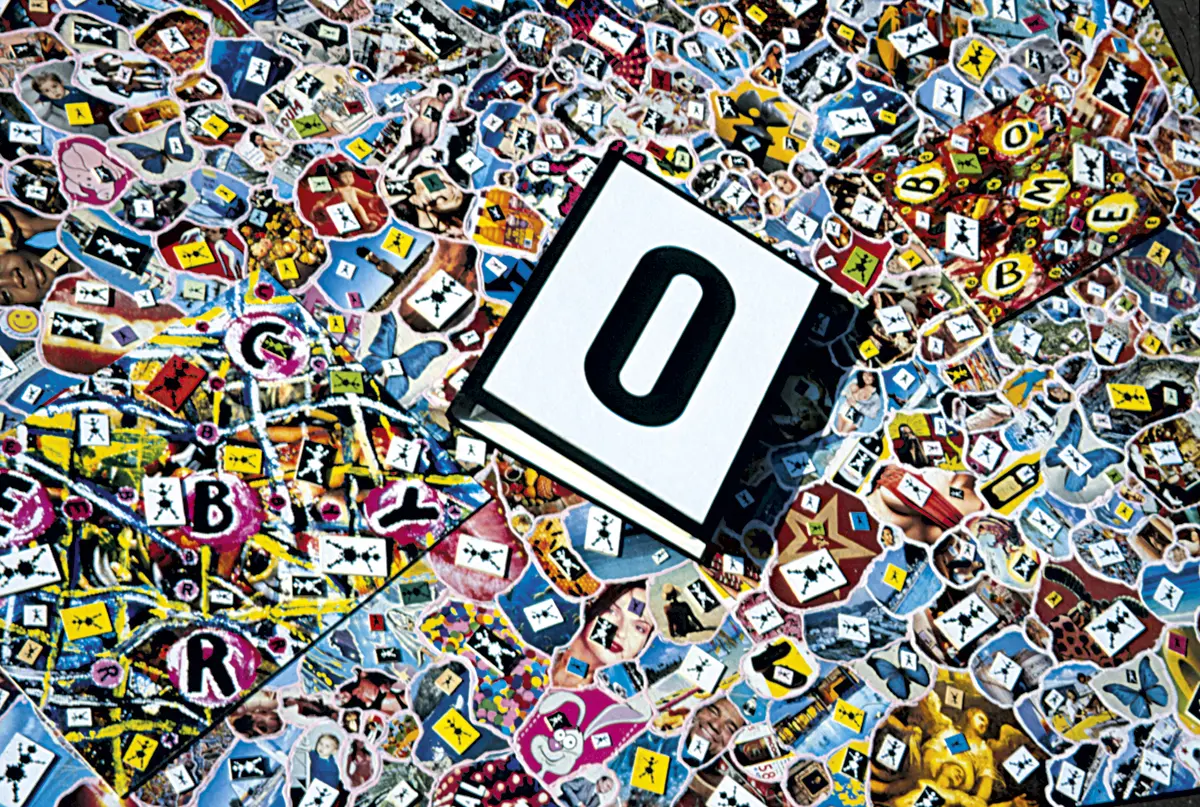
In this consideration of form and anti-form, of the openness to infinity, the artist has also devoted himself to the frontier between abstraction and figurativism. In each one of his works, observers will find two levels of interpretation, two aesthetic propositions, and two material and conceptual entities. Each piece (2m x 1.50 m) built as a 'chaos of chance', an expression that's dear to the artist, comprises two overlapping entities. One of them is pictorial, 'the painting', a collage where we find, painted, the outlines that frame each image with a pink-colored tracing, which gives it a cartographic or labyrinthine character. The collage is composed of numbered photographs, chosen randomly by the artist. These overlapping images have been collected over the course of years, and include political issues, pornographic representations, female images, fashion photographs, travel, and landscapes, all of them taken from magazines. On them the artist has affixed letters, forming recognizable words without any organizing or sequential principle. Among them: are screen, earth, cyber, brain (in English), decorating, ebola, health, forced, and ethno. The series is articulated by this symbolic weaving where, nonetheless, everything is the fruit of randomness. The little 'fractal' men are dispersed throughout the visual glut, but they give a rhythm to the work's plasticity. The second recognizable identity is the conceptual aspect, which establishes a dialog with and an interrogation of the pictoricity that carries it, contradicting it at the same time: it is a 'conceptual' object composed of a notebook on which we find images of the numbers 0 and 1, New York City's Twin Towers, French presidential candidates Chirac and Jospin, two toilet bowls side by side (one open, the other closed)—but also bags of 'compressed' plastic or photographs of the artist among nature.
Here are some of Ginsburg's own elaborations on his recent work:
1) "Modern art and contemporary art (more than modern and less than contemporary):" 'modern' is a painting with predominantly aesthetic value; 'contemporary' is the object on the painting, with a predominantly philosophical value.
2) "Handcrafted-mass produced-informational:" Duchamp, Jasper Jones, Rauschemberg, Schnable have presented in their works, each in his own way, the handcrafted-mass produced dimension. My work adds a new instance, the informational 0 1.
3) "Complexity as hybridization:" Many techniques are mixed in the work: painting, collage, impressions, numbers, etc.; contents are mixed: nature, politics, sex, religion, war, etc.; mixed images, words, and objects.
4) "Intermediary dimension:" The work is more than a painting and less than an object; more than an object and less than an installation; more than an installation and less than a performance.
5) We can recognize in the work several other formal procedures: they are seen, they are not a mere 'trick' of interpretation: a) chaos of images and informational code 0 1; b) abstraction seen from a distance, figuration seen up close c)aesthetic autonomy and heteronomy of the world; d) fractal visual chaos and minimal binary; e) webs and 'Homo Fractalus'; f) baggings; g) numerical images with words, etc.
This show certifies Ginsburg as an untiring researcher, an artist possessed by the insatiable need to translate into words his spirit of visual dialectics, or at least to use words in order to make sense of it. Ginsburg practices thesis and antithesis as speculation, not only at the intellectual level but at the formal level as well. He establishes a dialog between concepts and matter, between pre- and post-empirical theorization. He breaks his own work apart, perhaps excessively, superimposing explanations, definitions, justifications, and references. Widely legitimized, it is possible to wonder whether there is a risk of the work becoming hostage to the interplay of opposite, overlapping discourses, at once negation and affirmation, absence and reality. Is there a risk of it appearing as pure dialectical virtuality, negating itself as it is constructed? Then again, perhaps its only reason is to change in order to exist.
CHRISTINE FRÉROT