
Questioning the Line: Gego, A Selection, 1955-1990, the first exhibition presented by the Houston Museum of Fine Arts Department of Latin American Art and International Center for the Arts of the Americas, opened last March. The exhibition features approximately 130 drawings, prints, sculptural constructions, and environmental pieces by the German-born Venezuelan artist Gego (alias for Gertrud Goldschmidt). Originally shown at the Museo de Bellas Artes of Caracas in a larger version of 394 works curated by Iris Peruga, the Houston exhibit is a tighter selection co-curated by Peruga and Mari Carmen Ramírez, curator of the MFAH.
The work of Gego (1912-1994)1 is virtually unknown to most of the North American art community and until now there was little reason to expect otherwise. Yet Gego's is that type of work that is likely to become seminal. Swiss artists Daniel and Françoise Cartier¿who were in Houston for FotoFest at the time of the Gego's opening¿confessed enthusiastically, "This work is so intelligent! In Switzerland, all we have seen from Latin America is Botero, Botero, and Botero!"
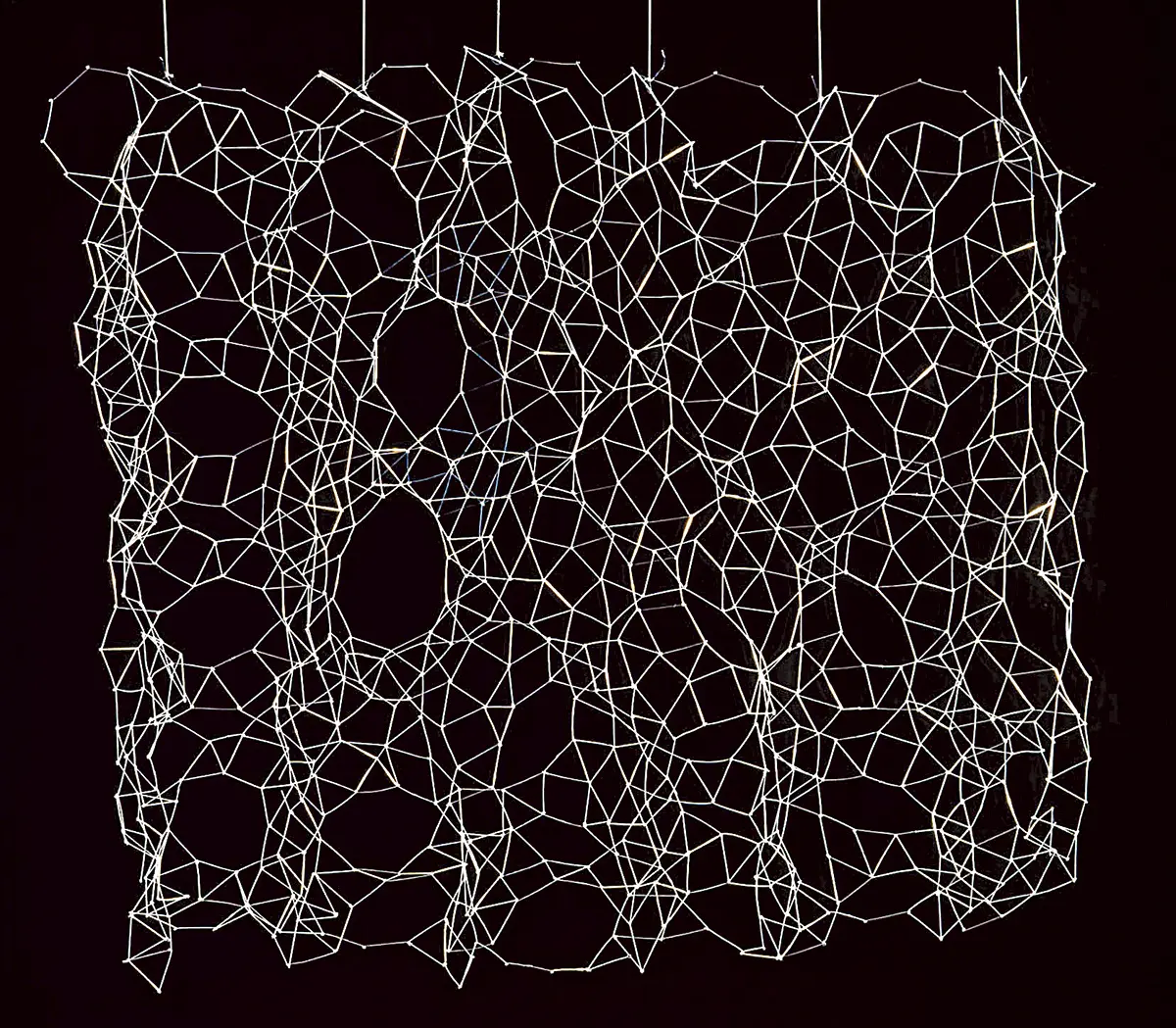
The Gego exhibition occupies the upper level of the section of the Museum of Fine Arts designed by Mies van der Rohe. It is fitting that these two German emigrés with a common interest in engineering should have crossed paths. "Less is more," states Mies's famous dictum and although Gego's work has been difficult to place in the context of Venezuelan art and even harder to place in the broader context of international art, at its onset there was always something minimalist about it.
The curatorial decision to pick 1955 as the starting date for the exhibition marks that precise time when Gego embarked on an exploration with a very simple premise: to draw parallel lines "without any reference to the real world."2 In the course of this exploration Gego produced some drawings that could be properly described as minimalist. As the work and Gego herself evolved, however, something substantial changed so what could have remained purely geometric and abstract emerged in the late sixties as hanging wire "sculptures" known as Reticuláreas. The heavy-handed use of quotation marks in the last sentence intends to bring out the peculiarity of these works that stretched the definition of "sculpture," and of their name, which was not really an existing word. Perhaps Gego's invention of the word Reticuláreas reflects her realization that she was—as Grace Slick once sang—"doing things that haven't got a name yet." Gego's neologism obviously alludes to the bona fide word "reticular" which means "net-like."
In 1969 the Reticuláreas series took a detour into Chorros (Streams). If the Reticuláreas are representational at all, they are so in the non-mimetic, suggestive, and ambiguous way some abstract paintings and Rorschach stains are. Perhaps it is more correct to regard Reticuláreas simply as abstract geometrical constructs whose meaning needs to be established beyond representation. Their webbing and mathematical structure point to themselves as objects of aesthetic contemplation or to similar structures in the world—i.e., neuronal networks, crystals, etc.—without really representing them. It is difficult to say whether with Chorros there is a departure from the non-representational abstraction of Reticuláreas; or whether in Chorros there is a variation of an abstract project that represents a mathematical aspect of a stream: its vectors. If that is the case, the appropriate sense of "abstract" that fits this work may not be strictly art-historical but scientific. Chorros represent the forces of streams as parallel, convergent, and divergent lines. With Chorros any trace of minimalism dissolves into such a flowing exuberance that one wonders if Mies's dictum really holds water.
It is interesting to compare Gego's work to that of yet another German emigrè: Eva Hesse (1936-1970).3 Although Hesse's early death at thirty-four was certainly more tragic than Gogo's at eighty-two, their lives were certainly parallel: They both escaped from the Nazis, they both had husbands who contributed to their work, and they were both influenced by their German art education. It is the striking resemblance of some of their works that deserves attention. Both Gego and Hesse produced works with a reticular structure—Gego made them with metal whereas Hesse used fiberglass—and both sought ways for works that appear as two-dimensional projects to break out of Flatland.4 There is, however, a sequential difference: Hesse's work evolved from this latter type of work into full-fledged sculptures and installations, whereas Gego's mature style is best represented by her Dibujos sin papel (Drawings without paper). It is in these later works that Gego found the casual yet controlled freedom that artistic maturity alone makes possible.
Peruga comments somewhat ironically, "Unlike most Venezuelan artists who studied in Paris, Gego's work was conceived in Caracas in contact with the most progressive ideas of the time and in an atmosphere of creative effervescence..."5 In other words, while the Venezuelans went to Europe to find their artistic compass, the European Gego found hers in Venezuela. There are some vague similarities of Gego's work with Jesus Rafael Soto's Penetrables and with the sculptures of Russian artist Naum Gabo. Indeed, Gego's admiration for Gabo's work led to their meeting in New York. Whatever her likes and dislikes might have been, Gego carved her own way, "Gego was extremely free-spirited, and her artistic pursuits responded to her need of finding new creative possibilities on her own. Consequently, she never quite identified with the Venezuelan geometric abstractionists, but worked in isolation, step by step, somewhat withdrawn from the newest trends and trusting only herself and her own skills..."6
True to its promise of pursuing research about the art it collects7, the Houston Museum of Fine Arts venue for this exhibit included the symposium "Questioning the Line: Gego in Context." Perhaps the most positive aspect of this kind of event is not so much reaching final conclusions about Gego's work but generating the right questions and reaching an understanding of the difficulties of the most important answers. The following specialists participated in the symposium: Iris Peruga, Senior Curator of the Museo de Bellas Artes of Caracas, with the lecture "Gego: From Matter into Space;" Luis Enrique Pérez Oramas, Curator of the Patricia Phelps de Cisneros Collection, with the lecture "Residual Grids: Gego's Involuntary Modernity;" Richard Shiff, Director of the Center for the Study of Modernism in the University of Texas at Austin, with the lecture "Gego's Materialism;" Guy Brett, Independent Art Critic, and Curator from London, with the lecture "Gego and Postwar Modernism." Mari Carmen Ramírez, Wortham Curator of Latin American Art at the Houston Museum of Fine Arts, delivered the opening remarks and led the panel discussion.
NOTES
1. Art Nexus published biographical information about Gego in an essay by Iris Peruga.
2. 5. 6. Peruga, Iris. Gego, 1955-1990: A Selection. Caracas: Museo de Bellas Artes, 2002, p. 13.
3. The exhibit Eva Hesse, curated by Elizabeth Sussman and Renate Petzinger was shown at the San Francisco Museum of Modern Art in the spring of 2002.
4. The reference here is to Edwin Abbott's nineteenth-century classic Romance of many dimensions, Flatland.
7. One of Gego's Articuláreas was acquired by the Houston Museum of Fine Arts thanks to a generous donation by AT&T Corporation.
FERNANDO CASTRO R.