
Iñigo Manglano-Ovalle's three video installations draw the viewer into the spare, modernist spaces of Mies van der Rohe's architecture while exploring the social dynamics of the contemporary world. Born in Spain, raised in Bogota, and now residing in Chicago, Manglano-Ovalle began working in video in 1997. Le Baiser (The Kiss), 1999, the earliest video installation in the exhibition, focuses on Mies' glass-walled, Farnsworth House (1941-1945) in Plano, Illinois. The video is projected on a two-sided rectangular screen suspended from the ceiling, with room-like spaces marked on either side by aluminum strips hanging horizontally, at waist level. The viewer may enter one of these delineated spaces as if walking inside the modernist architecture explored in the video. On the opposite side of the screen, similar to the video sequence, one can peer within but not pass by the transparent walls of the architecture.
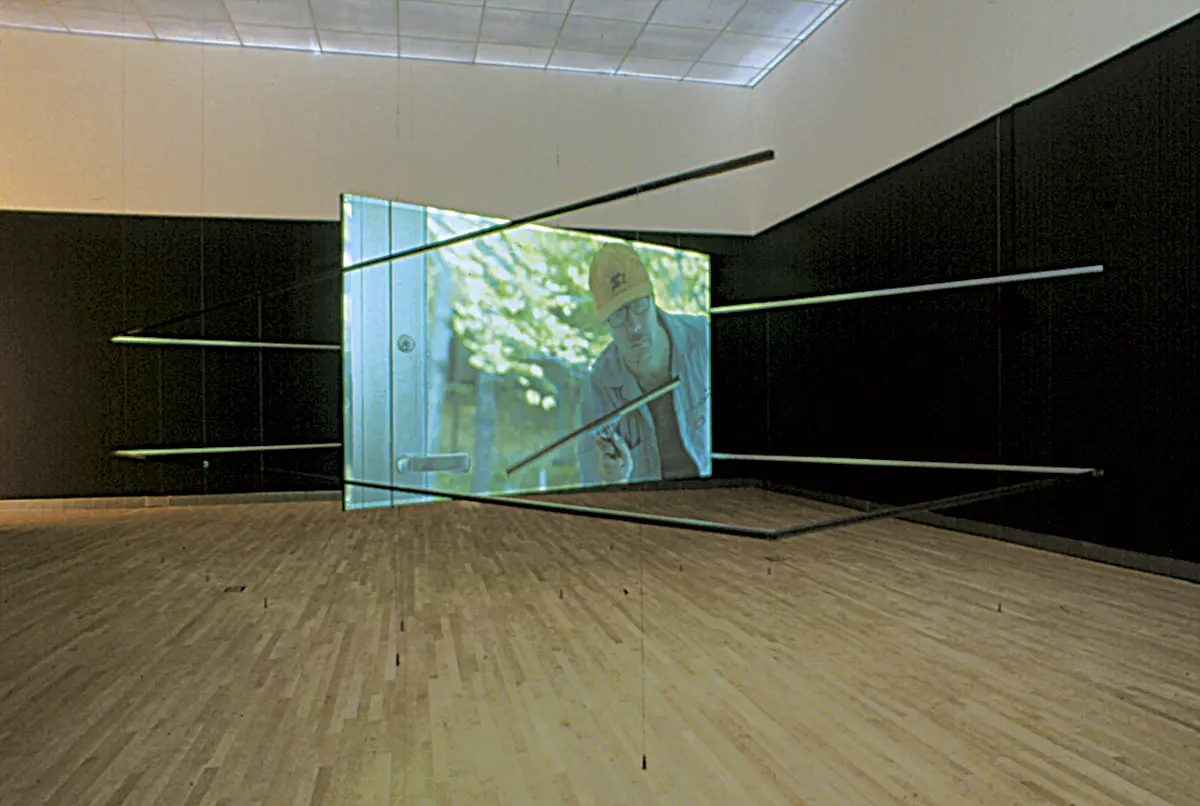
Le Baiser (The Kiss) video presents the artist dressed as a window washer, as he carefully soaps and squeegees the front windows of this striking glass structure. A woman wearing headphones stands before him in the house, her body swaying slightly to the rhythms of the music she appears to be spinning at a DJ's station. Only glass windows and a door separate the young woman and man, such that the effect resembles the spatial divisions created on a stage set. Each individual deliberately ignores the other, although the camera scrutinizes their geographical proximity, the line of sight, and the activity upon which each focuses his attention. Our ears are filled with the steady slurping sound of the water, the squeegee upon the glass, and the intermittent, gentle rush of wind, swirl of leaves from outdoors, and the electronic music that surfaces when the video presents an interior shot. Overall, the work acts as a commentary on contemporary life. Contemporary distinctions within societies may have been blurred by globalism, but like the transparent, open spaces of Mies' architecture, "walls" still separate groups within society.
A second video installation Climate, 2000, incorporates Mies' famous glass-walled, twin high-rise buildings in Chicago, as the site for the artist's three, unsettling film narratives. Three double-sided screens are suspended within three linked spaces, defined by hanging aluminum frame strips that refer to the steel window and door frames that characterize Mies' architecture. The three videos explore divergent yet interlocking narratives. In one, two weather experts with headsets watch the skies outside the buildings' upper floors, beside them stands an ominous-looking device used to measure the speed and direction of the wind beside them. The two figures present enigmatic profiles, as if reading the sky for some suspicious presence, an implication made more intriguing by the accompanying soundtrack of a Korean weather broadcast.
Interchanging with this video are two narratives of disturbing but unexplained significance. One presents, at close range, a man, his head hidden from view, dismantling, cleaning, and reassembling a semi-automatic machine gun, upon a gleaming glass table. The second follows the nervous movements of a young woman waiting anxiously in a chair within the apartment building lobby, while the sound of a lullaby interrupted by whispered stanzas of poetry fills the room. The three-screened, three-video installation fills one with a sense of unease. The gun, the wariness on the actors' faces, the unintelligible and at times, incomprehensible, foreign soundtrack unsettles the viewer, such that the work's title, Climate, takes on broader meaning than that of the weather. It implies a world globalized and rife with uncertainty.
Manglano-Ovalle's final work Alltagszeit (On Ordinary Time) 2000, is a deliberately choreographed, modernist piece set within the towering, austere lobby of Mies' Neue Nationalgalerie in Berlin. The artist manipulates twelve hours of footage combining time-lapse and real time segments, revealing the changing light across the vast lobby, from the radiant sunrise, through to the lengthening shadows of sunset and on into the velvet darkness of evening. Lone individuals and small groups of figures enter, pause, or sit and leave the space over the course of the day, their movements seemingly random and often awkward, like mechanized beings. The viewer is acutely aware of the artist's orchestration of the video sequences. The film presents an accelerated view of a day, and by implication, life, an effect exaggerated by the robot-like comportment of the actors and the modernistic music that accompanies it.
Ultimately, the viewer is consumed with thoughts after absorbing Manglano-Ovalle's video installations. Each work provokes on two fronts, aesthetically and thematically. The languages he employs both in video and installation force one to ponder space and the visual ideals of modernism, while the social issues he explores confront one with the shifting realities of the world today.
MARY SCHNEIDER ENRÍQUEZ