
São Paulo-based Jac (short for Jacqueline, b. 1961) Leirner was one of the first Brazilian artists to enjoy wide international recognition, paving the path for other artists of her generation such as Ernesto Neto, Beatriz Milhazes, and Adriana Varejão. Following Leirner's successful presentation at the 1989 Bienal de São Paulo, she took part in important international exhibitions, such as the 1990 Venice Biennale's Aperto, and the 1992 Documenta.
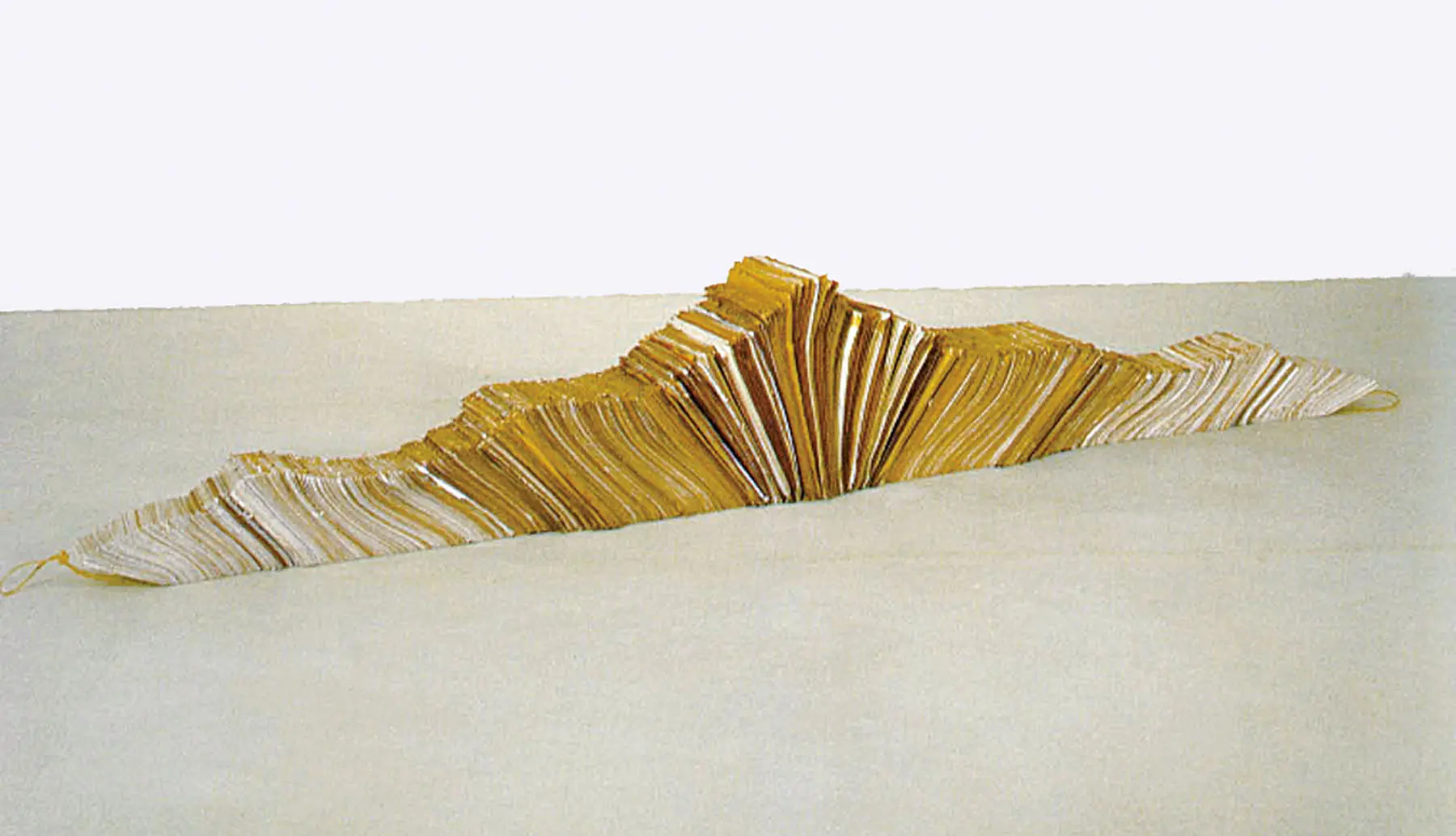
The early nineties were an inaugural moment for Brazilian contemporary art abroad. The work of Leirner played a central role, putting forth an artistic proposition that is both rigorous and unique, in dialog with Brazilian art traditions and approachable by foreigners who were eager to understand the country's art. This exhibition, curated by Rio de Janeiro-based Ligia Canongia, is the first survey of Leirner's work and provides us with an exceptional opportunity to re-access one of the most original bodies of work in recent Brazilian art. Gathered in three rooms are 29 works ranging from 1987 through 2001, coming mostly from Brazilian collections—an exception is Hip Hop (1998), a wall installation belonging to The Bohen Foundation, New York, which was reconstructed for the occasion. Included are objects and sculptures from Leirner's oeuvre: Pulmão (Lung), with empty Marlboro packs; Os Cem (The One Hundred), with devalued Brazilian currency; Nomes (Names), with empty plastic bags; Corpus Delicti, with stolen airplane ashtrays and other airline gadgets; Labels, with museum wall labels; Foi um prazer (Nice to Meet You), with business cards; To and From, with empty envelopes, and Adhesivos (Adhesives), with stickers.
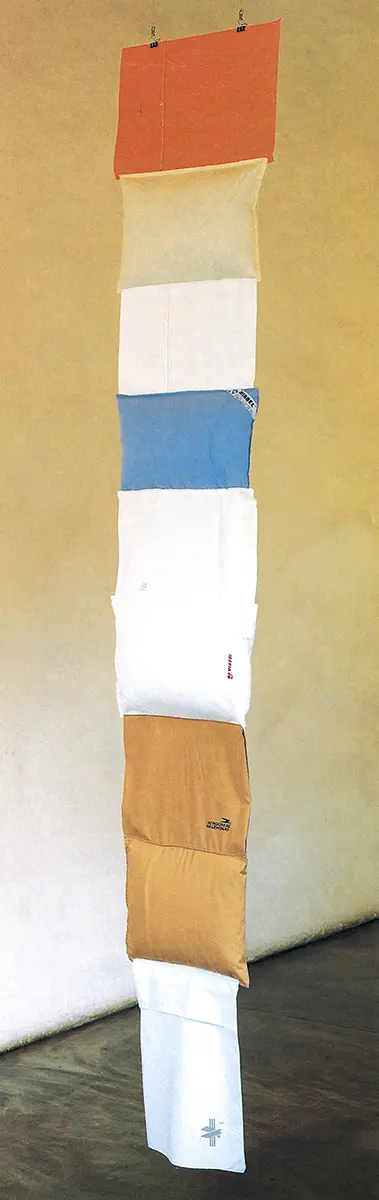
The survey allows us to understand Leirner's highly complex strategies and unique developments, which have been extremely consistent through time without ever becoming formulaic. Leirner begins her practice by collecting and accumulating a certain artifact, often of little or no value, with a distinctive industrial, urban, or low quality, and bearing deeply charged, manipulated, and throw-away features. Leirner then produces intricate objects with a delicate and precise hand, well-informed by the formal issues of painting and sculpture. Empty cigarette packs, bank notes, business cards, stickers, envelopes, and plastic bags have been extracted and removed from different circuits and economies. In becoming art, the original circuit gives way to another, very particular one: the art circuit. One could thus consider that Leirner's works exist in a permanent state of performance in private or public contexts within this new system, their moves through galleries, museums, auctions, collections, exhibitions, donations, and acquisitions being somehow incorporated into their conceptual and ontological breed. Even the passing of time and the rather precarious nature of some of the materials are conceptually articulated in such existence. Some plastic bags have begun to lose the bright new colors of their original shopping circuit, and the stitched-up pieces of the silver paper lining of the inside of many Marlboro packs have aged with time.
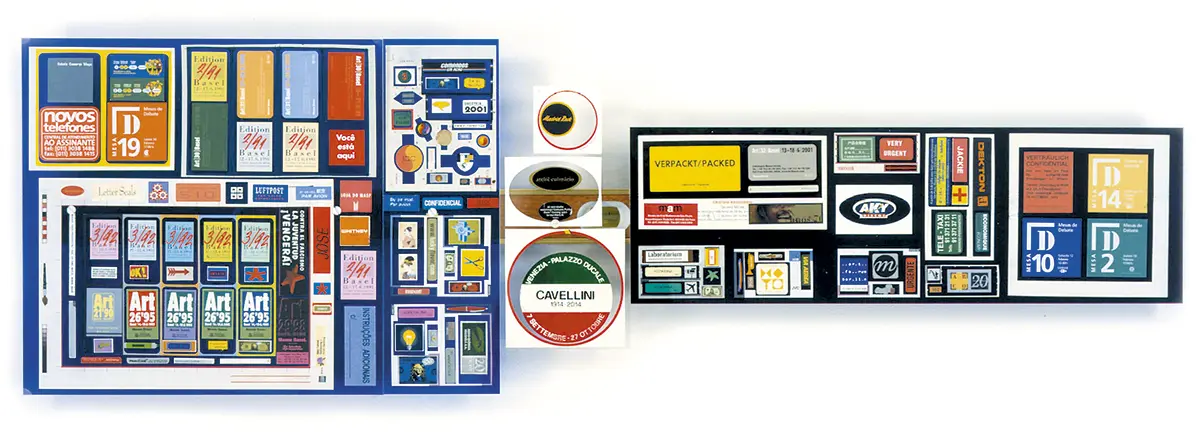
There were brilliant examples of Leirner's works here, and it is a treat to encounter pieces that we've seen time and again in reproduction or years ago in exhibitions. Corpus Delicti, 1992, is one of Leirner's most conceptual works: a floor piece consisting of piled-up sheets of glass and bubble wrap where stolen airplane ashtrays are connected to boarding passes as concrete evidence of the time and place of the crime perpetrated by the artist. Os Cem (Roda) (The One Hundred [Wheel]), 1987, perhaps the most eloquent of the banknote pieces, is a wheel made up of hundreds of devalued one hundred bills resting on the floor and held up together by a hidden stainless steel cord (information provided by the work's caption), its visible signs of mass manipulation providing an uncanny tactile and sculptural quality. On the more pictorial side, some of the recent wall Adhesivos (Adhesive), 2000-2001, are pieces of glass upon which a large and varied number of stickers have been arranged taking into consideration their size, shape, color, or origin—from cargo or mail stickers to museums or shopping ones—providing irresistible abstract geometric compositions which reference constructivism and Op Art on the high end, and our own teenage glass windows and closet doors on the low end. The construction level placed at the back of some of the mostly horizontal wall Adhesivos, and visible through the glass, winks at the proper and rigid rules of balance, composition, and form of constructivism as well as of mid-century Paulistano Concretismo.
In fact, Leirner could be contextualized within a certain Paulistano tradition of abstract painting and sculpture, which remains extremely strong to date, and which, unlike the Rio de Janeiro tradition, veers away from more contaminated references to the body and everyday life. The artist's upbringing amidst what is one of the finest Brazilian collections of geometric abstraction that belonged to her father Adolpho Leirner certainly provided copious visual material for her to develop her fluent formal skills. Jac Leirner's concern is with art itself, and this is very much translated in her dexterous use of and attention to sculptural and pictorial language. What distinguishes her from her Paulistano colleagues, however, is precisely how she brings these high concerns to the most ordinary, street-loaded objects, dislocating and shifting circuits in a deadpan serious, rigorous yet also playful way.
I waited for this exhibition with much anticipation, and in fact, since I first wrote about Leirner's work some eight years ago, I've always wondered what a survey of her work could deliver. Some artists may be victimized by the presentation of large quantities of their work from different epochs exhibited under a single roof; others may simply confirm what is already known about them, for better or for worse. Very few artists can manage to present a survey that surprises the most well-versed spectator, and Leirner is undoubtedly the latter. For those unable to see the real show, a look at the well-edited and designed 220-page catalog will certainly be an enticing substitute. For all this, and considering that this is one of São Paulo's most remarkable artists, it comes as a surprise that the exhibition will not travel to her hometown. One hopes this is because a larger, more comprehensive exhibition will be prepared in the near future, which must then include some of the many important works by Leirner presently in foreign collections. After all, Ad Infinitum only left us wanting to see more.
ADRIANO PEDROSA
Art critic, Curator at Museo de Arte de Pampulha, and Editorial Coordinator for ArtNexus in Brazil.