Jorge Méndez Blake's (Guadalajara, 1974) first New York show is a meditation on the relationship between literature and art, and on the subjectivity-driven processes of categorization operating within a culture.
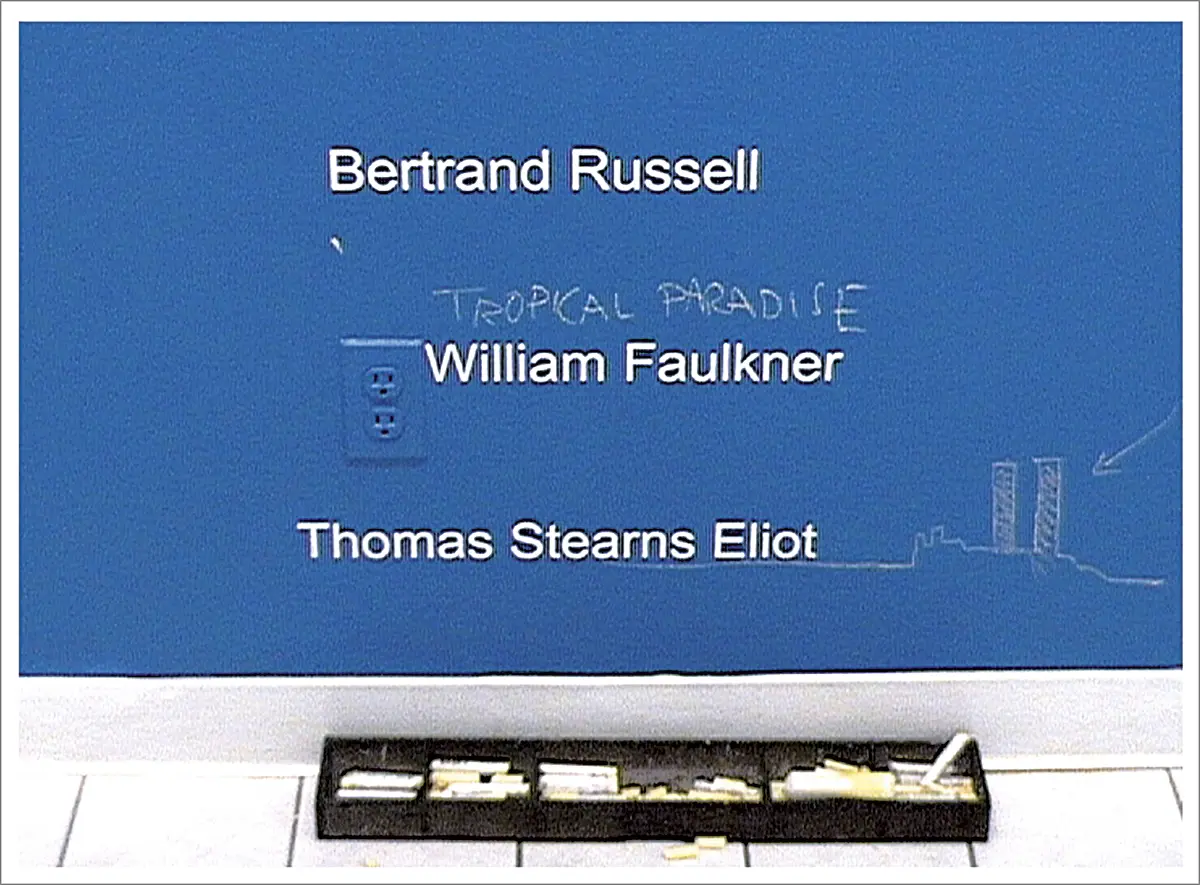
On one side of the gallery, Méndez Blake exhibits a simple, text-based installation: a blue wall covered with the names of 20th-century recipients of the Nobel Prize in literature, along with pieces of chalk for visitors to write, freely, their comments. On the other side of the gallery, we find Shakespeare's name, misspelled to read Shaekspeare.
Méndez Blake's literary interests are unusual among artists of his generation, who in general gravitate towards the themes of popular culture or socioeconomic aspects pertaining to their immediate environment. This artist, in contrast, focuses on working with literary references and wordplay in site-specific and public space installations, using texts that tend to be suggestive of certain human, historical, or cultural situations.
The title of his present show (Artists Can Write) alludes to the fact that artists can be people of letters, but at the same time, it suggests the idea of the text as a visual entity, where meaning is to be found also beyond what is written, as in the case of these works.
The work's final effect is only achieved through our own meditation on the literary names on the wall. The Nobel Prize, the most widely recognized among writers and a symbol of lasting achievement, is questioned by the mere presentation of a list of winners. The immediate realization, for any visitor with an average knowledge of the history of literature, is that the list does not include many of the names we as a matter of course include among the 20th century's most important writers: Conrad, Joyce, or Borges never received the Nobel Prize, while a number of much more obscure figures did. The list's subjective nature is emphasized with the invitation to write on the wall, which prompts the majority of visitors to inscribe their own favorites and to comment about the names included.
The wall's latent irony is made more concrete on Shaekspeare's side. Since the gallery space is located next to a continued-show theatre, the analogy with dramaturgy is particularly relevant. William Shakespeare's name is emblematic of the theater and of Anglo-Saxon high culture, as well as a code word for sophistication among those who style themselves as cultural connoisseurs. Shakespeare's works are known worldwide, but they are nevertheless seldom understood in all their social and historical implications; even their language is often misinterpreted. The ironic misspelling of the Bard's name makes us think of the contradiction of pronouncing the names of great literary heroes without knowing how to write them.
With these two installations, Méndez Blake questions the validation processes of aesthetic judgments and —in the same way one, at first sight, reads Shakespeare's name in its correct spelling, realizing it is misspelled only after careful observation— points out that such processes, often paradoxical and contradictory, can easily sneak unperceived through our consciousness.
PABLO HELGUERA