
Since its inauguration less than a year ago, Garaje Regium Gallery, under Damián Casado's direction, has consistently worked with young artists who so far have gained exposure mainly within the city of Barcelona's art circuit. This has given the gallery a singular character, helping it fill a widening void in Madrid: the absence of shows by non-Spaniard artists.
In the same spirit, Garaje Regium presents now En ninguna parte (Nowhere), a photographic series by Cuba's Juan Pablo Ballester (who lives in Barcelona). The series title is not devoid of irony, since the photographs are all set inside the artist's own home, into which he has invited several neighborhood youngsters to have them pose with his dogs. These images make evident the tension generated by the presence of extraneous bodies in a determined environment. Significantly, none of the subjects, not even the dogs, strikes an aggressive pose — at least not at first glance. What disconcerts us is the evident fact of them being in a place that isn't theirs, whence the seeming awkwardness of their poses and their contrast with the intimate space where they are photographed.
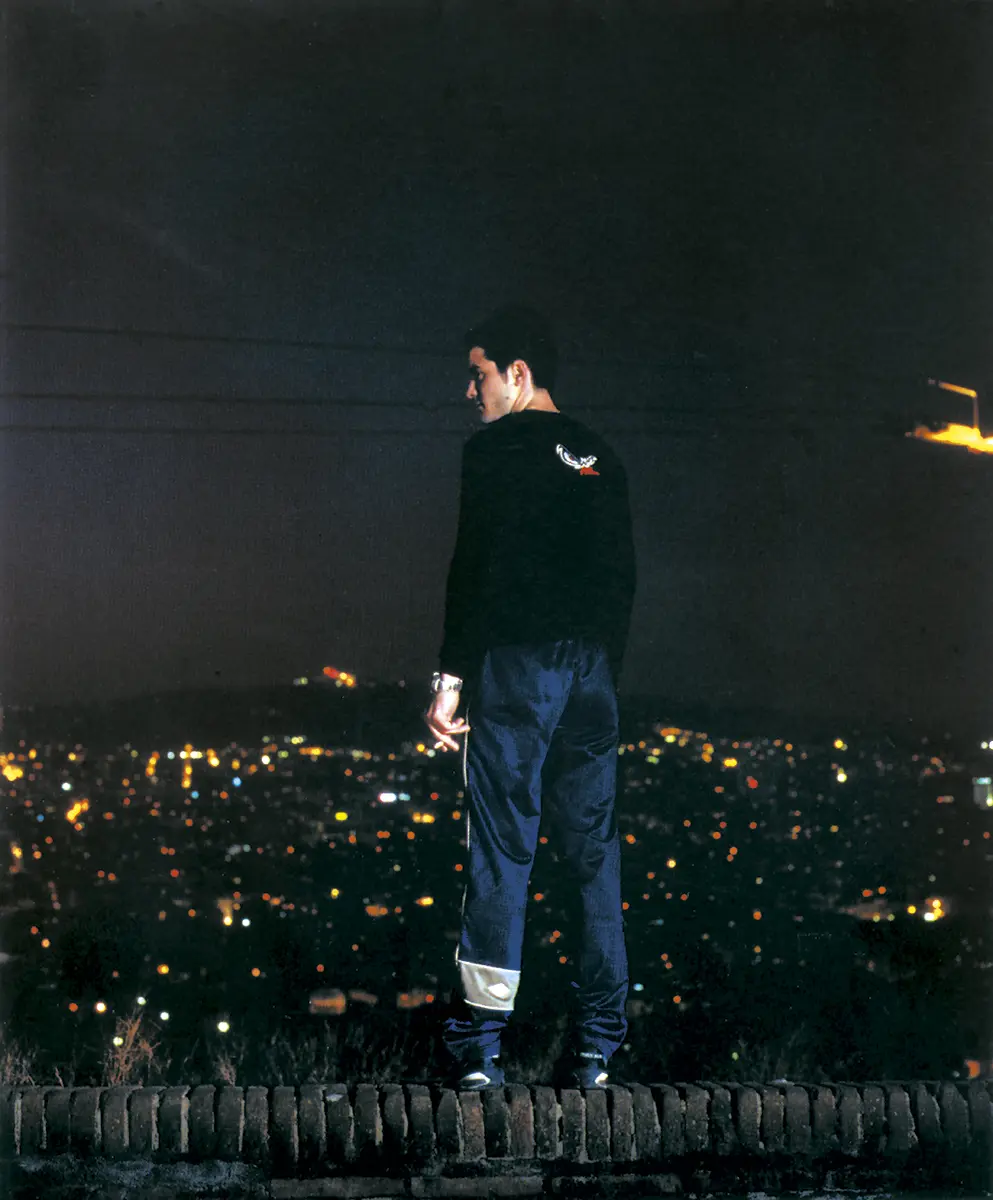
At first glance, these images might even resemble advertisements for hip sports clothes. The subjects' gaze, their clothing covered with logos and trademarks, and even the good care enjoyed by the dogs, allow us to imagine these same pictures on the pages of any contemporary magazine devoted to fashions and lifestyles. A closer inspection, however, reveals that we are seeing everyday people rather than fashion models, even if the artist has not opted to erase or blur the references to contemporary street fashion. This is interesting, as in some of the photographs the three spaces — fashion, street, and art — are necessarily linked.
The surroundings constitute an element of tension: in the series, we can see locations from the building's staircase and the apartment's door (painted in gold and inscribed with the phrase "en ninguna parte"), to more intimate ones such as the artist's worktable and bedroom. It is precisely here, in the artist's bedroom, where the element of contrast becomes more visible: towards the back of the room, behind a large bed covered with the skin of a zebra, there is an ample mural depicting a beach with a huge palm tree. As if ironizing the pet dogs he photographs beside his human subjects, in a close-up of the bed, the artist has posed his own couple of parakeets. The representational game turns complex, posing a scene within a scene, a piece of the tropics in a Barcelona neighborhood. Intrusions multiply, and the meaning of these works unfolds in several directions. In a kind of reversed voyeurism, Ballester destabilizes notions of "inside" and "outside", the "invaded" and the "invader", having welcomed the latter through the front door.
ISSA MARÍA BENÍTEZ DUEÑAS