
Marco Lamoyi's recent work marks an important turn in his more than 20 years of activity. Lamoyi (Jalpa de Méndez, Tabasco, Mexico, 1957), a restless artist who has searched in different media for a language adequate to his expressive needs, presented at Misrachi Gallery a series of works in oil, a technique that defined his beginnings and was later abandoned in favor of a successful foray into photography.
The matter is the true protagonist of Lamoyi's recent work. His painting is frank and plain, heavily charged and exaggerated to the point that his pieces are over 5 centimeters in depth, one of the most striking characteristics of Lamoyi's art for those who have followed its development. Their appeal, however, lies somewhere else. It lies in their attractively resolved conceptual position and the artist's peculiar attitude regarding the already old question about the end of painting as a paradigmatic expressive form.
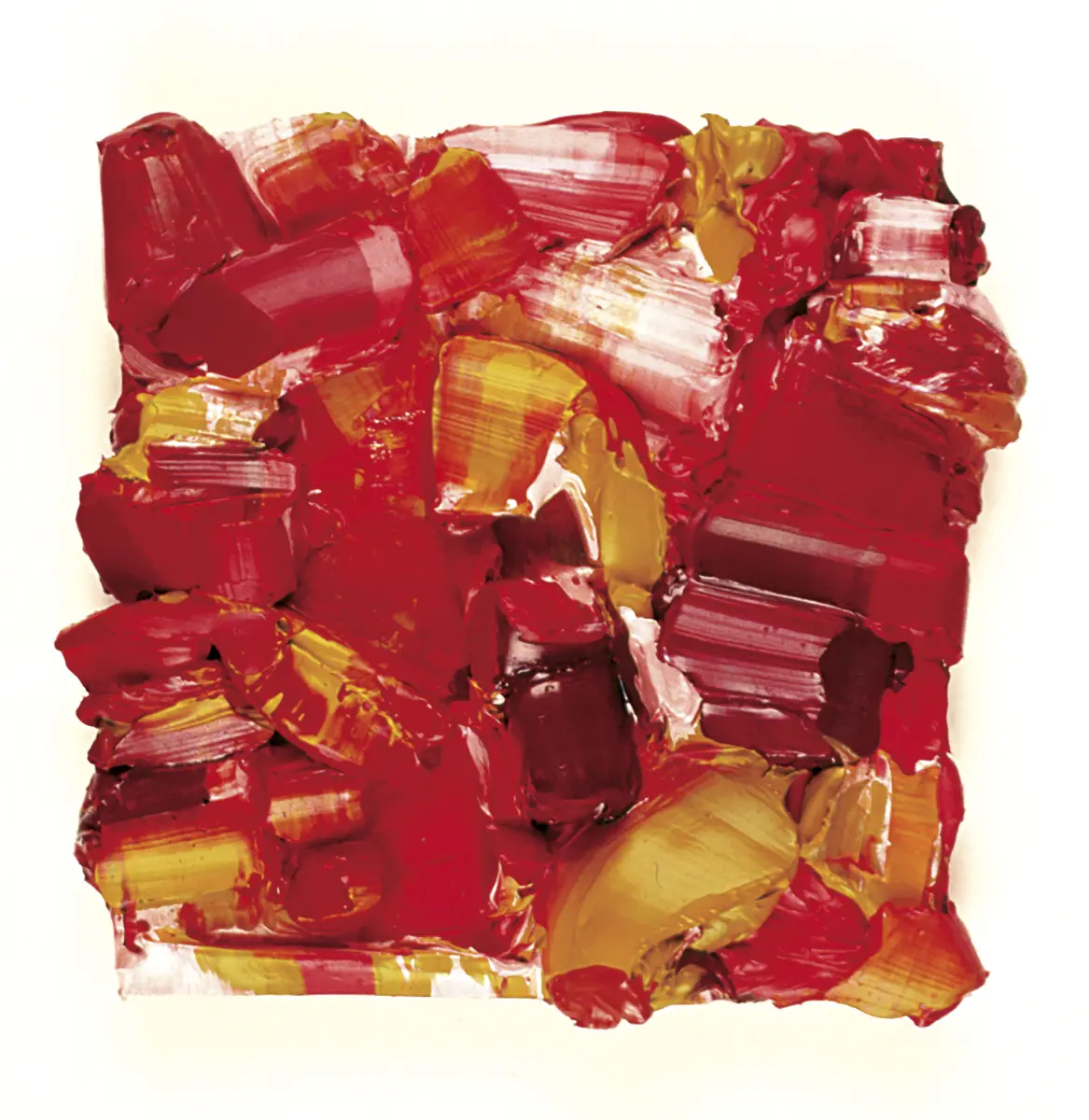
Lamoyi's inquiry into such issues is given a greater range when one realizes his works exist along the borders of the sculptural/objectual and the purely pictorial. The show's title is in itself, the evocation of a sound, a way to present in words the sensation produced by Lamoyi's work, so strongly and atypically charged with oil.
Lamoyi's work has moved between photographical abstraction, structured around specially created scenarios, and painting on the path of a matteric abstraction, often chromatized with colors as they come out of their tube (even keeping the width of the cylindrical container), and at times as a result of a mixture that doesn't omit the traces of a violent but precise palette, all the more noticeable in these small-format pieces.
Lamoyi's drying times are long. Several months are needed before a painting can be set up vertically and affixed to a wall. The painting's weight is tremendous, and its consistency would cause it to sludge to the ground if it is not completely dry. Such necessary precision in order to achieve the viewing of a work is also part of Lamoyi's artistic proposal since it is the artist's desire that his works live not just as objects on a floor, a base, a table, or any other support, but as paintings on a wall in the old tradition — a vindication of a use subverted decades ago and now recaptured as part of the conceptual proposition.
Lamoyi's work is an important inquiry into the old issue of painting's pertinence as an art. It locates itself along the border between the designed object and the accidental creation. It is a sort of collaboration between the author and the medium. Both play their part, resulting in an incisive question about the nature of art and its multiple expressive avenues to the public, as an object or as an idea. For these works, Lamoyi has developed an internal structure that is particularly difficult to achieve in small pieces, moreover in small pieces realized in the manner of much larger ones. On the verge of being defeated by the medium's expressive peculiarities, Lamoyi finds, along with an enormous taste for form and color, an equilibrium between his personal statements and the material's expressive freedom.
This show constitutes an important testimonial to a search that, conceptually, restates the contemporaneity of painting and its place within current art.
NOTE
*Pablo Goebel, representing Marco Tulio Lamoyi, collaborated with the artist in the selection and gathering of the works for this exhibition.
SANTIAGO ESPINOSA DE LOS MONTEROS