Presents and offerings are human inventions to express one individual's gratitude to and appreciation for another or for a divine entity. Turned by capitalist culture into a stimulus for consumption, presents became signs of status and wealth. It's not, however, of this kind of wealth that Marepe's show at Luisa Strina's Gallery speaks to us. This is Marepe's first solo show in São Paulo, and here the artist, born in San Antonio de Jesús, Bahia, in 1970, uses the concepts of the feast and the offering as a rich poetic instrument. His works recreate as a whole a univocal spirit of installation, while at the same time preserving their singularity and independence. For the show's opening night, the gallery seemed to have been transformed into a large Christmas feast in the Brazilian interior, complete with a display of presents and free popcorn for the attendees. Marepe (along with Rivane Neueschwander, Laura Lima, Cabelo, and Jarbas Lopes, emerged from the Antártica Artes con la Folha show held in São Paulo in 1996) is among those Brazilian artists that throughout the 1990s use typically national elements in their work, thus establishing a dialog with the more radical currents of the 1960s, such as the art of Hélio Oiticica and Lygia Clark. His is the new generation, following that of Ernesto Neto, Adriana Varejão, and Rosangela Rennó, among others, that is capturing the international circuit's attention.
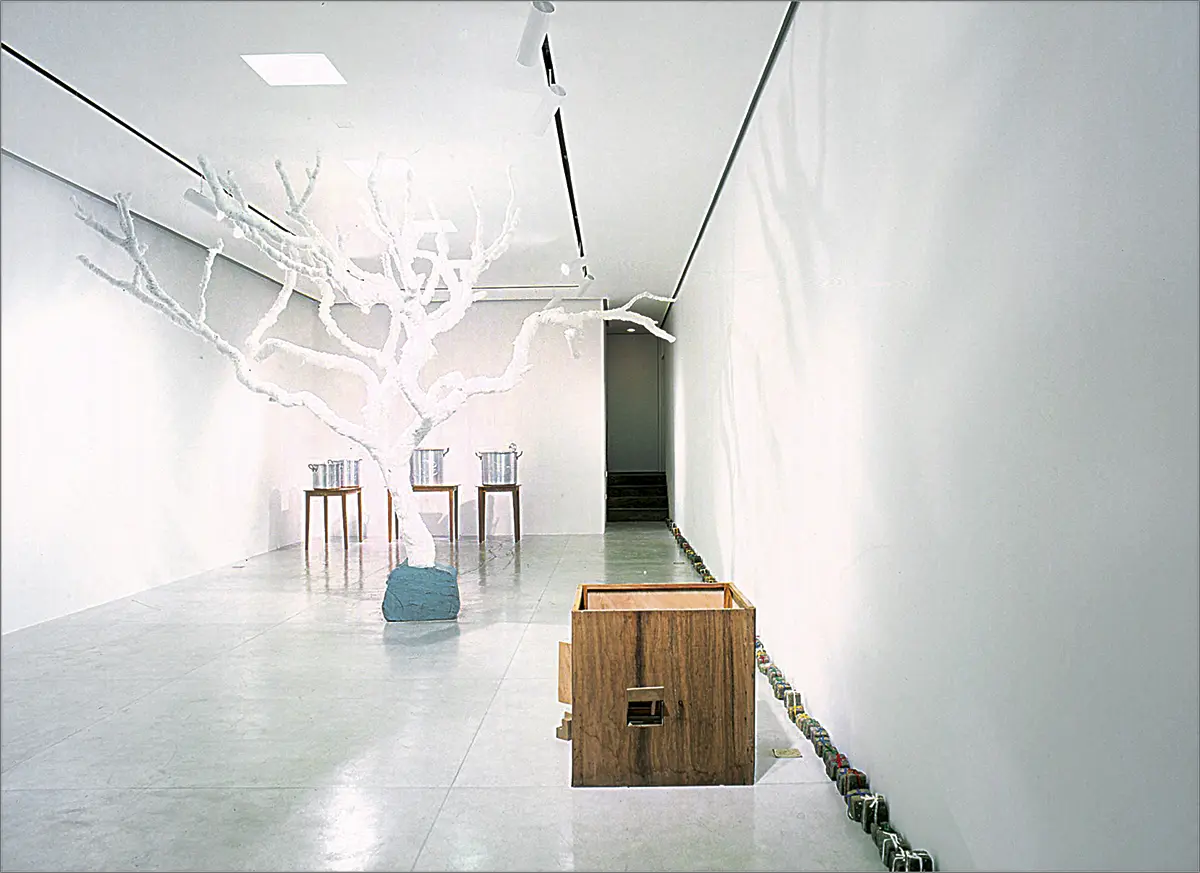
In the center of the gallery space there is a 3-meter high piece, Cajueiro com neve de algodão (Cuajú Tree with Cotton Snow, 2000), using a tree typical of Brazil's Northeast, the country's poorest region, where Marepe lives. The artist covered the tree in cotton, referring us to a blunt, abrupt imaginary and a Christmas practice characteristic of his region. The interplay between the tree's dryness, its branches twisted by the lack of water in its native soil, and the purity of the cotton's minimalist white, creates a radical metaphor for Brazilian art, revealing the contrasting mechanisms by which it operates. These mechanisms are translated here in the meeting of a monochromatic discipline with the Northeast's blinding light and weather. The metaphor deepens if the dead tree is presented straight, as if reborn in its new habitat, linking life and death.
On the floor along one of the gallery's walls, Marepe placed his "presents." O presente dos presentes (The Present of Presents) comprises tens of small clay pieces precariously modeled into cubes and ornamented with fine silk threads and simple stars on metallic paper. These tiny and violent earthen blocks are a counterpoint to the delicate decorative and industrial artifacts that offer them as presents. Their display in a straight line and the use of a rigid geometrical shape that responds irregularly to the treatment of the material, create a situation similar to that of the tree. The dialog between these two works results in the show's richest conceptual node.
The photographic essay Doce céu de santo Antonio (Heavenly Sweets of San Antonio) (2001) reproduces a performance by Marepe on September 27th in his native city. That day, Marepe produced 4,000 algodões-doces, a white or pink cotton candy that's typical of the region, and wrapped them around a palm tree. The September 27th date is important because it is the day of Cosme and Damião, two Christian martyrs who in the Catholic tradition are the protectors of children. After covering the tree with candy, the artist gave it away to city children, creating a sculptoric act. The referent is the state of Bahia's traditional religious syncretism, and also the offerings that are made in candomblé. In the photographs presented here, Marepe appears step by step eating pieces of candy against a blue sky with white clouds, whose shape interacts with the candy's. In these images, as beautiful as they are poetic, the artist maintains each photograph's autonomy beyond the mere registering of his performance, arousing interest in things such as the local light, the landscape symbolically eaten by Marepe, and the role of the artist in society.
In another series, the most intense exchange is established with architecture. In the context of the show's Christmas feast, the "toys" also play a role. Embutidinho (Small Sausage, 2001) is a kind of mock-up of an architectural space inspired by the favelas, Brazil's shanty towns, where the same room can and often is sleeping space, kitchen, living room, and whatever is needed: a polyvalent and ambiguous architecture, created as a response to the scarcity of space and material resources. Precariously built with wood and lacking in finishings, this work brings to mind Oiticica's bolidos (here devoid of their pictorialism) and Lina Bo Bardi's architecture inspired by popular ingenuity. The resulting piece confronts, on the one hand, the absence of comfort and space for the inhabitants of this informal, imagery architecture, and, on the other, the marvelous ingenuity of the architectural solution. Another work, Un fio que ligue os mundos (A Thread to Link Worlds, 2002), is an intricate apparatus in which three bases support an equal number of cheeses with images of the globe etched in them. The cheeses are linked by threads and pins, suggesting the interconnectedness between the First and Third Worlds through tenuous structures. It brings to mind the image of an inverted Western Hemisphere, painted by Uruguayan artist Torres-García, while rats made with industrial debris surround the piece as if in search of food, reinforcing a political and marginal reading; extreme poverty, conflict, and exploitation are some of the concepts evoked here.
There was some informal opining about the difficulty of inserting Marepe's precarious-looking art in the aseptic, white cube of the gallery. To some, the final result was that the space regime buried the work's complex and radical character. For me, however, the effect was just the opposite. Aside from having forced the space to interact with his pieces, instead of it being the other way around, Marepe was able to invest values such as feasting and present-giving with a new transcendence, bringing them well beyond their more mundane implications. He showed us that mimesis is all the more powerful as its truth value increases.
RODRIGO MOURA