"My profession is that of an actress."1 This statement seems convincing in the mouth of María Teresa Hincapié (1956, Armenia, Quindío, Colombia). Her artistic origins have little to do with the conception of work undertaken by the traditional actor who represents a role. Her proposal is the result of a long reflection on theatrical angles that draw her nearer to other practices. The intensity with which Hincapié projects her performances is such that she is able to turn her body into her artistic image.
She started quite early in the theater. In 1978 she joined the Acto Latino group, directed by Juan Monsalve, where non-traditional and non-Western techniques of acting were investigated. She created street theater and undertook a long journey through countries like France, Indonesia, Mexico, Denmark, and Japan. She participated in festivals and colloquia where she had the opportunity to meet Eugenio Barba, director of ISTA (International School of Theatre Anthropology). Fundamental at that school is the study of the phenomenon of the actor himself, conceived as an "empirical testimonial" where interdisciplinary and transcultural perspectives converge.2
According to Barba, there are two concepts that have an effect on the work of María Teresa Hincapié. On one hand, Barba maintains that, after multiple contacts with masters of different theaters, Hincapié found that Asian actors have a particular awareness of the difference that exists between the techniques of the body, with which we move about on a daily basis, and extra-quotidian techniques, which are those of representation. The conscious work with the body is able to transform it, turn it into a communication resource in itself, without the need for large visible unfoldings, but rather strengthening energy that is transmitted through the actions that operate on the spectator's attention, comprehension, and emotivity.3 Moreover, Barba distinguishes between the theater executed through staging a previously written text and the performative experience in which the textual fabric exists only at the end of the process.
Since her works from the '80s, Hincapié has shown interest in breaking with the traditional techniques of textual, visual, and gestural language. Her intention in those inquiries was to recover the trade of the actor. Pieces like Ondina (Undine)4 or Parquedades (Moderations)5 were key for exploring new forms of representation in which repetition, slowness, and true control of the body allowed her to explore her expressive resources through gestures and movements that seek essentiality. She is thus a theater actress who works with space, time, and action seeking "to awaken that which is not visible, but which becomes visible through an attitude in the face of life."6
In Punto de fuga (Vanishing Point, 1989), during twelve hours a day and over a period of three consecutive days, she began to explore dailiness. Through the repetition of common tasks for a woman—like sweeping, washing, cleaning, and ironing—she composes a subjective time, a time of her own, inside, where movement emphasizes calm more than action. Breaking the notion of dailiness is not only seen in that interest in internalizing it but also in the way in which she executes the movements. Her body plays the lead part in the breaking of the daily bodily balance supported by the legs. As Marta Rodriguez rightfully says: "During the duration of the performance, she adopts an equilibrium that is placed in the middle of her body, thus dividing it into two parts, into two antagonistic forces that comprise a whole. In this way, up-down, forward-backward, and left-right, take on a particular connotation of oppositions and unity, possessing a particular understanding and control of the body, acquiring a new awareness over the body that allows it to transmit metaphysical and spiritual values of some daily actions linked to physical effort."7
That reflection demonstrates the attempt to delve into and recover the basis of dailiness, and the spectator is invited to participate in those private acts in which Hincapié shares her female condition in a subjective time, her time. The daily acts are taken out of the simple mechanical action with which they are normally seen in order to turn them into rituals that have a particular importance and beauty. It is therefore not a question of representing dailiness, but rather of reflecting on its essence.
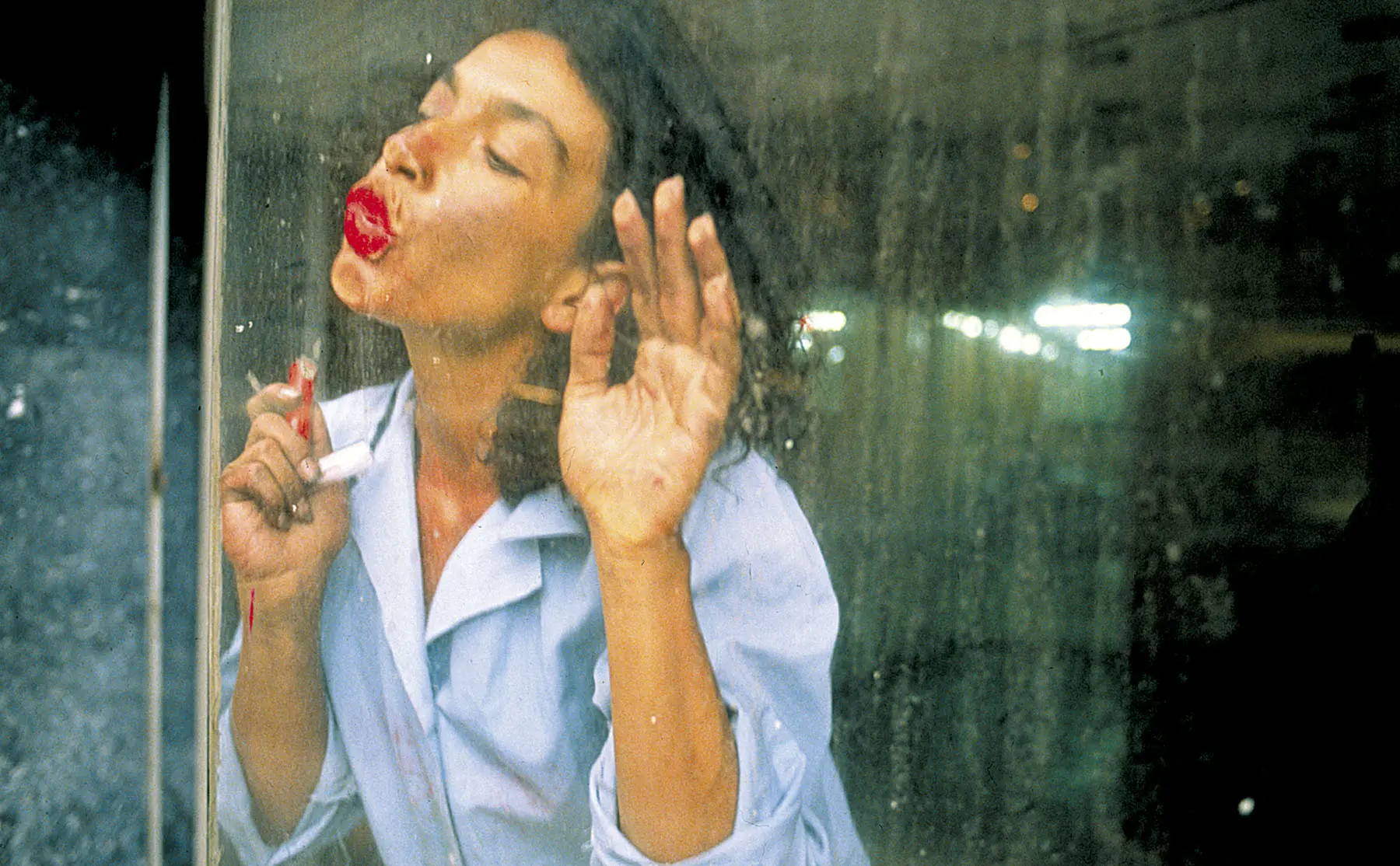
The poetics of dailiness continued to be investigated in Vitrina (Showcase, 1989), a performance in which she worked in real time and space. The idea of doing this was projected based on being inside a showcase in the very center of Bogotá. This urban intervention was carried out eight hours per day, the prescribed time of a workday, during which María Teresa Hincapié undertook the duties of cleaning the showcase. The glass functioned by separating the private sphere from the local, from the public space. At the same time, it operated as a limit and possibility for observation. Here the artist maintained very personal monologues while she cleaned, writing some of her ideas on the glass, making whimsical drawings, and using a female touch that proved to be moving: a kiss on the glass with bright red lipstick. Seduction and domestic obligations emphasized the roles that society attributes to the female figure. Once again, art and life, physical activity and art, were worked in a symbiosis that harks back to the ideas of Beuys.
In Punto de fuga as well as Vitrina and other performances carried out in the same period, Hincapié worked around daily actions that are dignified, inviting the spectator to think about her own dailiness from her personal perspective. In these actions, the objects play a central role: they are present with their silent network of relations, forming part of our daily living.
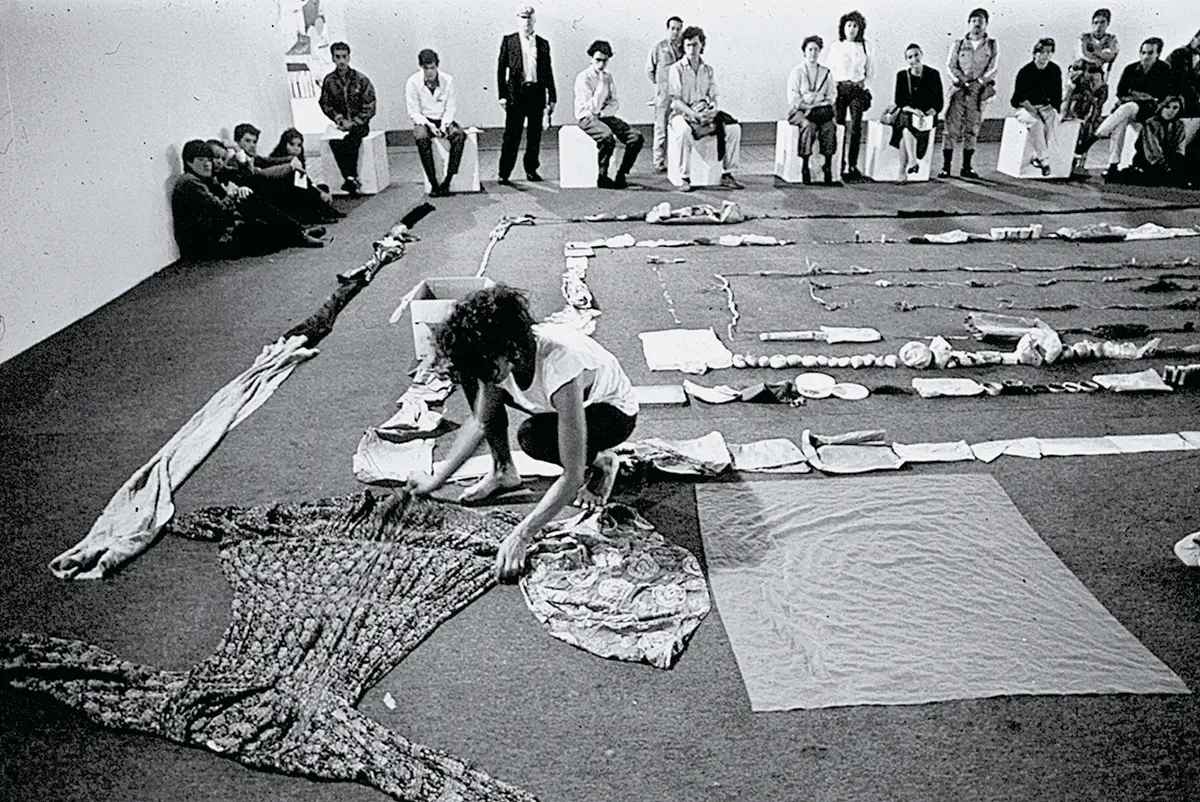
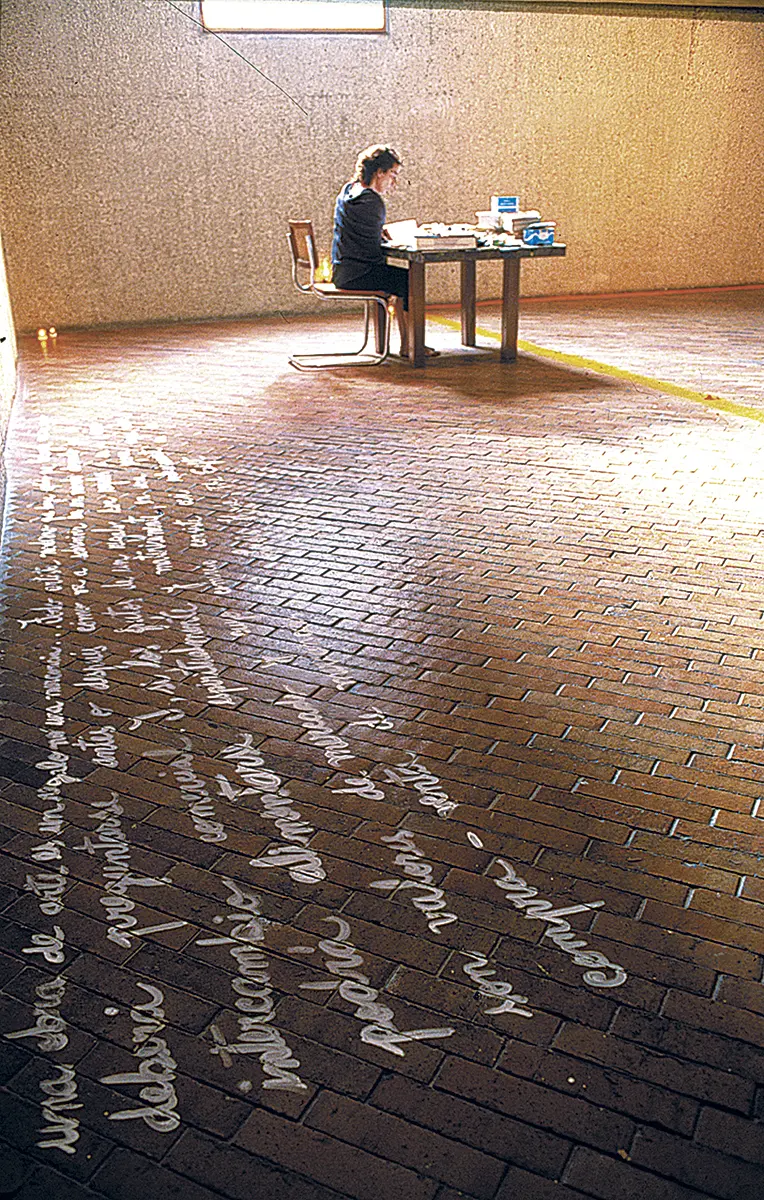
Una cosa es una cosa (A Thing is a Thing,1990) is doubtless the work that best synthesizes the artist's constant concern to connect our daily action, the space in which we move, and the objects that inhabit it. The dialogue between the body and the object in Una cosa es una cosa is repeated over and over; the space that it creates is alive, charged with its own energy. She does not act; she is herself; they are her things, her experiences. And she puts her objects in order without following any foreseeable model. Every object, no matter how modest, receives special attention. Little by little, a chain of natural links is established between them, but for each one —clothing, pots, mattresses, cosmetics— she resorts to a different movement. They are the little daily things separated by categories: form, function, color, and size. The associations have to do with the real experience; it is not a question of a spectacle for the public to observe. The length of her actions underscores the fact that she is the ultimate recipient, of her own experience, which is also that of other women. María Elena Ramos maintains that the labyrinth that she assembles puts us in contact with the temporal process in which the work is made and turns into the trace of her action and of what occurs within that elliptic time, at home, in the brain, in the female spirit that organizes. Everything happens almost the same each day. The monotony of cyclical thought can be perceived.8
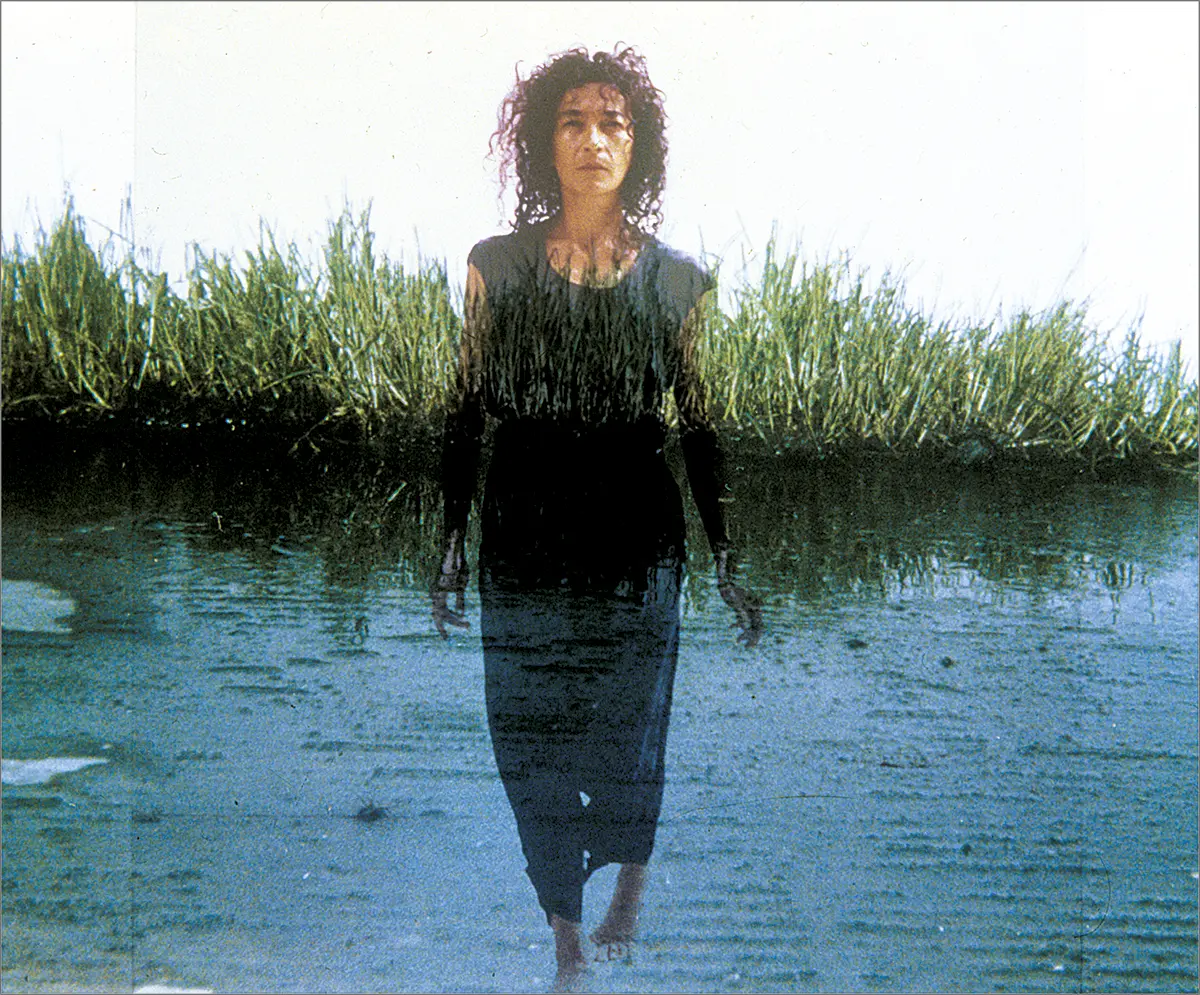
The artist wrote a text in which, through the use of the word, she reconstructs the non-linear, repetitive, and cyclical account of this performance: "movement here, straight away, in the corner, in the center, to one side, near him, her. far away, much further, further still, bags here, bag here, sack here, box here, bags there, sack here, and purse on top. box to one side, in the corner of the purse and the sack, and paper bags in the center, and near the box. clearing out. scattering, everything empties out. everything comes out. everything is dispersed, it is watered, mixed, they stop, they stand firm one after the other, indifferently, they surround a space that is enveloped, they separate into groups next to each other, common groups, where they look alike because they are white because they are made of fabric because they are dresses because they are plastic. because they need each other like toothpaste and a toothbrush, but also like toothpaste by itself and the toothbrush with other toothbrushes, or also by itself... I alone, he alone, she alone, we alone, a space alone, a corner alone, all the things are alone, we are all alone, a pile of sugar, a pile of salt, a pile of flour, a pile of things, text".9 With this work she won in Colombia the prize of the Salón Nacional de Artistas in 1990.
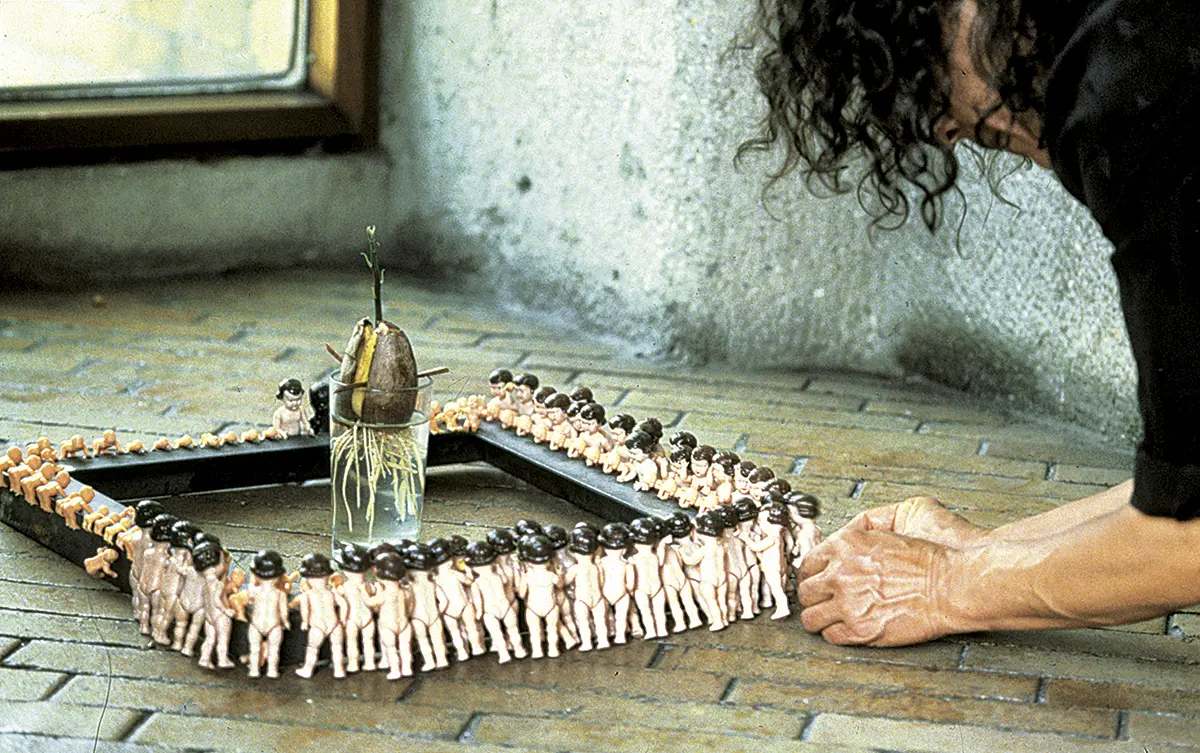
Throughout the '90s, María Teresa Hincapié's research delved deeper into the notion of the holy, understood as the sense of all things. "The holy is what makes sense", says the artist. Various aspects converge in the research. On one hand, she continues to explore the art-life relationship that has been so present in her work. In the face of the question: "To what are you referring when you speak of the holy?" she responds: "The artist has a way of thinking that is closely tied to the holy because it has to do with an integral thought, with the quest for unity: on the contrary, the secular fragments us. By holy I thus understand every goal that consists of establishing a harmony, an equilibrium, between the interior and the exterior, between the individual and the group, between the microcosm and the macrocosm, between man and the universe. It is related to what man currently calls ecology, a word that, as we all know, comes from the Greek oikos (house), and in some languages, it also means "school." Therefore, ecology bears within it a very precise program, namely, that man learns to live with his habitat, his people, his city, his country, with the cosmos".10 The ecological attitude is assumed as a position not only with respect to nature and its surroundings but also man's relationship with his society. The project Un marco para la tierra (A Frame for Earth, 1992) gathered twelve Colombian artists and thirteen Venezuelan artists who were asked to think about the state of the planet from that perspective, in a 40 x 40 cm. iron format. María Teresa Hincapié was one of the participants. She took the iron square covered it with flowers and surrounded it with a lot of little plastic dolls, placing a note of hope before the idea of death, of loss, through which the changes suffered by the Earth are analyzed. The frame with flowers also had part of Hamlet's speech on death, surrounded by flowers, those of his beloved Ophelia.
Hincapié's aim is not only to call attention to the changes produced in contemporary spirituality, but rather what she wants is for the actions that we execute on a daily basis to be conscious. Urban life, its speed, and the lack of communication generate a desacralization that distances it from the holy. In this respect she says: "When I get up and I can only trip against the walls, that's where life begins to hurt, I see how everything is designed for vice, for insensitivity and fear, for inert leisure, neither a tree to plant each day nor even an onion and everyone's so fat, so brimming with health and safety".11
For the artist, to emphasize simple acts like planting, walking, and getting in touch with nature, are vehicles to reinvent a simple universe in which the public's participation is very much a lived experience, generating awareness of the fact that there are other ways out. The important thing is to take a stance in the face of life, in the face of society: "We must confront the duality of the sacred and the profane and situate ourselves as artists on the opposite side of economic man. Not in a contrary position, but rather complementary; it is a position that leads us to ennoble daily acts, our thoughts, the institutions in which we work; in sum, our relationship with life and with others. The idea, then, is to bring the action toward the holy".12
The research Hacia lo sagrado was the basis for a series of significant actions in which she tried to discover once more the archaic sense of the word "sacred," that is, usefulness. It was a long preparation over several years that began with the reading of holy books, texts of history, philosophy, and anthropology, and then moved on to actions that allowed her to comprehend the holy. She feels that industrialization and consumerism have distanced man from spirituality, impoverishing him, and making him believe that if he does not have things he is a nobody. Industry, commerce, and urban sprawl offer human beings comfort and safety, but they also lead them to forget the holy.13
In the performance Esta tierra es mi tierra (This Land is my Land, 1992), she relates the holy with ecology. Land becomes the school where man learns to be responsible in his relationship with it in order to live in harmony, not only with himself but also with the cosmos. Caminar es sagrado (Walking is Holy, 1994-1995), Hacia los Huicholes (Toward the Huicholes, 1995), Proyecto de sobrevivencia (Survival project, 1995), and Divina proporción (Divine proportion, 1996) are actions that reveal this reflection. Caminar es sagrado was a twenty-one-day pilgrimage to San Agustin,14 toward holy places that hark back to a long historic tradition. To pilgrimage is as old as religion itself, and that journey without worrying about material things, without an overly fixed course, is crucial for Hincapié to recover the sense of belonging to the space that we inhabit. The performances that were created in galleries in the city of Medellin emerged from that experience shared with other pilgrims. There she planted small gardens, with the help of the public and other artists, with the same goal of recovering spirituality, questioning consumerism, inviting us to meditate on the essence of the human being, and encountering some form of religiosity.
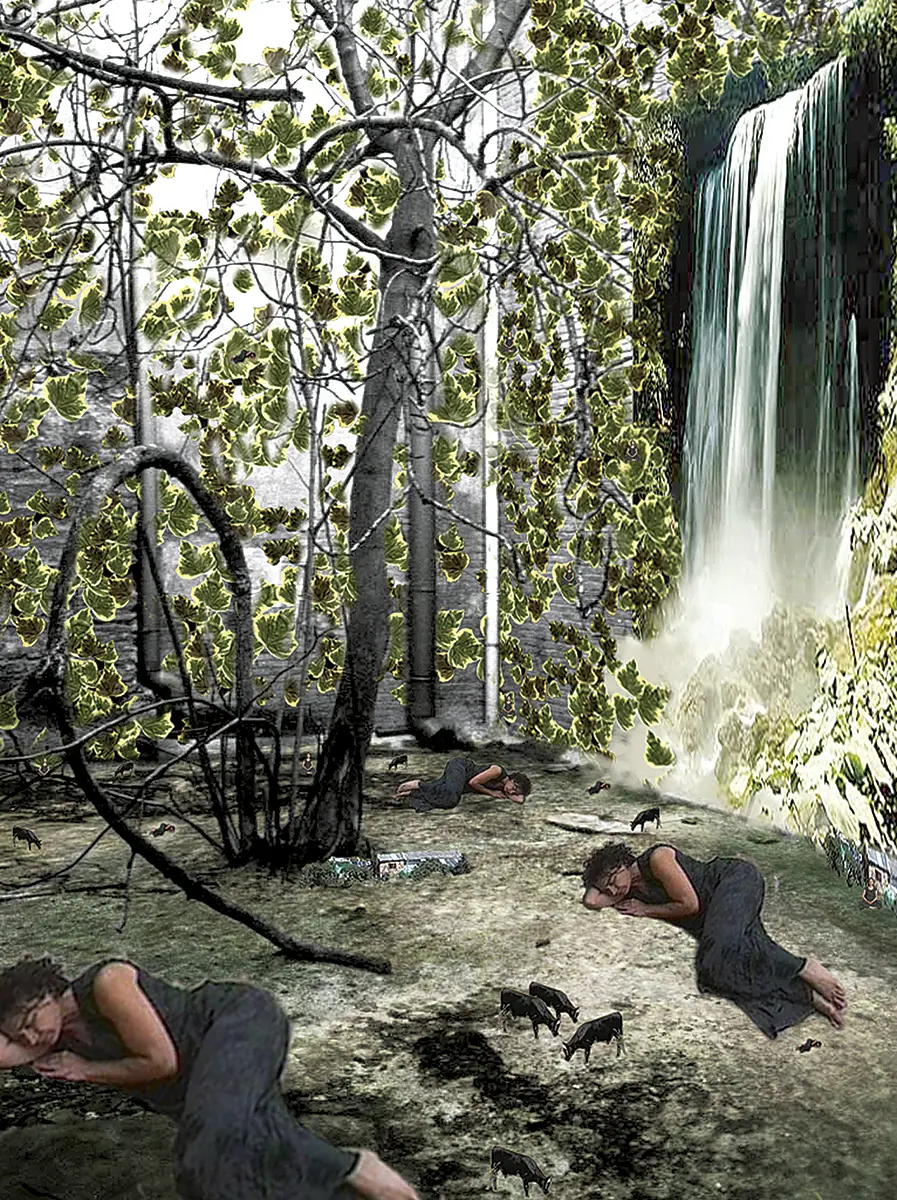
Tu eres santo (You are Holy) is a complement to her pilgrimage to San Agustin, and it was carried out over seven days in the Museo de Arte Moderno de Bogotá after a strict process of preparation (almost of initiation), as she isolated herself over four days in order to "pray, meditate, reflect, and love." During the performance, the space was opened in order to share it with those who visited her. The interaction with the public could only be done through written questions, verses, and phrases that spoke about the revitalized space, or by silently accompanying the artist who watered the grass—which was her bed in the museum—meditated, and read. She distanced herself from all attempts to accumulate certainty, logical truths, or reasoning for the sake of reasoning, inviting us instead into contemplation.15 In this action, as in the previous ones, she tried to enlarge the space of the museum and the gallery, transcending the customary use of the areas dedicated to art. The cycle of this reflection has an especially significant moment in Divina proporción, which once again earned the artist the prize of the Salón Nacional de Artistas in 1996.
She planted grass in the crevices of a space of large square cement modules, maintaining that "it is just like when you go out into the street and, walking along the sidewalk, you see nature filter through its fissures."16 In this work, she involves her body which walks her through it, watering the grass, but also in time, slowly, paused like her walking, a time in which she engages the spectator who rarely observes such details in which she stops and the marked-off space in which the action takes place. Her insistence on slowness is a sort of act of resistance with respect to the speed that stamps the process of contemporary urbanization, which is not very interested in the degradation of the environment and hardly allows us to dwell on the small details. In the same year as this action, she bought some land in the Sierra Nevada de Santa Marta17 and thus was born the project that she had been working on and which gave rise to a performance like the one presented in Valencia, Spain: El espacio inexistente (Non-existent Space, 2001).
After investigating the myth of paradise, the nostalgia for the paradise that remains in the collective conscious, she insists on seeking referents that demand contemplation. The typical rules of mimesis have little to do with the meaning that the small objects lost in nature have there. We must discover them, resignify them; and as in her earlier works, the relationship with the objects emerges out of a chain of associations that appeal more to experience with things than with their physical characteristics. In order for them to be revealed, the public must observe and discover. That return to the utopia of paradise once more becomes an inward look, discovering the solitude that—for Hincapié—surrounds the contemporary artist, something that belongs to him and which he can share.
Her land in Santa Marta is near the indigenous Kogi, Arsario, and Arhuaco settlements, and there she plans to formalize that permanent search between her project of life and art. She will create a unique Art School that will receive a few students who will live in that space, in direct contact with nature, and whose thoughts will derive from that contact. It is a matter of creating for those who work a place in which to develop processes, not learning in a fragmented fashion, but rather integrated into a reflection that can have continuity. The University of Montreal supports the project, and student convocation is already open via email: mthincapie@hotmail.com
This project is closely related to María Teresa Hincapié's consequent attitude to the art-life relationship: "This era demands that we turn our life into a work of art... and to speak of "artwork" in our time is something very debatable. My desire is to speak with you."
NOTES
1. Author's interview with María Teresa Hincapié. Bogotá, November 2001.
2. Eugenio Barba Nicolas Savarese, "Anatomia del actor," p. 7.
3. Ibid, p. 51.
4. Ondina was a monologue written by Juan Monsalve in 1985 for María Teresa Hincapié that gathered texts about women written by classical and modern authors. Her performance in the 7th Festival Internacional de Teatro de Manizales that same year earned her recognition as one of the best actresses.
5. Escenas de parque para una actriz. Video and music by José Alejandro Restrepo, 1987.
6. Interview cited above.
7. Marta Rodriguez, "María Teresa Hincapié," Arte en Colombia, No.40 (1989): 113.
8. María Elena Ramos, "María Teresa Hincapié: una cosa es una cosa," El Nacional, Caracas, August 1990.
9. Text in catalog María Teresa Hincapié: Hacia lo sagrado. Premio Luis Caballero, Galena Santafé, Bogotá, February 1998.
10. Artist's interview with Natalia Gutiérrez, in Caminar es sagrado (Medellin: Centro Colombo Americano, 1995).
11. María Teresa Hincapié, in the catalog Hacia lo sagrado, op. tit.
12. Interview with María Teresa Hincapié cited above.
13. Ibid.
14. San Agustín is an indigenous ceremonial center, located in southern Colombia, in the Department of Huila. There is a large collection of statues and construction of embankments and terraces related to the tombs of dignitaries. Augustinian culture had its greatest development between the first century BC and the second century AD.
15. Juan Alberto Gaviria, "Tu eres santo," in the catalog Caminar es sagrado, op. tit.
16. Interview with the artist cited above.
17. The Sierra Nevada de Santa Marta is the world's highest mountain system next to the sea. Even before the arrival of the Spaniards, it was densely populated by groups of indigenous Taironas who possessed a complex culture that displayed great respect for nature. The archeological remains of the Lost City are a contemporary testimonial of that relationship.
IVONNE PINI
Historian, Professor at the Universidad Nacional de Colombia, and Executive Editor of ArtNexus magazine.