
It's Thomas Anderson in front of a computer. Like the rest of the cubicles crisscrossing the floor, his workstation has been assembled with modular panels, as impersonal as the employees' suits. By day, Anderson works for the Metacortex conglomerate; by night, he is Neo, the hacker, who will shortly realize his life occurs in an even more regulated space, a virtual space that's nothing but the abstract representation of a data system. A Matrix. But while that revelation comes, if it comes, and regardless of what uses it is put to, Thomas Anderson will remain just another anonymous, faceless employee in that real space so expertly dissected by Ofill Echevarría in his Iconos/Reflections, dated last February. Ten oil paintings suffice to distill the dimensions of this topic, as much as in its subjects as in the urban landscape that distinguishes them. There is an apparent redundancy on the surface of these large-format pieces: men clad in suits of like colors, carrying similar suitcases; faces and bodies of imprecise contours inhabiting a public space almost as diffuse as they are. Reiteration, textural planimetrics, sobriety in the use of color, simplified scenes, and focus on an imaginary hand-held camera that segments and disfigures: these are all resources for contextualizing the corporate world's icons, the contemporary imagination of success, in their funhouse, merely illusory aspects. Or in what they seem to become: the materialization of similar data, of data perhaps organized in the same way a computer program is visualized, and perhaps at the same speed. Each one of these works magnifies the details of such repetitiveness, not only by presenting them but above all, by inscribing them in the plurality and the complexity of an urban dramaturgy. The title' bilingualism is another way of pointing out language's duplicity, which Isaac Joseph deemed the stepping stone for thinking in the public space.
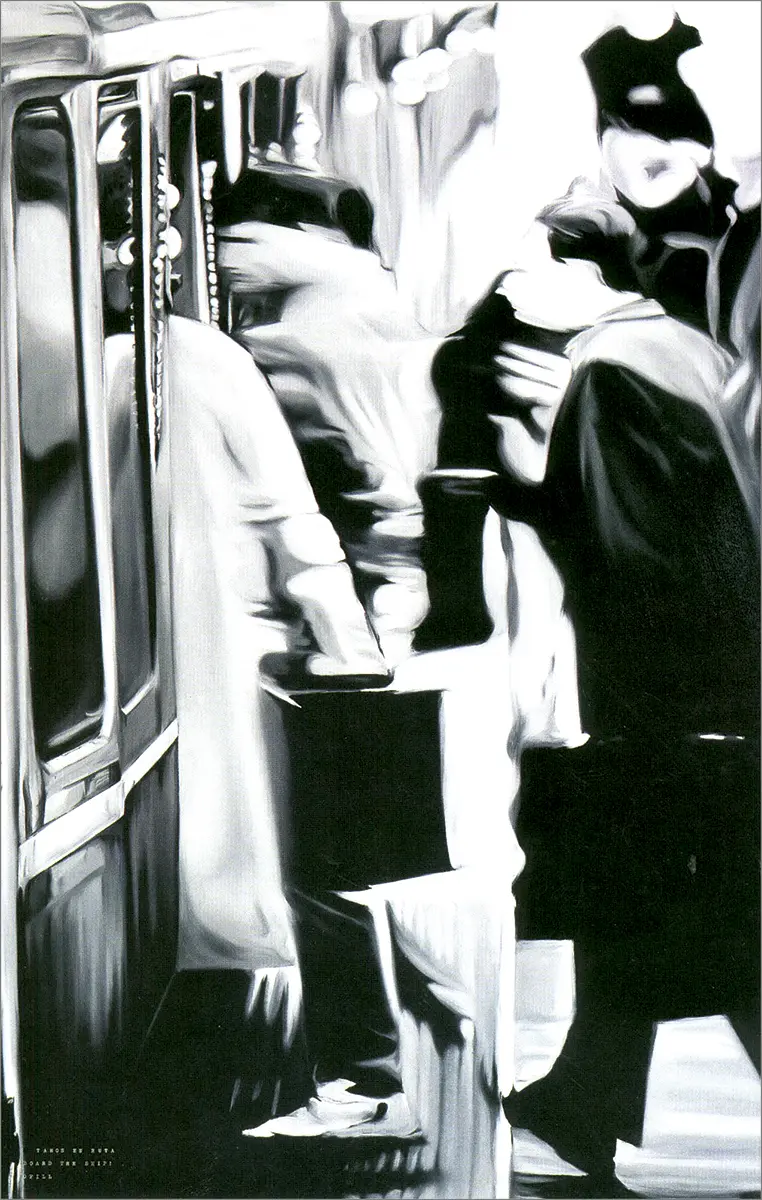
From Todos los días a las 9:00 hrs./Simpleman to Camino sugerido/Suggested reality, the journey covers one workday. The irony of Gitanos en ruta/Board the Ship!, Los paseantes/Escalator's men, El tiempo apremia/Time is Golden and W&W carry the time frame out of the office and into a wider daily experience; there is also an epochal or generational time that sustains these company men as archetypes of the illusory aspirations already identified for the 1990s by Douglas Coupland in his Generation X, and which don't seem to have lost their power. It's obligatory to refer to these character's intimate aspirations, as well as their fatigue, to Coupland's reflections: even if they received the revelation of their world as merely virtual, they would do very little, even outside of such constraints. Or they perhaps would unbound the accumulated violence of a monotonous routine in the way of Bret Easton Ellis' American Psycho, a much darker companion to Generation X, as suggested by the expressionistic tension of a work like Abstracto Street.
Similarly, the urban space's visual elements and functions are characterized here, territories in whose absence of individuality we discover that the non-place of the megalopolis promoted as an environment for the future or designed for a global citizen. We discover it in the norms for dress, the schedules, the harried pace of people in the street, and the congestion at the door of a city train. Out of their offices, Ofill's characters are not identified as carefree strollers but, rather, as travelers in transit, probably from the city to the metropolis and back. The selection of built structures signals a landscape of the transitory: stairs, hallways, sidewalks, train coaches, and platforms. The constant among these transitory elements is the office building, El mundo de los vivos/The Real World: windows turning the façade into a grid and exteriorizing the same rationality of the modular panels that divide the interior space; lit by night, the rooms appear as a succession of monitor screens or fluorescent points carefully organized on a giant screen. A whole space that could be called fractal and which reproduces, at an architectonic scale, the same impersonality that's forced upon its human component.
Some creative dimensions transcend the conceptual or aesthetic realm of significance or their importance for a certain context of origin with which they are graced by an aesthetic appreciation; it is what happens with Ofill Echevarría icons. The strict correspondence between the selection of a phenomenon's nodal points and its plastic expression does not reproduce the descriptive immediacy reached through a testimonial or a reportage; it signals the synthesis and the distance proper to the act of reflection. They signal, above all, the artist's mature ability to unveil the totality of an environment and its implications through its minimal defining elements. Anyone who's familiar with the current thinking and the current fiction about our contemporary large cities, about their possible dystopias, or, even, how they exhibit their adherence to a global character, will certainly pick up the multiple subtexts that make this show a solid critique in the field. Just as certainly, such an observer will admit Echevarría's work into the large cultural space where it belongs.
EMILIO GARCÍA MONTIEL