In the paintings of Portinari, Rivera, Pedro Nel, or Carlos Correa, the body is submerged in a telluric context, in the dense waters of ancestral myth; in Orozco or Siqueiros, it is a historical object; the body also appears covered by art's sublimating norm, or the norm of what we call "the artistic." Jean Claire has pointed out the meanings of the body throughout European art: body, or artistic nude? When Rudolf Schwarzkogier killed himself in front of a camera that registered his self-laceration to the point of death, did we witness an exasperated narcissism or a hysterical publicity act?
In the unforgiving loneliness of Elfriede Jellinek's novel The Piano Teacher, the main character mutilates her own sexual organs. In Débora Arango's nude, however, the female body is presented and revealed as a geography of pleasure, of erotic joy. A woman gazes erotically at another woman. Even in painting women in bordellos and working-class streets, Débora emphasizes a vision of the body in its animal freedom, in the strength with which it asserts its glands against social norms — social norms that, through the myths of hygiene and healthy living, erase that primal power Débora discovers and celebrates.
Here we find an act of authentic subversion since artistic propositions have been made under a strict life-based rationale. Nihilism is a reactionary position because it negates outlets for joy, for pleasure as an affirmation of autonomy, and as a specific truth. In recuperating the aesthetic dimensions of his body, a Medellin child-assassin transcends the immobilizing sociological categories of "the poor" and "the worker," transforming them into a body that assumes its own destiny. Hence narcissism is the measure of freedom for the oppressed, in the face of cultural barriers that negate the body.
Toni Negri states it forcefully: "If there is no art, it is only because it has been recuperated by bodies; art is truly all around us, in the practices of the masses: inside the body, art experiments with new metamorphic compositions. How powerful art is!" ("Arte y multitud" [Art and Multitude], Toni Negri, Mínima trota [Minimal Trot], 2000). A picture of a young child-assassin from Medellin could be a picture of any North American or British youth: mass-produced fashions, and the ingenious cloning of international brands, are a part of any of these groups' acts of cultural subversion. Here, the vindication of the narcissist implies a recuperation of the body from political and religious abstractions.
In her text El cuerpo y sus multiplicidades (The Body and its Multiplicities), Patricia Sáenz Duque says: "This adventure in the body and its multiplicities is intent on treating the body as a political problem, this is to say, as a site through which the various apparatuses of power/knowledge construct the body as socially apt for the different functions it is assigned." With great lucidity, she points to the exploratory lines in her research: the levels of both the sayable and the unsayable.
Video, bibliographical references to authors such as Deleuze, Guattari, Spinoza, Bataille, and the necessary referent of artists like Cindy Sherman and Witkins, allowed her to probe and search around a concept that cannot be seen from a single perspective since cultural and religious definitions can both lead to horror and monstrosity or carry us to joy and celebration.
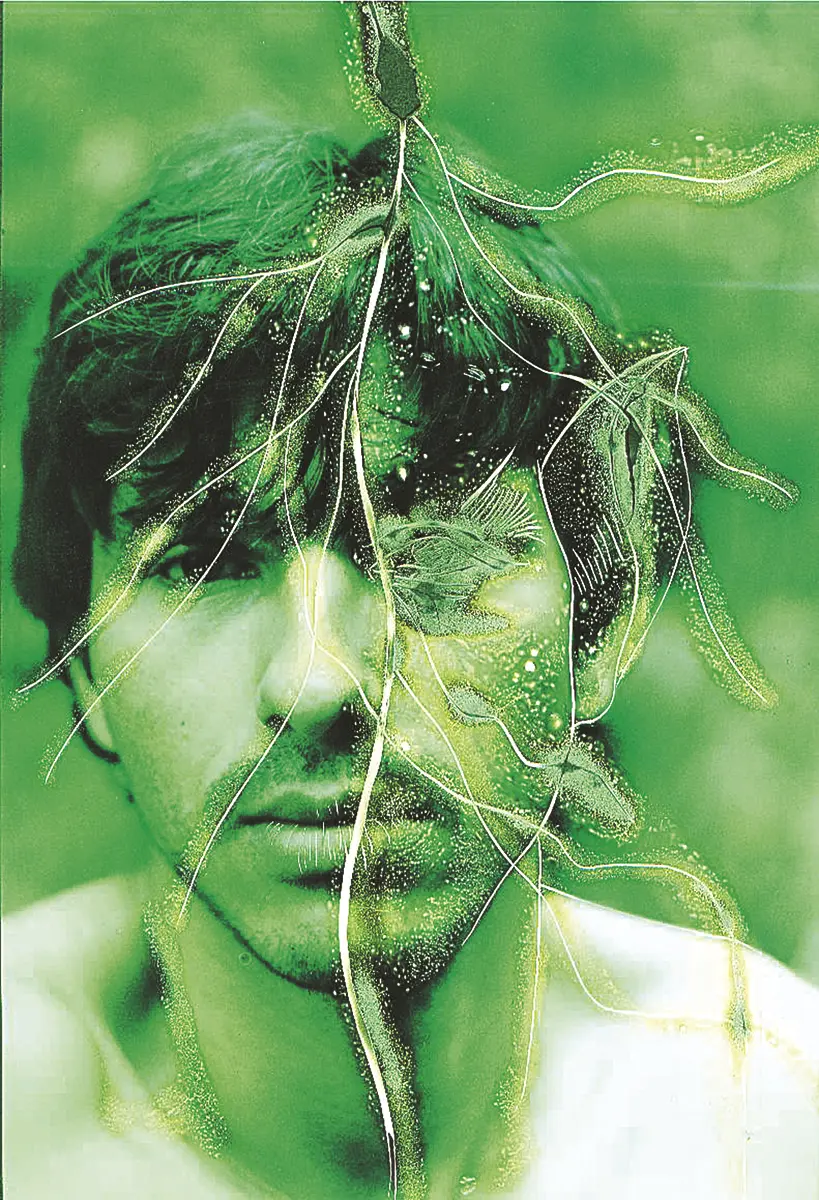
It is in these circumstances that she arrives at her insights: "In this simultaneously geographical and political exploration of the body, violence cannot be absent; it emerges in the force of color, in the different shades — now purplish, now reddish, now blue." Is this a reference to Medellin street violence, a violence that every weekend kills 60 people and, with the turf wars between gangs, gives us the total degradation of severed heads of youngsters being thrown from roofs, and placed in strategic positions, all of which would lead us to refer to Vito Aconcci?
Patricia Sáenz Duque goes beyond the merely facile: she uses testimonials for her photographic montages, and her video work, and bases on them her exploration of the self-mutilating body, the body uninscribed in lines of ritual-religious sacrifice, the body that rejects the secret narcissism of martyrdom. Her innocence comes from posing these questions through the experience of art, with recourse to the words of philosophers whom the academy has invested as prophets, words that crude reality turns into fatuous argumentation.
As questions, these images maintain the absolute dignity of the tragedy and human life. This is why they are not intended to persuade us with political arguments, but with the blunt force of that which cannot be said: the negated unity of a body — blood, skin, bones, brain, intelligence, love — mutilated by the world's barbarism and not by nihilism's supposed metaphors, the lyricism of a Vollrad Kutscher.
After finishing her art studies, Patricia was killed by her neighborhood gang. This is the question implied by her sacrifice: Is her fallen body a political and an aesthetic body? Are these images illustrations for a chapter on "art and urban violence," or are they the beginning of a new image? What I am admitting here is the flimsiness of the so-called critical vocabulary, and its impotence in dealing with something that has gone beyond its comfortable categories.
DARÍO RUIZ GÓMEZ