
Based on the recipe for a drink mixing Coca-Cola and red wine (the calimocho), Rubén Ortiz Torres and Eduardo Abaroa offer a suggestive collaboration where the key to meaning is the idea of "mixing." Just like two beverages "Coke and wine" are mixed to create a third one calimocho, these two artists' "technical, aesthetic, and cultural" interests mix in this show, as Torres and Abaroa put it in the text produced by the gallery for the show's opening.
The constant migration and exchange between Mexico City and Los Angeles, and between Asia and Los Angeles, have generated a sui generis culture where the combination of "high" and "low" or popular elements results not only in a new iconography but also in a new way to face daily life through the filters of mediatic culture. Thus, the main points of reference encountered daily in Los Angeles' working-class and immigrant neighborhoods, the new heroes and saints demanding people's devotion, are the same characters that populate the television screen: actors, comedians, sports stars, cartoon superheroes, etc.
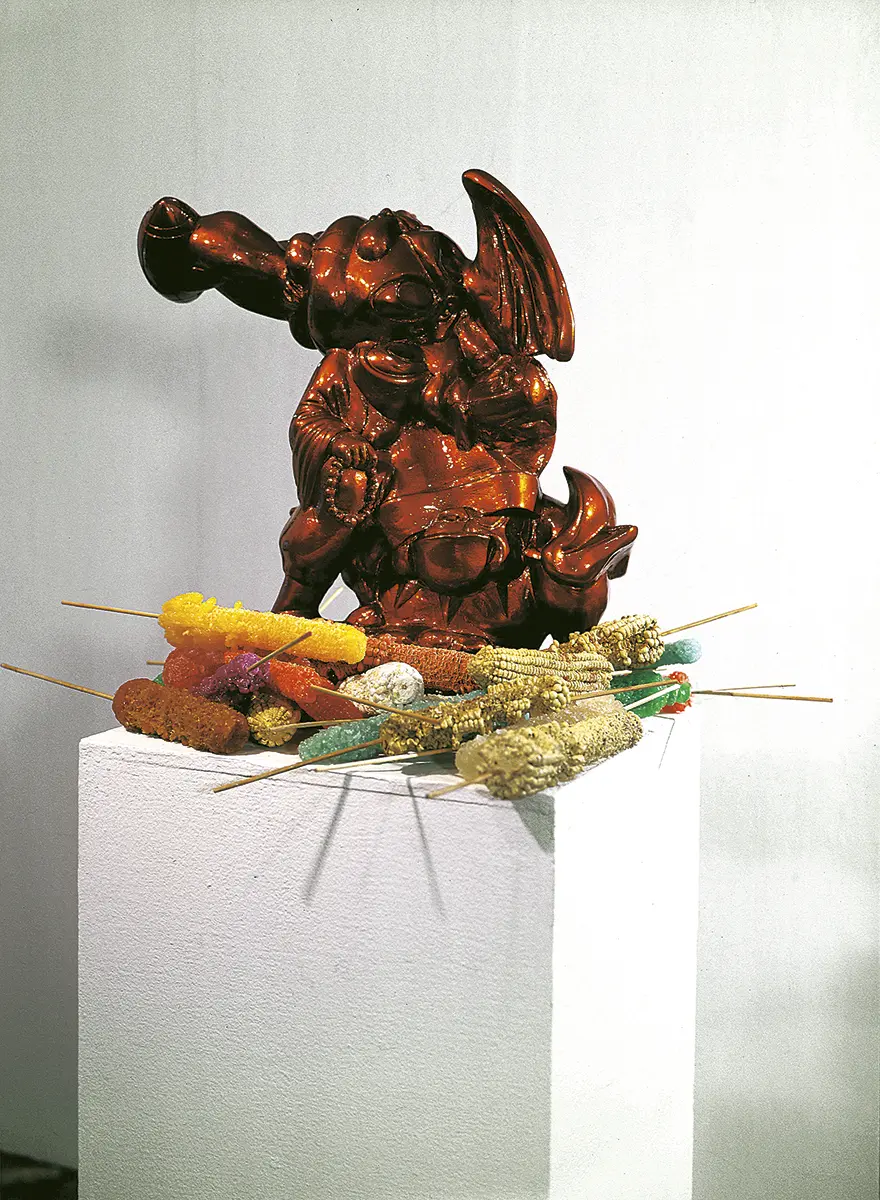
Abaroa and Ortiz have used this reality to configure an aesthetic discourse, placing a number of issues on the table: the media's influence on our daily life, the transgressions of borders, and the hybridization of cultures and geographical spaces. Abaroa and Ortiz Torres propose archaeology of the present, exposing the ways in which elements characteristic of the urban space and the urban imaginary coexist and intermingle. This is why the show presents accumulations of objects as well as reappropriations and resignifications of materials —all of which occur daily in any big city marked by multiculturalism, cosmopolitanism, and globalization.
Abaroa and Ortiz Torres' show includes 12 pieces in different media, six of them realized as a collaboration, three created by Ortiz Torres for Art Pace in San Antonio, Texas, and three photographs from their series A True History of The Conquest of The New America, which had been shown previously at the Centro de la Imagen, in Mexico City.
Of the six collaborative works, the video piece Bodhisatva (2002) is perhaps the one that comes closest to the show's core. It articulates an integral discourse, allowing the viewer to participate in both artist's interests. Bodhisatva uses a morphing technology similar to that used to such surprising effect in Michael Jackson's 1993 video Black or White. Abaroa and Ortiz Torres' video shows the transformation of several ceramic figures (the kind we could easily find in any cheap souvenir store or a neighborhood fair), each representing a different character and all of them belonging to the intersection of the West's new mediatic culture and the East's popular culture. Looney Tunes morphs into Woody Woodpecker, who morphs into the Incredible Hulk, who morphs into a ninja, who morphs into the Powerpuff Girls, an Apache Indian, a soccer player in the Guadalajara team, and, finally, ET, the Extraterrestrial.
Abaroa and Ortiz Torres' video reveals a kind of morphing between cultures as they converge on a city such as Los Angeles: East and West intertwine, Mexico and the United States fuse into a new hybrid that goes beyond its origins and establishes itself in North America as a new way to deal with daily life. At the same time, these two artists propose, on the basis of those popular icons, a new Olympus, new constellations of gods to be listened to, venerated, and kept in our minds.
Chupabuda con vergüenza (Prude Chupabuda) (2002) results from the crossing of the Buddha with the Chupacabras, or Goat-Sucker, a mythical figure along the US-Mexico border. Whether it comes from a natural copulation (which would be a metaphor for the hybridization of cultures) or from a transgenic process, is undecided. The small figure covers its naked parts with its hands, and a line of clothing items in different sizes and styles suggests that having become aware of itself as "not only naked but also a 'victim' of mixing," the Chupabuda is now looking for clothes to cover its "truth." A closed TV circuit captures the viewer, and a monitor placed just to one side of the Chupabuda forces the viewer to watch himself watching the piece. In the end, we are all spectators of these transgenic processes that mix things that had already resulted from previous mixes. We can only observe, patiently, the results.
Ironizing the popular Spanish phrase "aquí y en China" ("here and in China;" in other words, vast), Abaroa and Ortiz Torres present a piece titled Fernando Valenzuela aquí y en China (Here and in China, Valenzuela is Huge), (2002). It's a multi-headed Chinese dragon, a hybrid, a sort of minotaur that, instead of dragon heads, includes the head of Fernando Valenzuela from the Los Angeles Dodgers, perhaps the most important Mexican baseball player in history. The connection is clear and direct: once again, the mixing of culturally codified images, both associated with popular culture in their respective societies "the dragon used in Chinese religious festivals, the idolized sports figure," generates a third culture that has come to stay.
ANA ELENA MALLET