
Cabezas mágicas (Magic Heads), Agustín Bejarano's recent personal show at the Museo del Ron Gallery in Havana, makes clear that constant change, resulting from ceaseless experimentation, is one of the governing principles in this artist's work. He has left behind the sensuality of his Anunciaciones (Annunciations), which emphasized a joy of contrasts and highlighted the voluptuous materiality of anatomically precise figures; in place of that sensuality, we find now a more expressionistic, gestural action.
Bejarano's new series contains a large cast of characters. In retrospect, it is clear that this artist's work has had a number of protagonists, sometimes of an abstract quality, such as the hurricanes in his large-format prints, sometimes intimate and self-referential, as in those prints on plastic that used Bejarano's wife and son, as well as the artist himself, as models. At times he has also related his explorations of the private realm to the figure of José Martí, reinforcing those works' openness of meaning by giving them a context that expands toward the public space. Similarly, when Bejarano returned to painting between 1996 and 1997 with an almost abstract intent, he prefigured more than one presence; later, he added to this his androgynous angels and, also, the eloquent silverware of his Paisaje y naturalezas muertas (Landscape and Still Lifes). There were also those characters highlighted in groups that were designed to cultivate the enigma of annunciation.
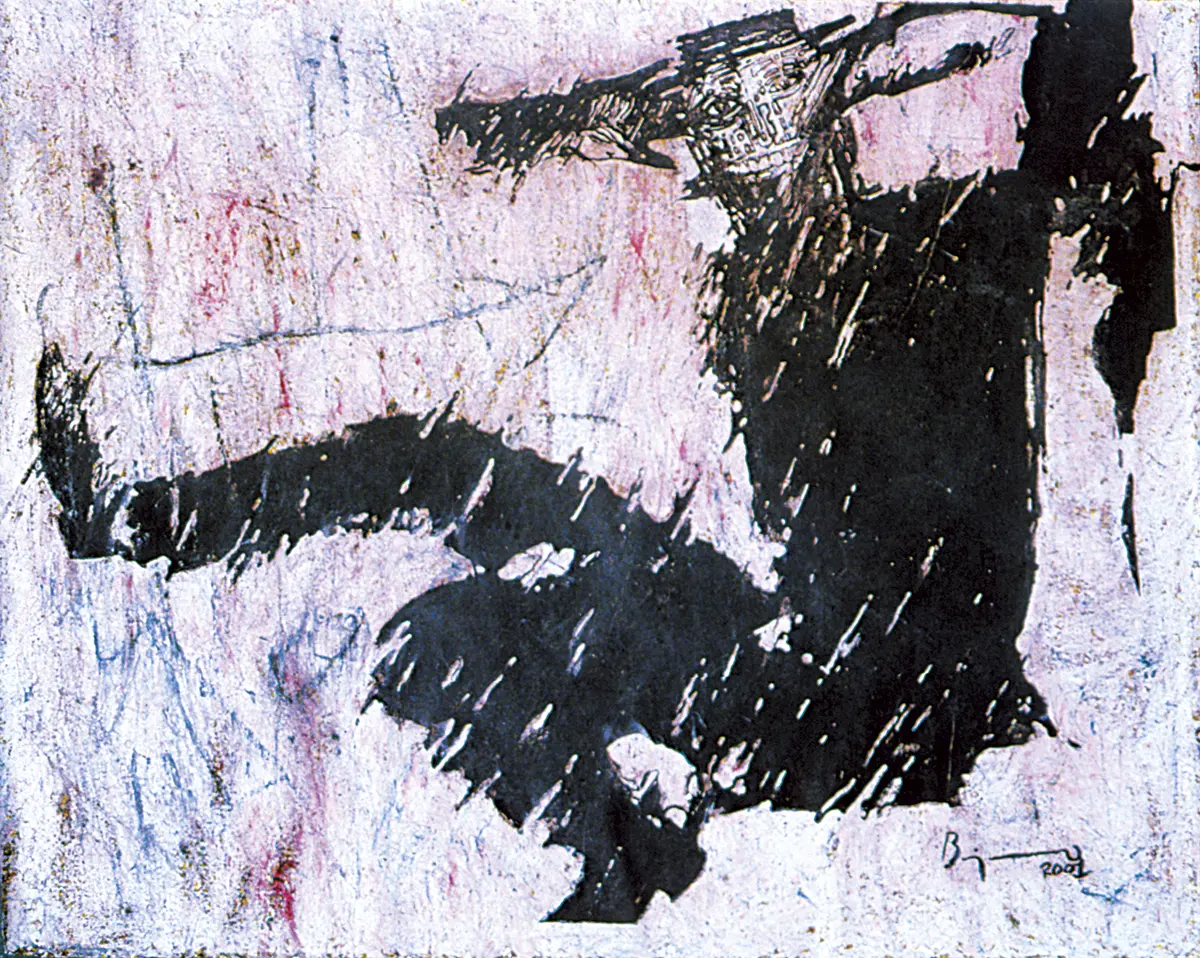
Bejarano is clearly an artist who avoids stylistic pigeonholing; given his formal versatility, his work is difficult to label. At the same time, he has sustained a vivid interest in re-elaborating themes that recur profusely throughout the history of art, as is the case with the portrait genre in Cabezas mágicas. The portraits' subjects are integrated into the austere surroundings the artist creates for them. Some of them are presented as half-figures, and some appear as full-body images; the emphasis, however, is placed on the series title on the head. Moreover, the symbolic reference is to the head as the site where thoughts originate, to the strength and the powers of the mind, and also to its exaltation as the location of spirituality.
Bejarano's figurativism now has an expressionist quality, unpreoccupied with physical resemblance or precise anatomical construction. Canvas and acrylic paint become, respectively, the field and the tool employed in a game of undrawing classical morphologies. This 54-piece series includes secondary scenes, remarking on the exceptionality of the quotidian. A daily existence whose simplicity and fleeting character compose the epic of the common man. There was room for goodbyes, for long waits, for wounds, as well as for the savage and the instinctive, shipwrecks and metamorphoses. From the personal space, Bejarano untangles the knots of daily events and, at the same time, the knots of memory; through many of the imagined characters of History's Grand Discourse, invoked now by the artist's spirituality, he hands us a sketch of his own experience.
Cabezas mágicas resurrects the portrait as a theme. Bejarano's is a portraiture that abstracts from the represented types: generic abstractions (Tejedora de mano [Hand Weaver], Pescador [Fisherman], Retrato de muchacha [A Girl's Portrait]), turning into fiction faces that recreate anonymity and, in unison, producing symbols based on a figuratism that's done in candor but not in naiveté.
Perhaps this series relates to Plato's idea of the human head as an image of the world; if that is the case, Bejarano is describing a world inhabited by multiple figures, some of the ilk of Businessman, Metamorfeo (Metamorphose), El conquistador (The conqueror), El haragán (The Lazy Man), El Cama-León (Chameleon-Bed), frequently appearing specimens both in the artist's daily life and in ours.
Most of these characters, however, transcend the banality of existence. Their substance tends toward typology; some even reach the status of allegories, as in the case of La montaña humana (The Human Mountain), La visión (The Vision), Escarbador (Scratcher), Brujero (Witch Hunter), Instinto salvaje (Savage Instinct) or La sombra (The Shadow). The meaning of these pieces is expansive despite the 'veilings' obscuring their true implications. In the same vein, but actually as an exception within the show (thanks to the presence of an immediately recognizable, paradigmatic figure), we should mention Metáforas de la salvación (Metaphors of Salvation), a 7-piece narrative work that tells of a dream about José Martí and of its coming to pass. This work brings back into focus themes related to the concepts of utopia, identity, myth, insularity, and, especially, the necessity of the sacred for a major spiritual renaissance.
Bejarano's strategy has been to alter history's selective and hierarchical mode of construction by recreating common types, gestures, emotions, and instincts that give form and energy to the human masses, without which any social process would be impossible. From that perspective, the artist outlines a broader view of what it is to be human, and of human beings' relationship to their environment. And he opens new paths for us to see that we are surrounded by often unacknowledged texts.
What Bejarano really does is to un-compact those same human masses and to leave a record of their particular existence, as he recreates the various typologies as if in an inventory of characters. Even if not every single voice is heard in this redemptive movement, the vibrations emanating from so many existential narratives are powerfully signaled.
The 'little' beings the artist has placed on the margins of time ratify nonetheless their presence in the here-and-now; they contain a present that's already a part of memory, but of a memory not generated in the grand historical narrative but in the personal space and in the space of psychology. Cabezas mágicas moves beyond distinctions of genre and the like, and it brings to the fore the redemption of the human condition, subverting the notions of anonymity and transcendence.
CARIDAD BLANCO DE LA CRUZ