In recent years, Fundación Telefónica has paid considerable attention to 20th-century Latin American art; now, curator Nelly Perrazo has prepared a selection of works by the Argentine artist Alfredo Hlito. All the pieces in the show were created between the early 1960s and 1993, the year of Hlito's death; this is to say, they all came after the artist's participation in the Arte Concreto-Invención movement, where he collaborated with Tomás Maldonado, Raúl Lozza, and Enio Iommi, among others.
Within the established period, the curator has chosen to limit the show to three significant series in Hlito's work: Simulacros (Simulacra), Efigies (Effigies), and Iconostasis.
After developing as a purely abstract painter (probably the best-known period of his career), Hlito turned toward a more colorful and expressionistic art. As stated in the current show's catalog: "It was not just a response to earlier art; it was a total rejection, an abandonment of all types of forms, regardless of whether they were geometrical or nature-inspired. It was, to use a metaphor, to paint without painting anything." These early experiments echo, in formal terms, both cubism and impressionism, particularly in the technique of applying paint in small strokes and directly with the brush, without prior tracing. These are open, linear compositions where no clear distinction is established between line, form, and color. Such is the case of pieces like Forma oscura (Dark Shape") (1962) and Sin título (Untitled) (1963-1966).
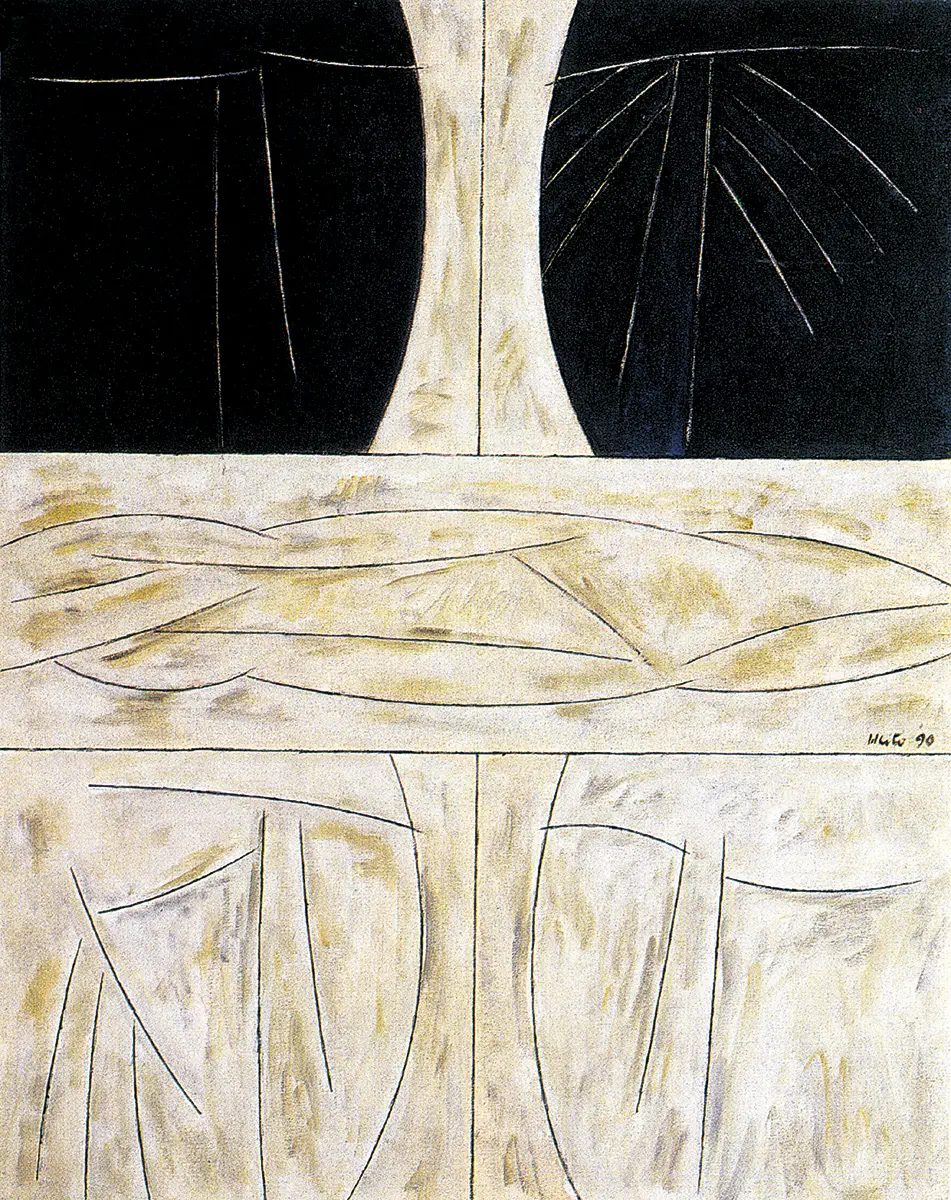
Between 1963 and 1973, Hlito lived in Mexico. It was during this period that those open lines that barely formed a structure began to turn into larger blocks. It was then also that the artist defined his "obsessive images": Efigies and Simulacros. Indeed, if his works of the 1960s compositions are open and free, already in Efigies the dominant element is the presence of figures. These are more or less monumental pieces, even within the limited formats Hlito worked with. His effigies come either in accumulation or in unfolding display; it is a process of continued pictorial experimentation rooted in a single, essential motif, which will fuel the artist for over 20 years. These paintings alternate with a series of faces obviously derived from the earlier linear constructions, which gives an element of expressiveness to a body of work already far from concrete art. Of special interest is what happens when these faces are interspersed with the effigies in a single work: Efigie yacente (Lying Effigy) (1990) or in a composition such as Rostros con fondo negro (Faces Against a Black Background) (1988).
Finally, Hlito's Iconostasis is the product of the artist's desire to group several effigies in a single composition. The name derives from those Russian artworks of the 14th and 15th centuries, of very large size, entirely covered with icons. In this case, the effigies' imposing presence becomes a powerful image thanks to the repetition of a central motif.
In this show, Hlito comes across as a painter obsessed with his experimentations and motifs, a formalist who, nonetheless, finds the meaning of his art in the act of painting per se, in the way in which his work reinvents itself by widening or narrowing its motifs, altering his palette, or elaborating on a composition. But there is also an Alfredo Hlito interested in theory, in writing, and in the search for a distanced gaze upon his own work.
ISSA MARÍA BENÍTEZ DUEÑAS