
The street altar has long been a part of the traditions of respect for the dead in many Latin American and Caribbean cultures. Now it has found its way to the United States in urban environments where large immigrant populations struggle with the hardships of adjustment and violent deaths. After September 11th, all Americans (and indeed the world) have become familiar with the poignant response of the street altar that appeared throughout the city and especially in the neighborhood of the World Trade Center. As a newcomer to New York, arriving two years before the September 11th tragedy and finding such altars in neighborhoods throughout the city, Dario Oleaga was profoundly moved by the arrangements of personal items, flowers, and messages that documented the violence of everyday existence. In his homeland of the Dominican Republic, mourning was a private and quiet time for family and friends, not to be shared with strangers on the street.
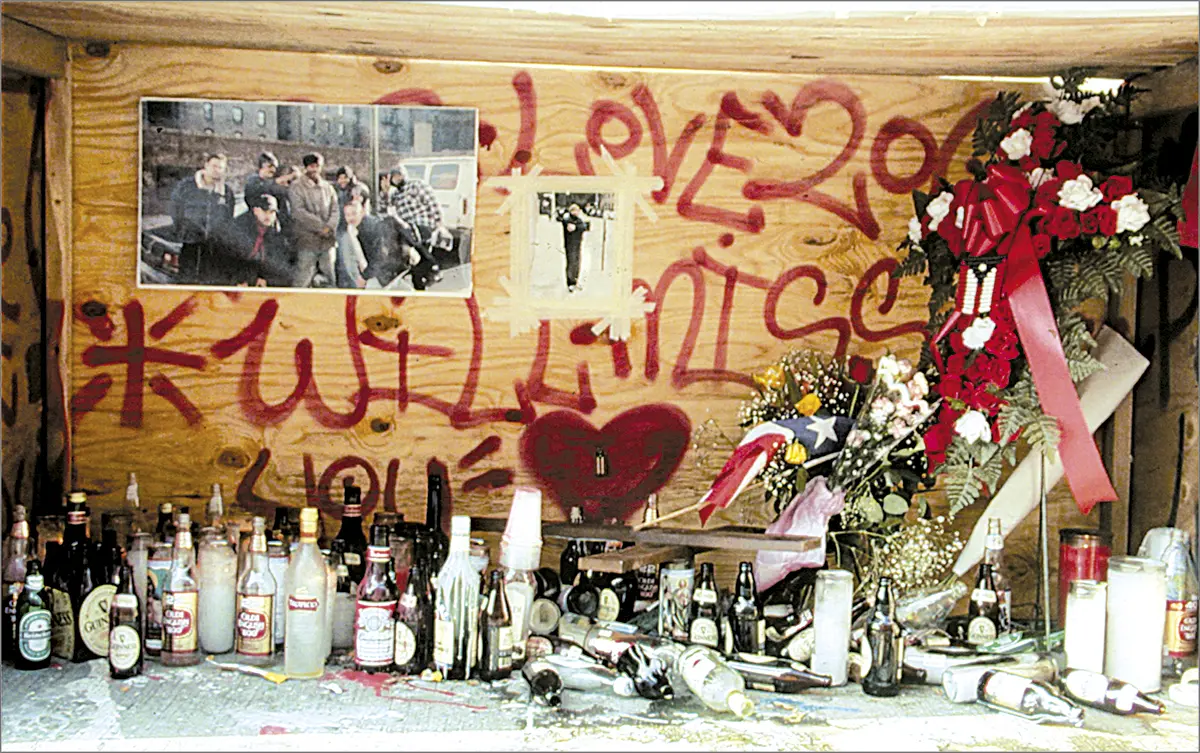
For the past two years, Oleaga has photographed street altars located in his neighborhood of Washington Heights. He realized in the short time that he lived in this mostly immigrant neighborhood that the increase in the number of altars meant an increase in the mortality rate. He also realized that the altars, which he describes as urban still lifes, were impermanent and would disappear over time. The very nature of this transient reminder of mortality made them even more distressing, and the need to document them more immediately. Oleaga's work thus becomes a reflection of his social environment, with its constantly changing sense of turmoil, as well as a tribute to the fallen and the survivor. Fascinated by the arrangements of such ordinary offerings and found objects as empty bottles and toys among candles, holy figures, flowers, and other written personal reminders, he used his camera to preserve these most ephemeral situations and pay homage to his neighbors.
The exhibition at Artspace - Virginia Miller includes images from the artist's first solo photography exhibition in New York in 2001, with the addition of a photograph of an altar dedicated to those lost in the World Trade Center and one that details the altar's candles (Untitled, 2001).
The photographs capture the heartrending and moving responses of friends still searching for their loved ones with messages, pictures, offerings, and personal mementos. They are an anxious plea for answers in the frustrating period of grief and hunt for closure that followed the tragedy, and affected everyone in the nation. Thus, the altar becomes an object for everyone, near and far, whether personally involved or not. In the powerful image of the candles, a detail from the altar, the most commonplace of objects become significant as works of art as well as spontaneous expressions of sorrow that are distorted over time—as are the tears of the anguished relatives and friends who go through their stages of grief. In Sanctuary for Steven, New York, 2000, with its detail Dedicated to Steven, New York, 2000, the altar features cookies, a rum bottle vase with flowers, candles, and a message on cardboard that reads: "From all your Niggas, From the Deuce to the Fifth." The message is especially touching with the words of his most loyal friends, spoken unabashedly in their language. The photographs are huge Flex Prints, some as large as four feet by eight feet. Their size lures the viewer to regard the altar as a real experience in which one must become a participant. Strangers are brought in close to the objects, invited to read the notes, and share in the offering ritual. To further bid our participation in this absorbing act of reverent contemplation, Oleaga also presents photographs that magnify particular details of the objects on the altar to create another group of monumental images that complement the entire accumulation. These descriptions of weeping wax from candles, flowers, and other emotional tributes to the dead, are particularly beautiful and reveal Oleaga's training as a painter with a deep understanding and appreciation of color and composition. His eye for focusing on the altar both as a complete entity and as an object deserving of aesthetic scrutiny serves to elevate his photographs above the mere documentary and place them within the tradition of still-life art. Each object has been placed on the altar as a spontaneous response and will disappear when the altar is dismantled. Dario Oleaga plays the role of the artist who can capture the essence of the humble altar's significance with personal respect, and at the same time preserve each one as a worthy image of art.
CAROL DAMIAN