Juan Carlos Marcos, a well-known artist born in Argentina and a Panamanian by adoption, presented one of the shortest art shows in Panama's history: the exceptional exhibition of his recent works lasted only for one night—or, more specifically, for three hours of its inauguration. It was what Marcos calls a colgada ("hanging"): the works shown are not part of a thematic group, nor do they express a homogeneous concept. But by that very quality of not constituting a defined series, they displayed the variegated character of the artist's work in recent years, which he has spent in Italy.
Marcos sees his art as a lifelong striving for technical excellence, and in that striving, he has created a figurative oeuvre of rich imaginative qualities, reflecting his own cultural baggage and his knowledge of art history. Marcos also incorporates a mordant sense of humor into his works, along with a suggestive sexuality. Through all of this, his journey is yet to find a final destination; despite his technical maturity, he still considers himself an apprentice. He is skilled in the handling of color and the brush, which he does with a proficiency that can only come with experience. His excellent draftsmanship, a skill that contemporary art tends to shrug aside, contributes to giving his works an oldish, classical air. In fact, Marcos largely rejects contemporary artistic expressions, which he sees as extremely superficial, the product of a drive towards instant gratification and of slavish attitudes toward the market.
The more than 30 pieces shown revealed many aspects of Juan Carlos Marcos' artistic personality. The observer cannot fail to be intrigued by the thematic ambiguity, the extreme realism of the details, and the mysterious, seductive characters that populate Marcos' paintings, related to European surrealism. As an example, let's cite the three oil paintings of a suit jacket (the masculine garment par excellence), where the male subject's presence is perceived only through the realistically depicted hands that emerge from the jacket's arms. Those hands, realized in admirable detail, with shadows and color, give greater intensity to the man's absence. In La chaqueta 1 (Jacket 1), oil on paper, a gray woolen jacket hangs on a hanger supported only by a tenuous thread, which bends under the weight of the male symbol—one of the best works in the show. In Camp David, we see a military jacket, intensely blue in color and complete with golden buttons and epaulets; it hangs on a chair's back, within an enigmatic space suggesting wall and floor but composed as a single plane. In the background, an absent fleur de lis has left a white shape reminiscent of a dove, a symbol of peace, whose shadow lies underneath the chair among fallen petals, prompting a reconsideration of the painting's title.
There are traces of masters like Paul Delvaux in works such as Jaque a la dama (Check Mate to the Lady), where three men in suits, ties, and bowler hats surround a magnificent female nude, occupying spaces in a room that resembles a three-dimensional chessboard. In a world where everyone has a cubicle, Marcos presents men as gray figures in business attire, and women as purer, more mysterious characters: here she is bald, her head an oval, her skin fair and luminous, her lips and ears a pink hue. With the artist's characteristic ambiguity, this woman is more real than everything in her surroundings, yet she is absolutely ethereal, almost ghostly.
The presence of women in Marcos' work is a worthy topic for a separate, longer essay. In his recent show, he exhibited a series of paintings depicting a small, doll-like girl in old-fashioned clothes, standing on a Thonet-style chair, quoting what seems to be a 19th-century photograph. In another group of large oils, he offers female faces in black and gray hues; these portraits are frontal, strong, and challenging. In ...Y fijó la mirada (... And She Fixed Her Gaze), the alluring visage of a woman who seems to have emerged from memory appears crowned by a large black lace hat; it takes a while and a second look to realize that instead of eyes, she has hexagonal bolts, painted with an impressive realism that captures the cold reflection of light on metal as if behind the face there was only emptiness. in Blue Eyes, the figure's eyes are formed by what seem to be bullet holes on a tin skin. Finally, in Smile, in place of a woman's mouth, we see a small rectangular bronze plaque, perfect, polished, and shining, with the word SMILE inscribed in it.
Less successful is the similar use of a bronze plaque in Mail, a not-too-interesting oil painting depicting a chicken who fancies itself a carrier pigeon. This figure covers almost the entire plane, and on its side, we find a bronze slot similar to those used for mail deliveries; on the bronze slot, we read the words "mail" and www.com, the latter in reference to the internet and to globalization. The message, however, is lost, and this ends up being among the lesser works in the show.
Marcos' ironies about popular images of beauty or modernity are in part derived from the world of advertising, to which the artist devoted several decades of his life. Also, in recent oils, there are explorations of public and historical figures, as well as references to newspapers, events in the news, and the world of politics. In Saturno democrático (Democratic Saturn), Marcos presents a large open mouth about to devour small paper figures of men, in an obvious but modernized quotation of Francisco Goya's famous Saturno. In Prensa libre (Free Press) there's a shouting mouth in a female face, whose dismembered arms, unattached to the body, are forms in torn newsprint, seemingly affixed to the canvas by two more of the artist's favored hyperreal screws. One of the clippings is in Italian and the other one in Spanish, and in the latter one we distinguish the words verso, perla, plu..., fragments of a Rubén Darío poem. The darkened extremes of a horizontal and a vertical line suggest the crucifixion of the free press, a critical issue in Panama and the world, in a work that also achieves aesthetic meaning.
Political history provides the source for a dual portrait of Sacco y Vanzetti (Sacco and Vanzetti), the Italian anarchists who were the victims of a famous and unfair trial in the 1920s in the United States, which in turn occasioned a global protest. Marcos paints them against a white background formed by what appear to be panels nailed together. Their eyes, peeking out of hats, are dark, and the outlines of their faces are left incomplete. The mouths are only insinuated in the faces of these men who were silenced by the electric chair, in an act acknowledged decades later as one of the US judicial system's greater errors.
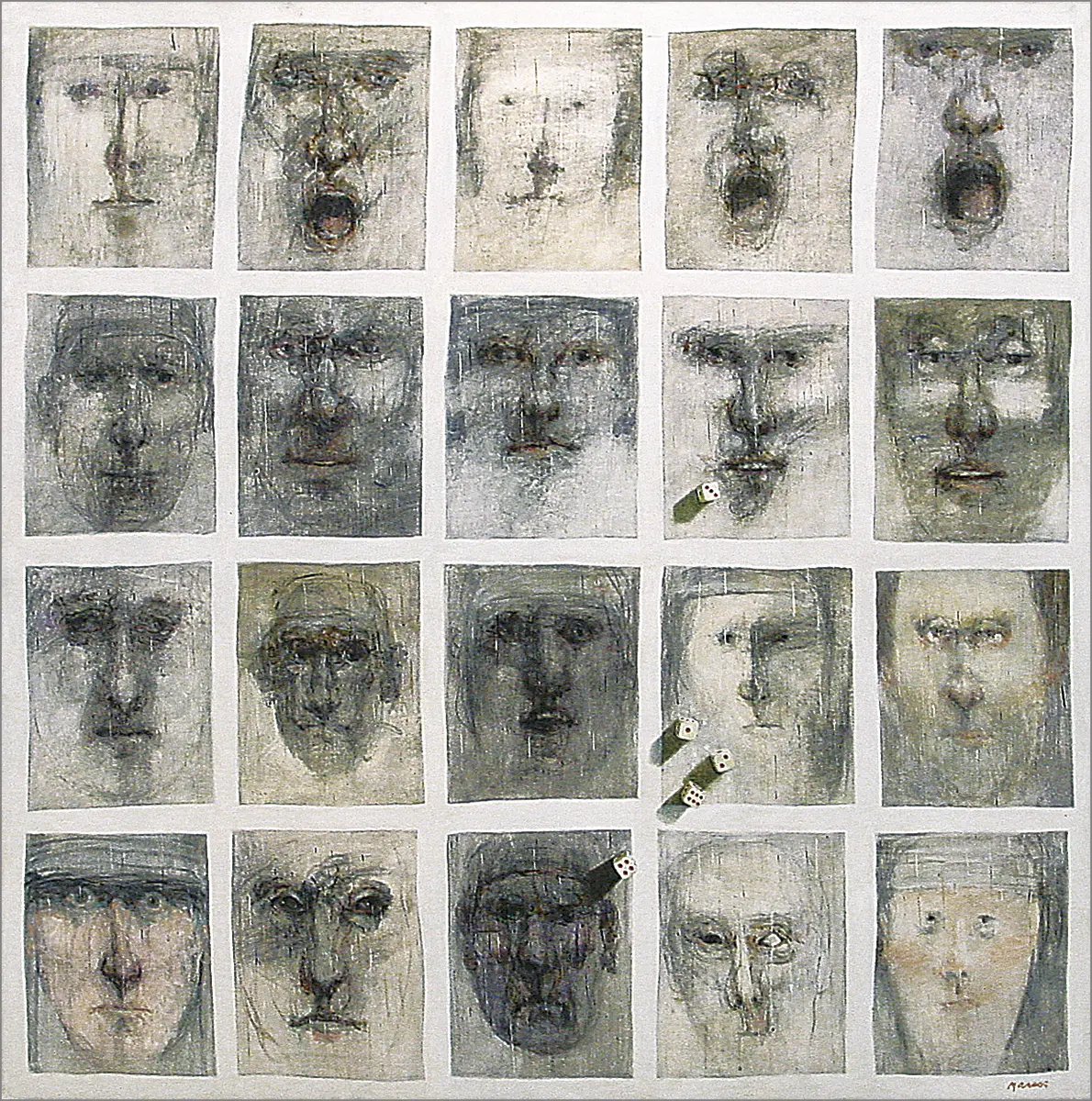
Luck and justice are also the subtext in ¿Quién es Giuseppe Rinaldeschi? (Who is Giuseppe Rinaldeschi?), without a doubt among the most impressive oils in the show. It is a large composition with a white background divided into 20 smaller squares, where Marcos presents male faces in gray, black, and light pink, ranging in expression from contemplative to emotional distortion, and even despairing screams. In a typical gesture for Marcos, who is constantly reminding us that the whole illusion is nothing more than a canvas, we see also five painted dice, very realistic, throwing their shadows on the painting's surface, thus turning into a game table. The title refers to the story of Rinaldeschi, a 16th-century Italian who, after losing money and clothes in a betting game in a Florence tavern, encounters the Virgin Mary in the public square; enraged and furious, Rinaldeschi picks up some horse manure from the street and throws it at the Virgin. He ends up being shunned by the citizens and sent to prison and later is hanged for his offense. As in the Sacco and Vanzetti painting, Marcos uses a historical anecdote as a parable to comment on situations created by men and the ways in which Justice is manipulated. Even without knowing the story, however, this oil painting generates a feeling of solidarity and an unmistakable humanistic message, especially in the way in which we are confronted by the faces' expressions, including what seems to be a self-portrait.
Beyond the fascinating opportunities for thematic analysis in these works, Marcos' production continues to be distinguished by the moments of purer pictorial pleasure it achieves. The series of works titled Superficies (Surfaces) shows details of textured walls where Marcos inscribes washers and knots, bolts and nuts, and even imaginary orifices where supposedly there were screws. In the huge urn of Jarrón de Oviedo (Oviedo Vase), we see the fasteners of a woman's corset supporting the marble. The artist tricks the eye with trompe l'oeil exercises in ambiguous compositions that make us doubt reality as we understand it, while at the same time transmitting ideas about human values. He incorporates humor and sexual innuendo even in stone and metal.
MÓNICA KUPFER