In his first New York solo exhibition, Juan Céspedes presents fifteen recent works that explore high-tech concepts with low-tech materials. His multi-media installations reference video games, satellite transmissions, and computer imagery, playing upon our expectations of technology-based processes. Using simple recyclable materials, Céspedes builds homemade devices that investigate such scientific ideas as the moving picture, color theory, and visual perception.
Céspedes, a native of Santiago, Chile, presents creative solutions to the "throw-away" culture found in contemporary urban societies. Recycled items such as an upturned umbrella metaphorically become a satellite dish, while plastic lids from bubblegum packaging are transformed into reflective prisms used to explore optical effects. In Bee Eyes I, Céspedes places these small prism-like pieces on a turntable above colored paper creating a kaleidoscope of moving color and refracted light. In Thunderbirds II, pixilated imagery is simulated using large pieces of colored paper on a gallery wall. By looking through a small lens from across the room, the viewer can perceive what appears to be a "computer-generated" image of a fighter plane. Using simple items such as prisms and lenses, Céspedes's works expose the limits of human perception while promoting the experience of optical phenomena.
There is a youthful sensibility to these pieces that makes one think of an adolescent inventor or a high school science project. In his Fresnel paintings of 2002, Céspedes designed lo-tech cartoon animation using rudimentary compositions of ribbed plexiglass over colored ink drawings that change depending upon where the viewer is standing. These "animated" illustrations are playful, and range in subject matter from a depiction of a newscaster reporting a bombing to a Game Boy and a go-kart crash. In Self-Portrait, the image transforms from a full body in profile, to a frontal portrait, to a partial view of the eyes and the head.
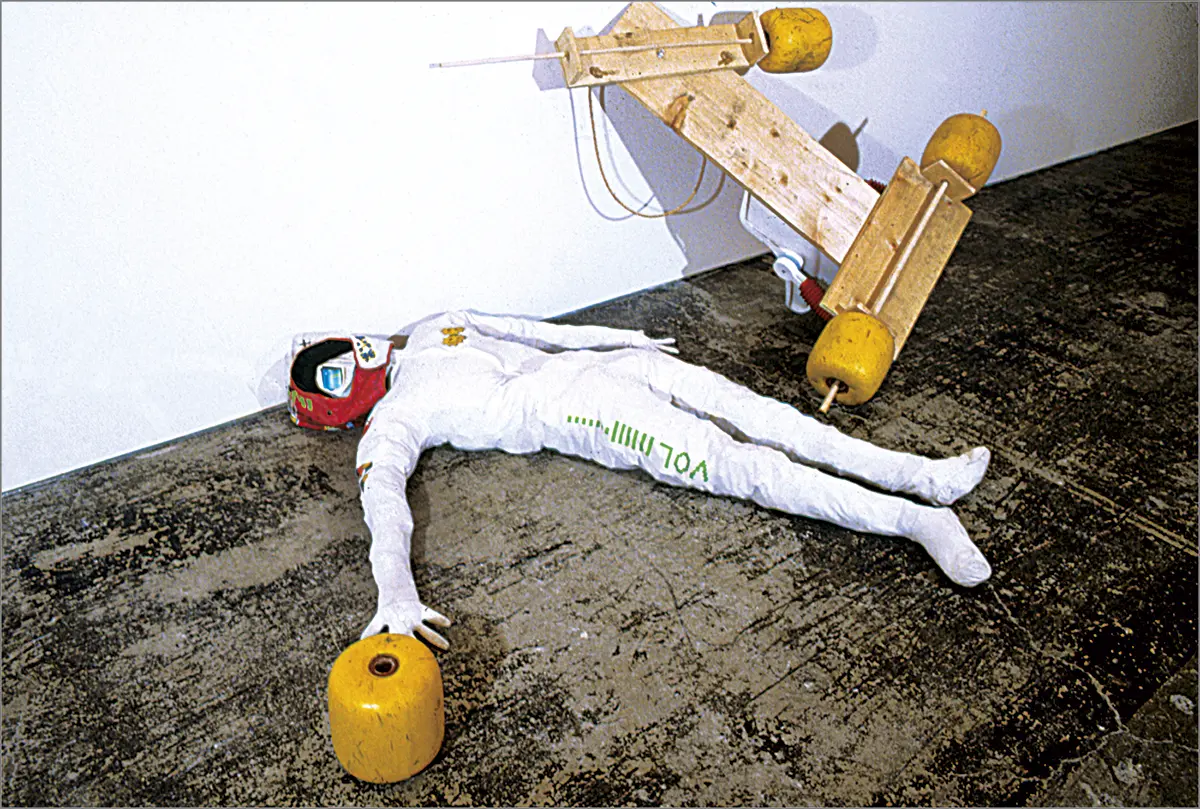
Other works that incorporate video tend to have a more aggressive edge. In Trying to Get Somewhere Almost Without Gasoline, 2002, Céspedes stages a scene using a broken go-cart and a lifeless figure with a video screen for a face. The scene suggests the site of a car crash, yet the continuous filmic imagery simulates the experience of driving, blurring the distinction between thought and action, between the real and the virtual. The human figure is substituted by a crash-test dummy and the human experience is seen through a DVD screen—life is comprehended through machines and cyborgs.
Céspedes' clever juxtapositions of high-tech video monitors with rough and flawed constructions underscore the man-made quality of technology and the artificiality of the technological fantasy. The artist calls attention both to the uniformity of manufactured technology and also to the human effort that lies at the heart of its production.
His irreverent and experimental style caught the attention of curators last year at La Panadería in Mexico City where he presented Inside, a video that depicted the artist crouching within the borders of the video monitor. His work incorporates the human element back into the technological world and demonstrates that although access to these systems is not universal, human ingenuity can generate alternative media with a surprising economy of means.
CHARMAINE PICARD