Leonel Matheu's recent show at Elite Fine Art Gallery summarizes the work done so far by this artist, a possessor of a personal style that combines elements derived from his education as a designer and elements from painting proper. This is why, above all, the most striking element in each piece is its composition, the placement of figures within the frame, and how Matheu structures and resolves elements such as buildings, weapons, ships, etc., represented in a very graphic way. Matheu's forms acquire infantilized characteristics and features due to the synthesis his entire iconography is subjected.
Fabulation is the content that organizes and supports Matheu's poetics. The artist attempts to turn every painting into a story, and in turn, each painting can be read individually or as part of a group, as in the case of this show. Matheu wants to create and describe images that bring childhood to memory, through easily recognizable symbols of that age. In his work, colors are convincingly worked in ample areas that are perfectly delineated in black. He turns to the imagination, making it unnecessary to find one reading for each element; there are keys to access a language that makes use of signs and symbols. The constant is a tiny human figure, who at times works as a connecting vessel and appears submerged in apparently uncontaminated environments that subsume him completely. Each fable is conceived as a discourse on the environment, the technological world, and the increasingly insignificant place that human beings occupy in the developing postmodern industrialization and the coming to pass of worlds only conceived of in science fiction. This, along with the formalized language, results in appealing works and a comment on environmental issues as if from a very basic point of view, such as that of a child—a sort of metaphor, if one takes into account the notions of purity, innocence, and absence of corruption that are associated with children. Centering on childhood also allows Matheu to use the same weapons and to establish coherence between his intended message and the direction in which he wants us to look, in a language that is easily recognized by all. The apparent simplicity of Leonel Matheu's proposition is nonetheless surprising, facing us with issues we don't hear about much, and forcing us to become aware, if for an instant, of things that surround us in our daily lives and to which we have become accustomed to the point of obliviousness.
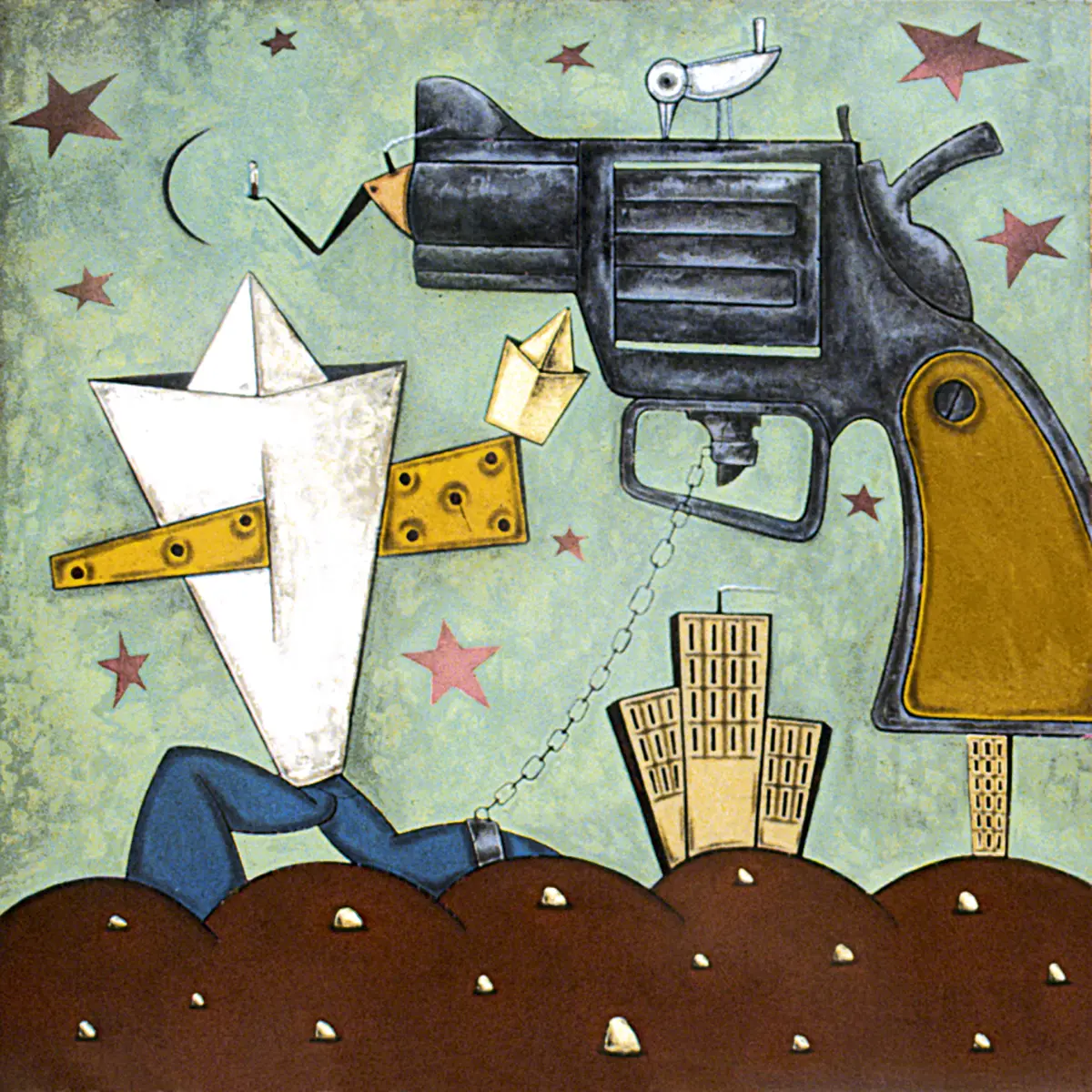
The tensions generated by contemporary society, derived from industrialization and modernization, are exemplified by firearms, a powerful element that takes center stage in When the Moon appeared. Here, a large pistol is chained to a man, and from it emerges a strange figure with a small, moongazing human character in its hand. There are also buildings with chimneys, and their counterpart, several ship-icons representing a greater innocence, a more natural state of being for humans. The opposition of buildings to ships seeks to generate a dialog of coexistence, to forestall extremes that would endanger humankind's very survival. The artist displays a commanding need to achieve equilibrium, and his discourse attempts to make us realize that such equilibrium is indeed necessary. He does not advocate the negation of development, but an increased awareness of its use.
The works' titles help us formulate specific readings, as is the artist's intention. Coexistence, Cohabitation, and The Doubt of Infinite are some of these titles, and they speak to the relationship between the individual and society.
Leonel Matheu is stricken by the direction the world seems to be going in, by the technification and pollution of the environment, and by the pitfalls and dangers that surround us. His works want to explore the spiritual in each of us and to do that appeal to our most cherished experiences. In Matheu's canvases, an alternative is posited, real, and necessary even if it seems hokey: we can see the stars, the Moon, and the comets. Matheu's painting is an art that wants to discuss daily issues, without any interest in returning to a world without the benefits of progress but with a forceful call for the use of reason in our interactions.
MARISOL MARTELL