
The fantasy worlds that Argentinean artist Marcelo Pombo paints are whimsical landscapes in which the abstract and the representational merge. The brightly colored, highly textured, and detailed works combine geometric forms with natural elements like trees and planets in an imaginary setting. In each of the twelve enamel paint-on-panel works in this exhibition, appropriately titled Paisajes fríos que hierven (Cold Landscapes that Boil), Pombo depicts the unexpected as if it could exist. Fuzzy but empty street signs, swirling planets, rectangular-shaped leaves, purple skies, and yellow horizons occupy his uninhabited landscapes. The lush surfaces are charged with energy. Each painted dot vibrates and commands the viewers' attention.
Pombo's paintings are made up of repeated geometric forms: a pattern of overlapping circles and rectangles. Out of these simple forms, Pombo creates deep and wonderful spaces. By limiting himself to a vocabulary of colorful shapes Pombo transforms the flat surface into a dynamic environment. These are escapist works that depict fantasy worlds. Each element in Pombo's paintings is, upon close examination, a detailed abstraction. The closer one gets to these paintings, the more one sees. Millions of colored dots and sketchy lines make up the foreground objects. The backgrounds are broad horizontal washes of contrasting colors that define the area where the sky meets land. Each painting has a clearly articulated horizon line, yet the colors of the sky and ground are not based on reality. The settings of Pombo's paintings juxtapose ideas described in science fiction fantasies with the recorded beauty of the undersea world. He combines plant forms and celestial bodies with hard-edged geometric shapes. All the elements dance on the painting's surface. Taking cues from the desert landscape, the night sky as well and the underwater world, Pombo creates paintings that could be interpreted as dreamscapes and might be described as fantastic sunsets on a strange and distant planet.
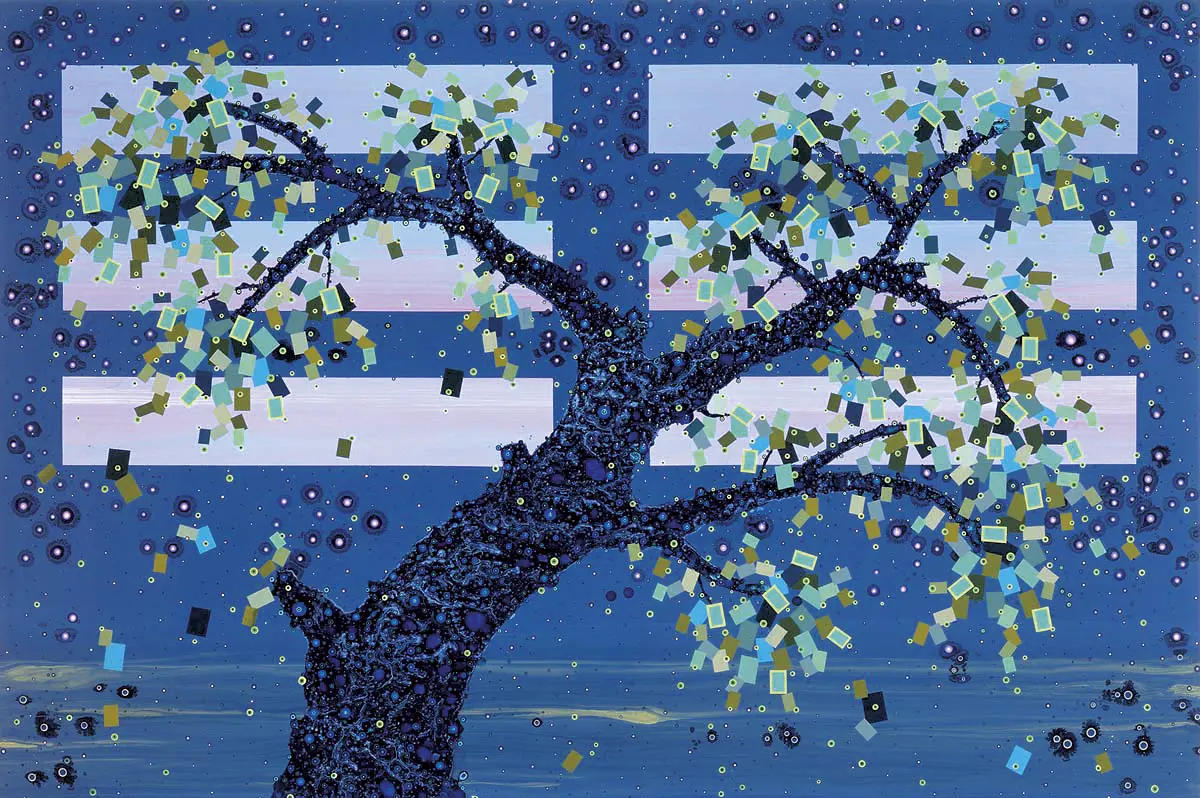
Although Pombo's works reference the Surrealist landscapes of Max Ernst, Salvador Dali, and Giorgio de Chirico, where forms often have contradictory functions, they are less about bringing the unconscious to life than they are about describing a new world. In the painting Árbol viejo (Old Tree), for example, a tree is drawn into the glistening layers of enamel paint that swirl across the surface. The knotted form of an old tree is given a new life in Pombo's painting. The tree now has bright blue, green, and yellow rectangular card-like leaves that dangle from its branches. It is set against a deep blue background that represents a sky that has been filled with ambiguous purple rectangles and floating dots of color. The painting describes the potential for both order and chaos in nature. Similar ideas are investigated in Planetas sobre el horizonte (Planets Over the Horizon) where bubbling circles representing an array of planets populate the night sky. Each disc is a dynamic cluster of drips and lines and transparent layers of paint. Some appear to pulsate, while others begin to penetrate and flow across the foreground leaving a trail of painted residue.
Pombo's titles often refer to the natural landscape or to interventions within that space and his images use that ground as a point of departure. In Acueducto (Aqueduct), one can imagine the grid-like structure within the painting as a carrier of phantom liquid. Similarly in Noche en el mar (Night in the Sea), a waterfall of light blue liquid cascades from a planet that hovers above a roaring sea. The elements depicted in his paintings might be modeled on the observed but they are always transformed into a boiling abstraction. In Dos mesetas, two black table-like forms, covered by a lattice of bubbling blue and white dots occupy the foreground space. Two orange horizontally orientated planks float above them, a dominant and perhaps threatening presence in the purple-colored sky. Is either of the rectangular forms alive? Where are they going? How do they relate to each other? In essence none of this matters. We can create any narrative we like. All that matters in Pombo's paintings is how the forms coalesce on the canvas at the moment they are depicted. Pombo's animated works invite viewers to leave reality behind. The who, what, where, and when become anything we want them to be upon entering into Pombo's fantasy world.