Kid Kapicúa (Palindrome Kid), Marcos Lora Read's show at Carmen Rita - Arte Actual, intrigues with its title and surprises with its sole topic, boxing. Our progressive discovery begins with Púgil (Boxer), a heroic portrait in black and white, perhaps evocative of Joe Louis. Indeed: in twelve "rounds" — twelve pieces and multimedia works — the Dominican artist pays homage to the legendary American fighter, to his story of triumphs and misfortunes.
Marcos Lora Read likes boxing, but his motivation here goes beyond mere personal interests. Even as he explores, like almost every artist, existential and intellectual referents in an autobiographical vein, his introspective faculties project themselves towards others, towards the collective, towards history and society. His smiling figures, strange and fascinating, are a call to human conscience.
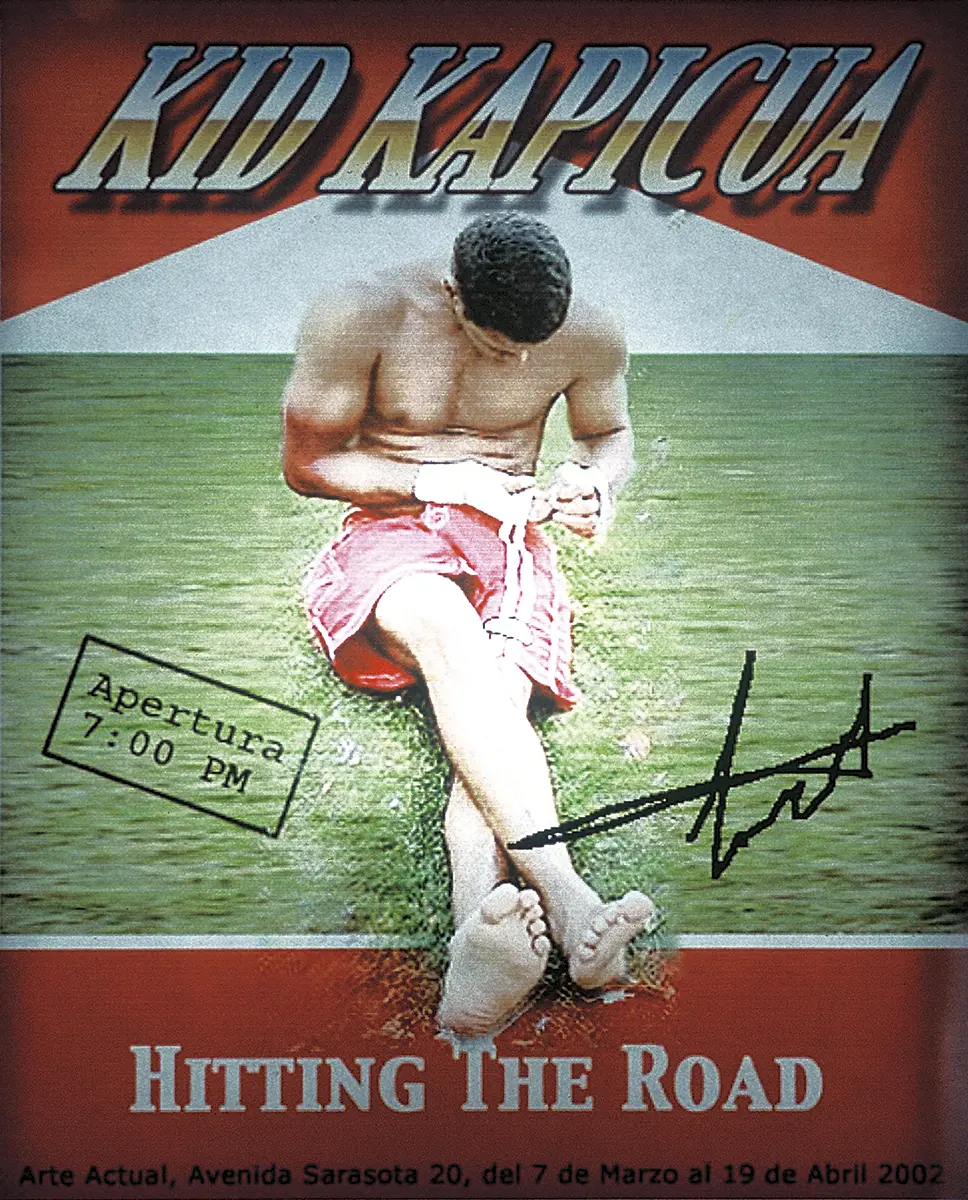
In his first individual show at a private gallery in the Dominican Republic, Marcos Lora reiterates a commitment made years ago: "in accordance with my desire to escape the puzzles of history, a history that's still being written by the victors — I am just a chronicler of my times, times that I face contemporarily and with due responsibility."
Continuing with his saga of colonization and slave commerce, Lora evokes here a different kind of slave — equally black, equally exploited, used and abused for his extraordinary strength, a victim of racism and injustice. Lora brings Joe Louis (a "harder hitting" name than his given name of Joseph Louis Barrow) back from boxing history's arcana, from prejudice and persecution. The boxer, then, is resuscitated.
Few shows boast so much coherence and such a sustained handling of metaphor. Marcos Lora is a figurative painter of expressionist leanings, but one who has not left realism behind. Stubbornly contemporary, he feels free to retain different aesthetic options. From those who would pigeonhole him as a sculptor and installation artist, he asks now a widening of criteria: Lora loves painting (he has shown works in this genre before), and he is intent on showing that a certain dose of academicism has a place in contemporary art...
In four large-sized acrylic works, Lora recreates offense and defense, punch and counterpunch, throwing hooks and uppercuts with a dry stroke on the canvas. In fact, his canvas, tied with ropes to the frame, can be seen as a ring. Something that seemed merely testimonial and traditional, acquires a new relevance. This is the well-known Lora Read wink to the public.
The most impressive painting, Peatón cruzando al paso de cebra (Pedestrian Crossing a Zebra) (a title to be revisited later, under penalty of greater confusion), presents in the foreground a large bird, almost like a poster; in the background, we find the boxers, sketched. Birds thus return to Lora's work, fallen, caged, victims of stupid and cruel aggression. Nevertheless, birds have not taken over so much space before, and they never carried so much symbolism, as fleeting witnesses or aggrieved victims... like the boxers in the enjoyment of the spectacle and the frenzy of betting games. It is difficult to stop looking at this work.
Marcos Lora reaffirms his passion for objects, not limited to a simple duchampian placement in space. He is not after the mythification of the object, nor does he seek to alter it: his intervention, or reinvention, attempts to make it blunter, more effective. There is the boxer's paraphernalia, the almost archaeological vestiges, and artifacts: the jumping rope (an exquisite piece), the mouth protector (amplified, bloodied), and the towel (thrown?).
Two well-realized constructions point out Lora's roots in sculpture. One is a chair done in sheets of crystal (the only piece exhibited before), which materializes the climax of seduction and vulnerability. The other one is the show's central piece, a punching ball in mahogany wood, minutely carved, emerging from the wall as if a lowered head with two small, open eyes. Here, humor gives way to drama.
In a small number of works, in formats that range from medium to small, Marcos Lora Read, who previously presented monumental pieces such as La calimba (The Branding Iron) in Havana and El puente colgante (Hanging Bridge) in Barcelona, projects now the main branches of his artistic production: drawing, sculpture, assemblage, object, installation. This discretion, in accordance with the space, allows you to savor each piece in the show.
María Lluïsa Borràs has seen in Lora Read's work "a kind of art that addresses the aspirations and frustrations, the pain and nostalgia of today's men and women." We are faced again with that ontological and social proposition, and it wouldn't be out of place to understand the boxer — triumphant and beaten up, mistreated even in victory, forced to win at any cost — as a metaphor for the artist's condition of uncertainty about the future. Marcos Lora condenses the history of his class, its challenges, and risks, through the figure of the boxer.
Successes, honors, and the market's favors — these all leave artists exposed to incomprehension and biases, to the sting of criticism, and to his own decay, just like in the case of Joe Louis. The famous heavyweight champ, however, defended his title until the edge of retirement, over almost 12 years, in 25 title bouts. To resist 25 large exhibits is perhaps a similar accomplishment for a painter. The meaning of Kid Kapicúa remains open: Marcos Lora Read invites us to see, think, and remember.
MARIANNE DE TOLENTINO