
A series of 15 graphite-on-canvas drawings is what Cali-based artist Miguel Böhmer presented at Bogotá's El Museo Gallery through April 13. In these large-format pieces, Böhmer conferred a protagonist role to figures of animals, either in full or as anatomical details of cow, deer, dogs, and lion limbs.
Each one of these canvases is an exercise in impeccable drawing, where witnessing a realistic but ambiguous image is enough to hold the spectator's gaze for a long time. On the one hand, the spectator is captivated by the drawing's technical excellence, which the artist has transferred to huge canvases with a special emphasis on detail—each muscle and hair defines the animal's contour, making it recognizable. On the other hand, we are invited to a contemplative analysis of the hidden worlds found in a goat's or a deer's hoof. Light and shadows in the animal's skin reveal an unknown corporeal quality that needs to be explored. The cave-like spaces in a hoof are organic grottoes Böhmer adds to our inventory of daily images. There is a meditation on things that have always been present but we have never really observed.
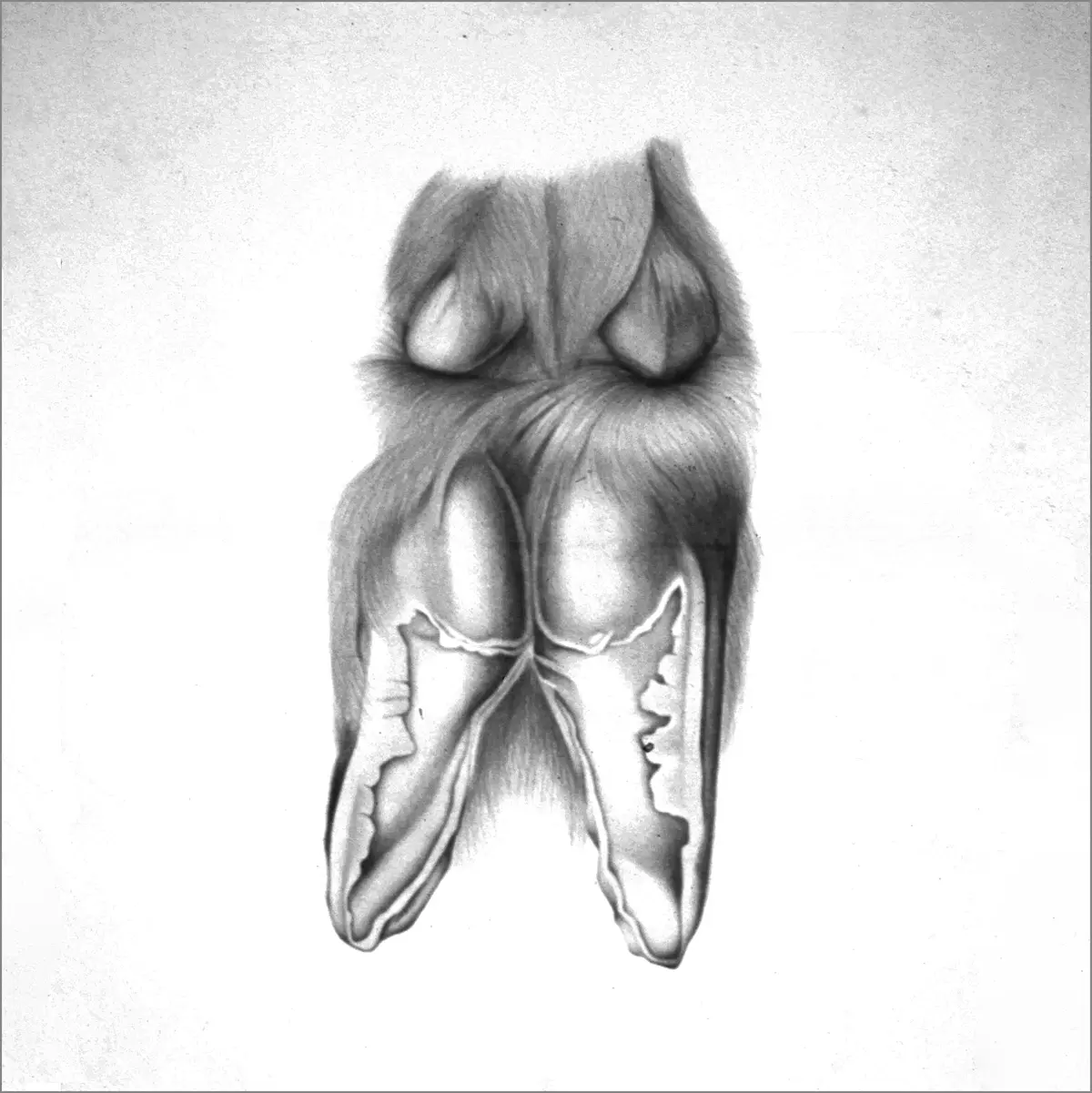
With an almost photographic intention, Böhmer captures a living material reality and transforms it into the object of his anatomical analysis, inscribing it in a two-dimensional plane. The animals, in profile, seem to be posing for the artist. In their stasis, they reveal physical features in the same way classical portraiture does, inducing the observer to seek referents in order to identify a face. In this case, what is identified by the gaze is the familiar animal. But the artist's exploration goes beyond this: he attempts to clearly establish the differences between the images. Two drawings of cows are shown on opposite walls, facing each other. One is a Holstein, the other one a Jersey. They differ in particular details, thus becoming individuals independent of each other. The same happens with limbs belonging to animals of the same family, such as mammals: they are marked by their distinct features, such as a lion's soft coat of fur or the bony, geometrical rigidity of a deer's limb.
The pieces' disposition in the gallery plays with a logical ordering suggestive, to a degree, of scientific reason. It is not surprising, then, to find out that Böhmer has based his drawings on an early 20th-century animal anatomy tome. The unframed canvases suggest the sheets of paper used by a scientist to sketch observations and acquired knowledge, which the artist reproduces and complements with new conceptual options at the level of perception and image analysis.
Böhmer has long been interested in keeping his work open to multiple readings. In previous works, he achieved this through the superimposition of diffuse images of characters in different situations. Also, his titles have always pointed in this direction. In the present series, the images are very specific, and they are titled with simple descriptive words: hand, hoof, limb, lioness. The only exception to this emphasis on clarity is the show's general title: La bondad de la belleza (The Goodness of Beauty). Beauty, in this case, could reside in the act of discovery, and goodness in the fact that such discovery is possible everywhere. The artist captures our attention with his findings and invites us to explore our natural surroundings, of which he has taken only a very small portion.
MARÍA JOSÉ RAMÍREZ