
A promising new gallery in Santo Domingo inaugurated its exhibit spaces at the same time as the inauguration of the IV Caribbean Biennial. The gallery's director, Carmen Rita Pérez, lent her name to the space, labeling it "Arte actual" (Current art). Preceded by a personal trajectory in the Dominican art circuit, Rita Pérez has surrounded herself with a young yet experienced staff, leaving nothing to mere intuition.
The gallery's first months of activity offer reason for optimism: the exhibition spaces are beautifully simple and versatile, high-quality shows have been presented, and the program has included panel discussions, children's workshops, and seminars. Also, the new gallery has been in continued contact with the Museum of Modern Art as well as other galleries, artists, critics, and the international circuit, all of which point toward a future of sustained openness and inviting quality.
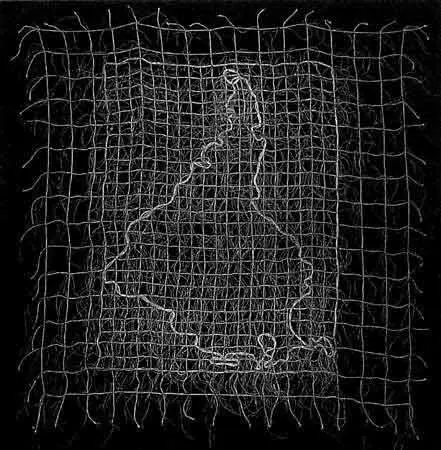
Milton Becerra is the first artist to present an individual show at Carmen Rita - Arte actual. Becerra has lived and worked in Paris since the 1980s, but he maintains a connection with Venezuela, his country of origin, and his works have been exhibited in Europe and Latin America, making him a fixture in important international events. I met the artist many years ago and admired his "arms" period, his work in ceramics, and his stones. But we only saw each other again on the occasion of his recent show in Santo Domingo.
Circumstances erase the time passed, and I have rediscovered Becerra in his language, his signs, his materials, his images, his works... all of them almost unpredictable decades ago. Yet, the polyvalent nature of his creative processes, his unquenchable curiosity, and his complete sincerity as an artist are still there, as they have been since the beginning of his career; in fact, it is with them that he weaves his "magic carpet."
Indeed, there are more than 20 magic carpets here—neither horizontal nor flying but belonging to a different kind of magic. The more we contemplate these transparent pieces in different sizes, woven with obsessively tied threads, discreet in their cream-textured colors and their dark blue hues, the greater our fascination becomes, and the possible readings multiply along with the thoughts provoked by them.
The first thought arises from Becerra's interest in ancestral, indigenous roots, which results in a form of contemporary art that's linked to the past, to a legacy evoked and sought after in successive stages spanning from the artisanal processes and crafts to the mythologies of the bird, the jaguar, and the serpent. Exploring his indigenous ancestry and the ancient Chibcha culture, Becerra created masks, breastplates, necklaces, weapons, and ceramic pieces, and he has developed a passion for the weaving arts.
Becerra's textile sculptures could in past times have been one single piece displayed in space, a kind of mythical "hammock," a hanging installation: they possess a subtle sacramental undercurrent. But they ended up in the shape of these magic carpets suspended in the air, offering their gracile seductiveness, immaterial and insidious at the same time, as they hang from the ceiling. If we look at them frontally, they are open webs, live schemata, and figures of thought; in profile, they become minimalized into a strictly vertical line. But this contrast is not enough: the pieces redouble their visual and formal effects with the power of their own shadows on the wall.
Becerra, however, does not limit himself to resuscitating old myths and ceremonial idols or sacred animals, such as the bird and the jaguar. A man of his time, his work is marked by contemporary myths and events. This is why, as a symbol and an interrogation of global culture, he uses the figure of Mickey Mouse to crystallize a new, "inevitable" mythology that spills from the universe of children's images over the whole culture and its products, including art.
While encountering this Mickey takes us by surprise at first, we soon become familiar with him and let ourselves be led by his image, less a representation than a recreation thanks to Becerra's clear conceptualization and skilled technical execution. The ludic element generates a playful empathy in the viewer, a game of contemplation. There is no demystification or "de-Mickeyfication," but an epochal reference and a divertimento, brought up to the level of the highest art. Perhaps the question behind this is "Why not Mickey?"... All of this derives from Becerra's free inspiration, his interior enjoyment, evident throughout his oeuvre, as the artist himself has stated.
We witness the perennation of the imaginary character, magnified in Happy Birthday, where the World Trade Center's Twin Towers, tiny beside Becerra's Mickey, have acquired after their physical destruction a strikingly memorialistic nature. Two symbols of the same civilization, with different histories: one continues on with its comedy, and the other was destroyed in tragedy.
Another imposing work—I feel uncomfortable using the words "carpet" or "tapestry"—is titled Estatua de la Libertad (Statue of Liberty), and its particular intelligence motivates a wealth of possible readings. Here, the Twin Towers occupy almost the whole space, flanked on both sides by two toy-like airplanes and the Statue of Liberty; we find the latter only after searching for an element correlating to the piece's title, which in turn correlates to the terrorist attack of September 11, 2001, a complex metaphorization of the Statue of Liberty. The proportions and the scale are realistic, and the piece is strikingly effective, its own material fragility suggesting the vulnerability of monuments that are usually thought of as indestructible.
Each one of Becerra's carpets would merit a detailed individual analysis. We should mention here his upside-down Western Hemisphere in Homenaje a Torres-García (Homage to Torres-García), referring to the Uruguayan master's well-known drawing of 1936. It is also worth noting the extraordinary Símbolo Madofedi (Madofedi Symbol), formally abstract and distilled example of so-called Latin American sensorial geometry. Mesa de cristales (Table of Crystals) is a unique work, a confluence of furniture, painting, and masterwork, a true "mystery" that forces us to wonder what lies beneath, hidden under an organized web of fibers.
Milton Becerra enjoys the manipulation, combination, braiding, and knotting of his materials, and we respond with our own enjoyment. Natural fibers predominate, in the indigenous textile tradition. When acrylics are to be found, as in Puerta a las estrellas (Portal to the Stars) and the cosmonaut figure, the synthetic character of the material carries a connotation of technological times and spaces.
Becerra's works do not block space or light; they absorb them and then incorporate themselves into them. His planes are visual, but the materiality-immateriality evolves according to the thread's width, which sometimes is as thin as a sewing thread. Another solution is found in the superimposition of two separate layers: the first one is a simple grid and the second one bears the design, a method that emphasizes the work's composition and internal rhythms. Variations abound in Becerra's work.
Becerra was a disciple of and has worked with Carlos Cruz-Díez. Certainly, with the great Venezuelan master by his side, Becerra has developed his personal talent and temperament, founding his art on a different emotional geometry and on personal optical effects, on an economy of color—here "Reveronian"—, and on an attitude towards people and art that is full of generosity, respect, and optimism.
Santo Domingo has adopted Milton Becerra, and Becerra has adopted the city: he came back after ARCO, to everybody's surprise and satisfaction.
MARIANNE DE TOLENTINO