
I have followed Mónica Meira's artistic career, and I have always been impressed by her careful, clean work. Originally, she concentrated on objects, especially clothing items, among which her designs, often based on nature, are particularly noticeable. Later came her exploration of characters, above all those beach-goers who appeared in a peaceful state of being, evidently pleased with their surroundings. Some of these paintings brought to mind moments in the history of art and its constant dealing with both female and male nudity. It wasn't difficult to be reminded of such an admirable work as Seurat's Bathers at Asnières. From these early-1990s paintings emerged Los inmigrantes (The Immigrants), and practically all of Meira's current works. In her series depicting those travelers that arrive in a new country with hopes of settling down but without any guarantees about the future, the artist reiterated small figures surrounded by water, characters alone or in groups that seemed lost in a wide, limitless watery space. These paintings and prints had a clear romantic connotation and invited us to think of the feelings of disquiet, melancholy, and solitude that permeate the works of Gaspar David Friedrich. Since the late 1990s, it is no longer water that surrounds Meira's small, anonymous human figures, but land and mountains.
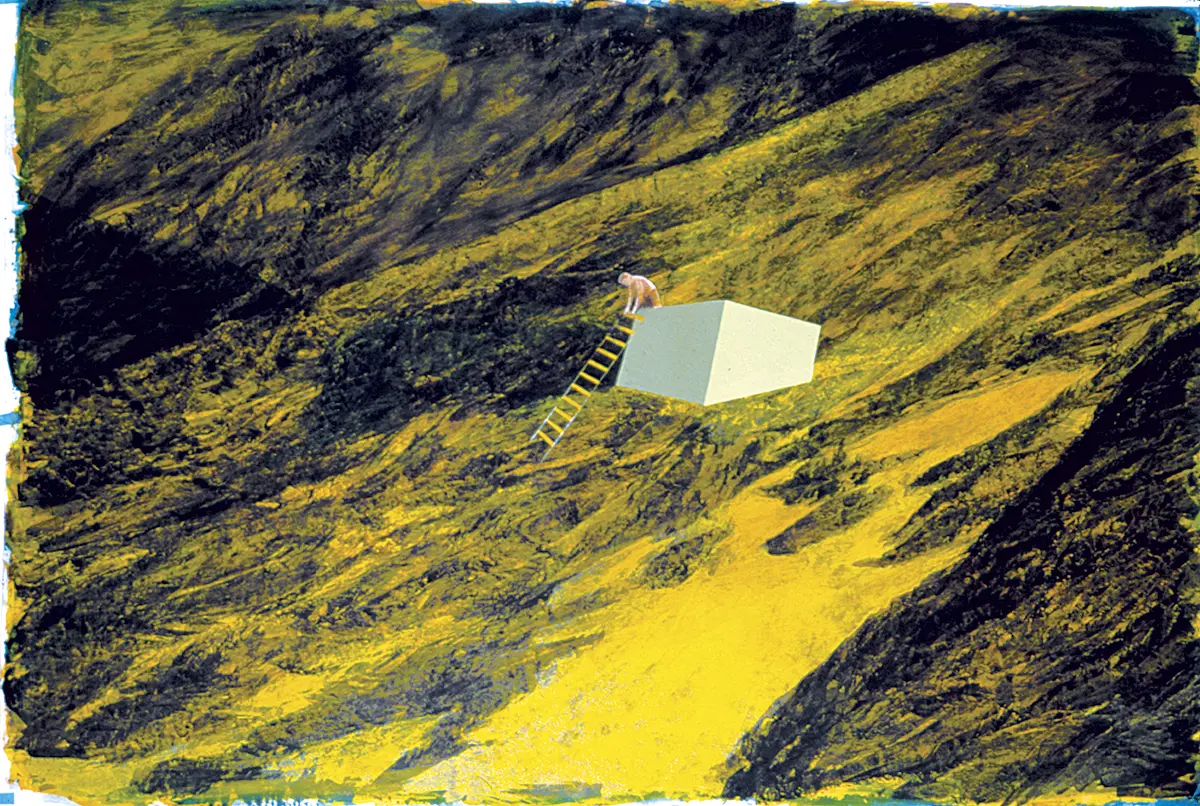
Meira's show at Galería Diners, held between April and May, comprised a number of acrylic paintings, some of them in large formats. They demonstrated that Monica Meira's work, while insisting on her themes, continues to gain in audacity and quality. Active for more than 30 years, Meira is in full maturity as an artist; her paintings, drawings, and prints have been long acknowledged as serious investigations, but her most recent work achieves greater levels of excellence. With a single exception, Meira's landscapes—her dominant images continue to be of this sort—leave aside the sky, focusing instead on a terrestrial vision dominated by inclines, and where, on occasion, the composition would seem to be installed on a vertical plane. The surface of her canvases is covered by visible brushstrokes that converge and mingle forcefully in different directions. Her colors are intense, arbitrary, and in most cases unrelated to those of nature. The space represented has a thick, gooey texture, and the small characters inhabiting it appear in a state of expectation or working in undefined labor; they are almost always carrying something or accompanied by objects of an uncertain nature.
It is evident by this description that Mónica Meira's painting is not of the realist kind; her works are, above all, a product of imagination, and they possess a deliberate symbolic connotation. Those spaces without a horizon, marked by large depressions where the human figure appears lost and almost insignificant, allude to the modern condition and to the increased uncertainty about the future that defines it. There is nothing, here, however, that could be interpreted as apocalyptic. In these rugged regions, human figures are active, even engaged in what seems to be play, not only work. Perhaps there are solutions, and perhaps it is possible to continue forward. One should notice that these figures do not appear overwhelmed; on the contrary, their labor would seem to be recreational, in the dual sense of creating something new and of being enjoyable or diverting. Many thoughts can be evoked by these complex, disquieting images. As Umberto Eco writes, "The suggestiveness of symbolism tries to favor not as much the reception of a given meaning as a general scheme of meaning, a range of possible meanings that are equally imprecise and equally valid." It bears pointing out, on the other hand, that any interpretation of Mónica Meira's excellent acrylic paintings should be based on the vitality of this artist's work, where the act of creation is constantly renewed in order to elaborate images that are as intense as they are appealing.
GERMÁN RUBIANO CABALLERO