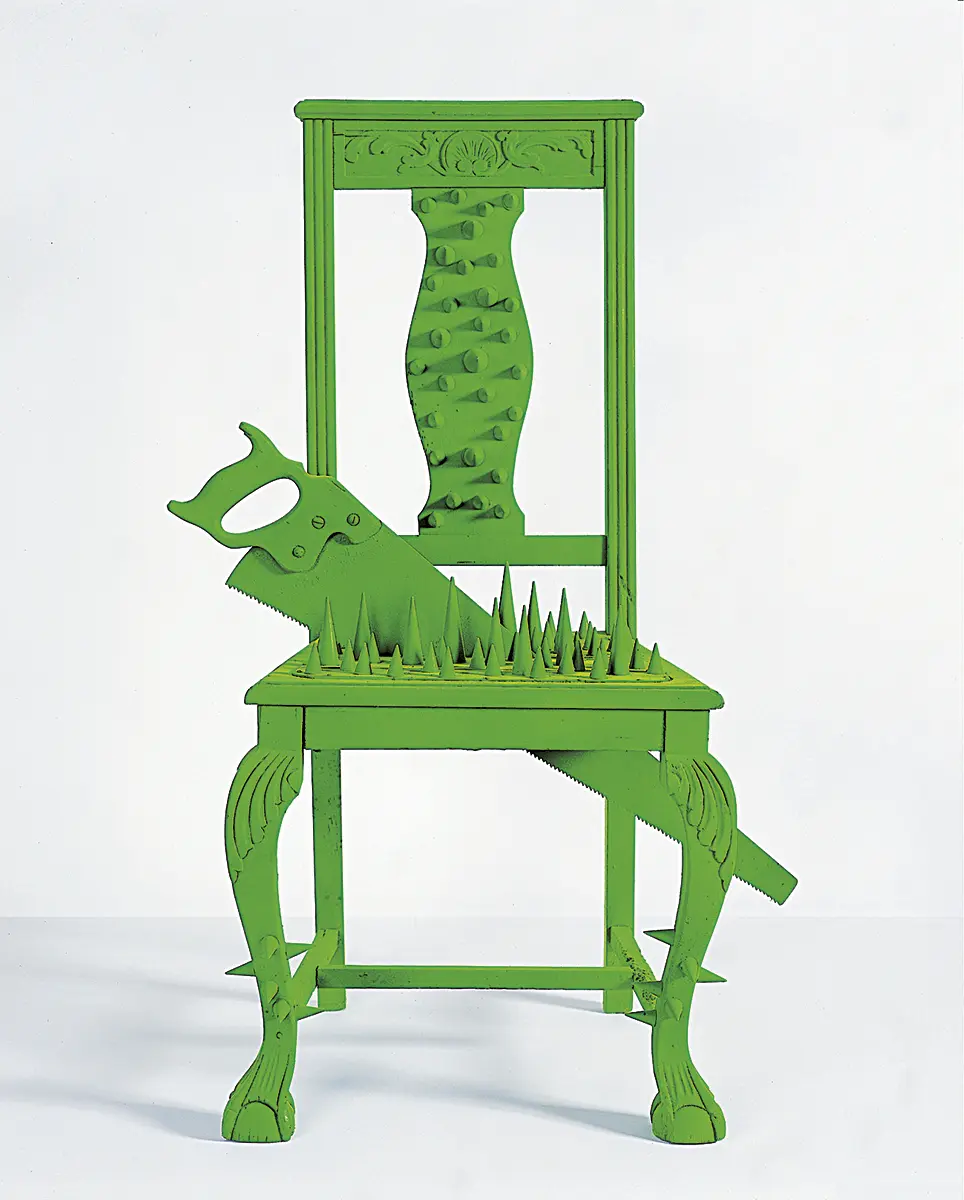
For many years now the work of Nicolás García Uriburu has been identified with the greenest shade of green, and it is indeed green the dominant color in Víctimas y victimarios (Victims and Victimizers), the artist's new show at the recently inaugurated Daniel Maman Fine Art gallery. The show comprises 22 objects, the majority of them intervened pieces of furniture; 17 digital, mixed technique photographs; and ten oil paintings. It is a "hopeful protest" in which García Uriburu develops in detail a series begun in 1996, recovering "the memory (...) of the chair that wishes to again be a tree, the furniture that would like to be a forest."
A precursor in many ways, García Uriburu (Buenos Aires, 1937) has since 1968 intervened in nature against pollution, the fruit of greed, corruption, and indolent negligence. That year, the artist used non-toxic fluorescent sodium to color green the waters of Venice's Gran Canal (coinciding with the city's Biennial); he has since realized more than 30 actions related to his environmental interests, such as the planting of 7,000 oak trees in Kassel, Germany, as part of Documenta 7, and the installation of over 50,000 trees in the streets of Buenos Aires and Montevideo during the 1980s and 1990s. New York City's East River (1970), Paris' Trocadero Fountain (1972), London's Trafalgar Fountain (1972), the Rhine River (in collaboration with Joseph Beuys, 1981), as well as the fountain in Plaza de los dos Congresos (1983) and the river in Puerto Madero (1992), both in Buenos Aires, have become the green-colored stage for García Uriburu's concerns as a citizen and as an artist regarding human being's relationship with the environment.
The current show, curated by artist Joaquín Molina, asserts once again García Uriburu's belief in art as a mobilizing force, and that ecology (along with Buenos Aire's local mythology and the union of Latin America) is the central preoccupation of his extensive oeuvre. García Uriburu renews his intention to "go from aesthetics to ethics and solidarity," displaying a series of good pieces of furniture (perhaps, actually, too many; did he feel a need to fill the main hall in its entirety?) that appear wounded and uncomfortable. All of them are painted in green with fluorescent oil, and some reveal, in their exquisite design, the nobility of their provenance. These preexisting objects (chairs, tables, chests of drawers, light tables, shelves, desks, laundry boards), from which bold spikes are growing, have been attacked by saws, axes, and other cutting tools. Thus, the artist says, "Humans exact their green tribute by destroying entire forests, turning them into pieces of furniture."
Seventeen digital mixed-technique photographs are interspersed in contrasts with the objects. This provocative graphic proposition finds its highest, most challenging meaning and its greatest efficacy in its very intimate nature and its lack of spectacle.
In the gallery's upper rooms we find four paintings that offer the viewer a vision of the Amazon basin, the area's generous natural environment severely damaged by so-called civilization and rapacious, powerful interests. Among the remaining images, the more abstract ones are worthy of notice, appearing as a celebration of the color green and of natural seasons, especially a delicate, poetic version of Invierno (Winter).
Back in 1999, in a show titled Empresas contaminantes auspician (Sponsored by Polluting Companies) at the ICI Spanish Cultural Center, García Uriburu denounced by name several companies (tanneries, cold-storage plants, paint makers) that dumped liquid waste on the River Plate, without adequate waste treatment. These were large documentary photographs intervened by the artist, constituting a powerful argument against the poisoning of the waterways. This is one recent instance of how, since quite some time ago, García Uriburu has demonstrated a willingness to carry his militant thinking into his art. However, presenting in the current show two works whose content is defined as "eco-political (...) the judge's bench and the corrupt politician," seems somewhat contrived. The artist's protests against Argentina's sad and exasperating condition come across as biased to a degree; he seems to have forgotten about finance sector officials and the executives in the private sector, who are also responsible for the country's debacle.
Content with his show, Nicolás García Uriburu is also celebrating the recent publication of Uriburu, Utopía del Sur (Uriburu, Southern Utopia), a large book by French critic Pierre Restany about the artist's work and times. Uriburu is a commanding figure in Argentina's artistic scene and an important practitioner of Land Art at an international level.
VICTORIA VERLICHAK