Along with Miguel Ángel Rojas, Óscar Muñoz is one of the most representative artists of the generation that emerged on the scene in the 1970s. That cohort of young artists sought to establish the practice of drawing as an autonomous language through which it was possible to express a new sensibility in Colombian art. It was a sensibility oriented, on the one hand, towards an attentive gaze on the immediate urban environment, the daily reality lived in the country's cities large and small: it is a reality strongly conditioned by socioeconomic differences, where a middle-class neighborhood determines a way of life and a behavioral norm; it is a society whose values and beliefs were deeply affected by the revolutionary stirrings of European and North American youth. On the other hand, these artists shared with their international peers a particular preoccupation with the mass media such as magazines, movies, television, and photography— "low culture" images that became an important source for the production of several series of monochrome drawings, worked with painstaking technique, whose appearance brought to mind the intentions of photorealism. These artists began to establish a path, a distinctive language that brought day-to-day preoccupations and realities into individual gallery shows and national salons.
Ever since those years, Muñoz has maintained a draftsman's outlook, taking, however, the parameters of drawing as a medium to a deeper level of reflection and conceptualization, acting with great sensitivity and intelligence, and keeping a constant and progressive pace. In this way, his work, without forced contrivances, has evolved along with the problematic of contemporary art, an art that, among other things, seeks more active participation of the public, involving not only the gaze but the body as a presence, incorporating formal or historic characteristics of the particular space where it's presented and propitiating works of an ephemeral nature. It is within this framework that Muñoz presented, at the Santa Fe Gallery of the District Planetarium last February, an installation titled Eclipse. Here he attempted an appropriation of the gallery space and an active and attentive tour on the part of the spectator.
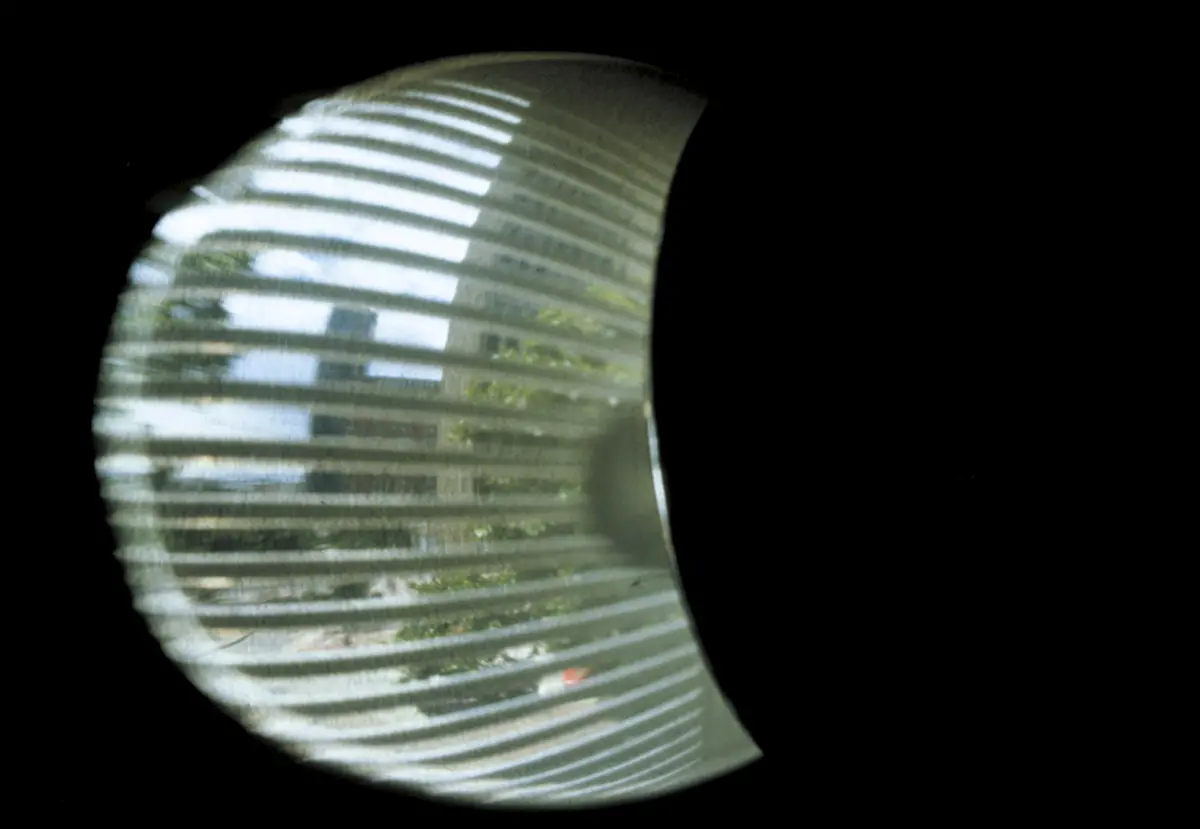
The gallery was completely darkened, so that whoever entered the space found at first an empty space, entirely in the shadows; this forced us to be cautious and tentative, but as our eyes became adapted to the minimal light, a series of shining, silver half-moons could be distinguished on the front wall that divides the gallery. The image immediately referred to the phases of a lunar or solar eclipse (a pertinent topic for a show presented at the Planetarium). Upon approaching one of these phases, the spectator found a monochrome image in a round format, in movement, which was blurred initially but could perhaps resemble the luminic values of a photograph, in whites, grays, and shallow blacks.
As one progressed through the gallery, slight, subtle variations from one image to another became evident, until finally, the realization came that the general composition, initially perceived as an abstract combination of whites and grays, is a figurative representation, an inverted depiction of the city's Carrera Séptima, and that the movement comes from the trees that surround the Planetarium being swayed by the wind, as well as from the large numbers of cars on one of the city's most important avenues. To produce these images, the artist used twelve concave mirrors that captured the scene outside the gallery, filtered through small orifices.
These orifices remind the spectator of the exhibition space's formal characteristics. This is a historic place, which for a time hosted provisionally Bogotá's Modern Art Museum and later became an important exhibition space. Many collective shows were held here, a number of them by young artists, as well as first-rate national events such as the Luis Caballero competition. In the beginning, the gallery was not ideal for the exhibition of artworks because its main wall was dominated by a large window that opened, precisely, above Carrera Séptima. In time, though, the windows were covered with a large panel that maintained the concave shape, so that the gallery served better its new purpose. In Muñoz's installation, the orifices remind us of those old windows above the street, and the image that they allow into the gallery seems to synthesize Muñoz's interest in monochrome images, images that are close to photographs but described by the artist as "amnesiac photographs, photographs with no memory." What we see in them is only the present; "the past doesn't exist." These images are intimately linked to the immediate urban environment (like Muñoz's own Inquilinatos [Boarding Homes]); images of the city presented with the same magic of his bathroom curtains, with the mystery of his Narcisos (Narcissuses) and the magic of the drawings in vapor in Muñoz's Aliento (Breath). These are also ephemeral images since turning on the gallery's lights suffices to make the city, the cars, and the people walking the street disappear.
These are images, finally, placed in front of our eyes to be experienced, thought over, and deciphered.
MARTA RODRÍGUEZ