
Paula Santiago's newest exhibition presents drawings, photographs, and sculptures suffused with tales of desperation, longing, and hope. Pulsing with the immediacy of a diarist's sensibility, the opening room profiles over twenty gossamer wash drawings, startlingly created with wax, blood, and human hair. Presented on pale white papers and silks, these delicate images outline barely visible, bulging, biomorphic forms that interpret the body as a site of both pleasure and pain. The most riveting is a suite of drawings collectively titled AMIC, 2001, enshrined in glass-topped wooden boxes and mounted to the wall. Their visceral materials, invented organic forms, and occasional texts unfold narratives of women's rites of passage. AMIC, Number 3, for example, profiles a circular lock of hair, set atop a circular paper and situated on pure ivory silk. Inscribed in dried brown blood along the bottom is the word "matrimonio," carrying allusions to the female body and sexual initiations.
The adjacent room profiles a multi-component installation, Self-Requiem, 2001, which draws its theme from the artist's recent battle with cancer. Here forty photos hang at eye level on the room's four walls encircling a centrally placed assemblage. Functioning as a document of the artist's recent ordeal, the sculpture is constructed of cancer biopsy slide sheets strung together into broken crucifix formations. But instead of being hidden as religious relics often are, the modern curio-sculpture is openly displayed and surrounded by photos, which further detail its relevance. While looking like abstract paintings, the photos are actually microscopic images of human tumor cells, photographed with color filters. Investigating the microbiological world in poetic terms, the photos comment on the irony that distinguishes artists and scientists who both use imagery to describe and interpret reality, but arrive at radically different readings. The show's visual climax occurs in the large back room where twenty-three wax sculptures are displayed. Whispering simultaneously life's sensuality and ephemerality, these works evoke the vulnerability of flesh while sounding themes of renewal and hope. One wall profiles twelve wax torso sculptures, illuminated from behind with electric light. Like candles in a darkened church they seem simultaneously ominous and benevolent. Ranging in color from pure white to vanilla yellow, each torso is embedded with an incrustation of glittering stones that concurrently suggest both tumor sites and badges of honor.
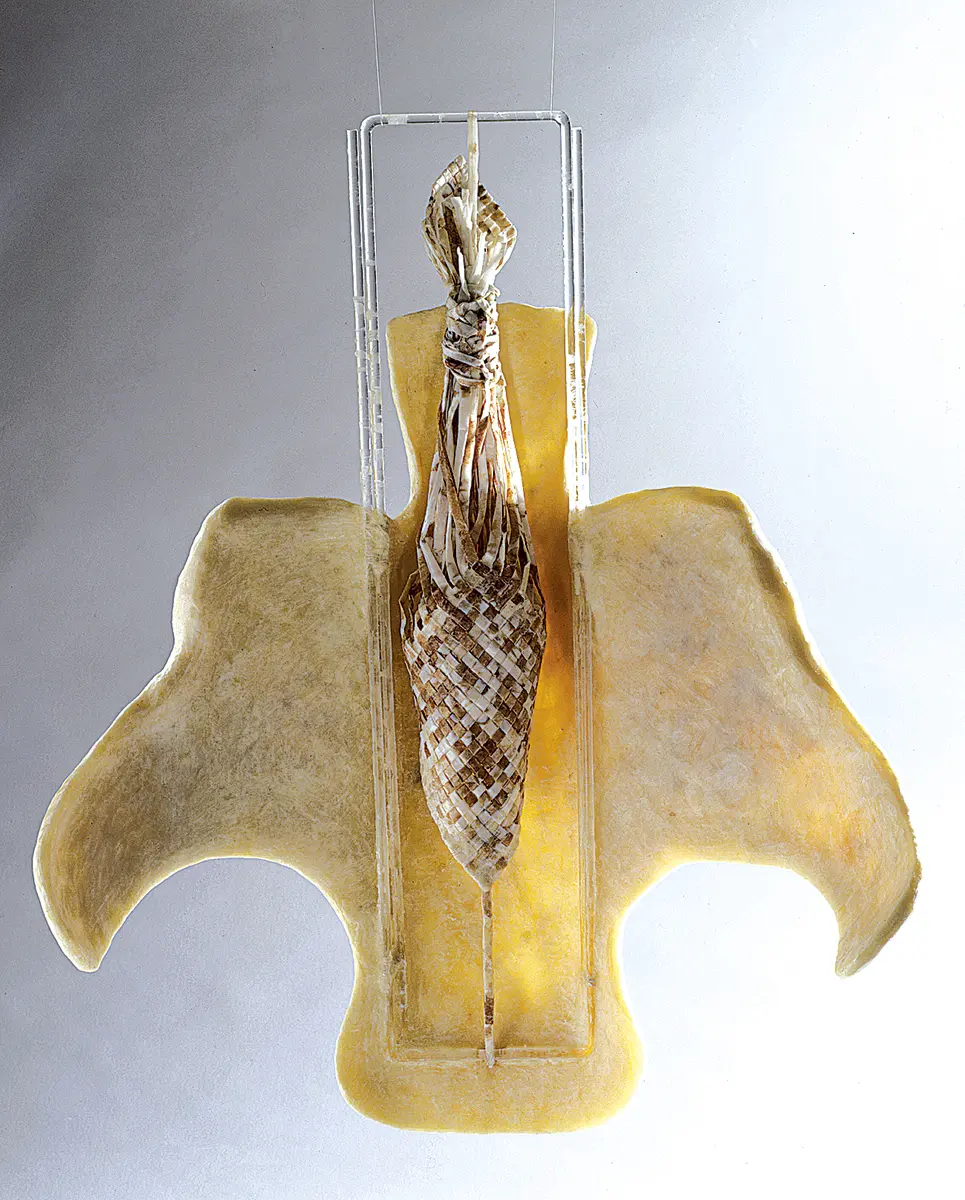
The remainder of the room profiles meticulously wrought sculptures that resemble vessels and body parts. Septum, for example, profiles a pelvic bone structure modeled of translucent off-white wax veined with red blood, and implanted with a wax-woven vial presumably filled with healing herbs or medicines. Other works similarly model solids and voids, sensitively engaging light and shadow, and metaphorically alluding to the precariousness of bodily existence. Exploring the tenuous relationships between nature and technology, hope and rationality, the unpredictable and the orderly, these works form the exhibit's indisputable climax, raising complex issues and themes. Embodying a consciousness of both pain and pleasure, these sculptures give presence to the fragile yet vital nature of the body and its existence.
COLLETTE CHATTOPADHYAY