
Renowned in Los Angeles for its important historical and contemporary Latin American art exhibitions, this spring the Couturier gallery mounted roughly fifty black-and-white photographs by Raúl Corrales. Marking Corrales' first solo exhibition in the United States, the show served to introduce the works of this legendary Cuban photographer, who is now 77, to a North American audience.
Ranging chronologically from 1948 through 1983, the exhibit underscored above all Corrales' breadth of photographic investigations, offering a broader-than-usual interpretation of his work. Historically, along with his compadres Alberto Korda and Osvaldo Salas, Corrales' is most renowned for his documentary photos of the Cuban Revolution that have become visually synonymous with those events. But the images showcased in this exhibit ranged from those that quietly focus on the unremarkable interstices of existence to those that knowingly document and record political events in a photojournalistic manner.
Thus the opening images of sleeping children and working peasants come as something of a surprise. There is a seductive and alluring intimacy in these works that on closer glance manifests worldly, ironic undertones. A photo of two young children napping in a hammock looks like an advertisement promoting the Caribbean as paradise until one notices its title, Beauty Rest, 1948. Wryly naming a mattress brand, the title intimates that the hammock, far from being a vacation idyll, is the everyday bed of the underclass. A similar charge appears in a nearby image, Las botas del mayoral (The Foreman's Boots), 1955, that profiled two standing males seen from the waist down. One sports leather boots and flashes a sword while the other wears rolled-up trousers and bare feet. Although the image unassumingly presents itself as a visual aside, the incongruity of the men's social positions, which is magnified by the title, again underscores the issue of economic inequality that would become central to Corrales' subsequent endeavors.
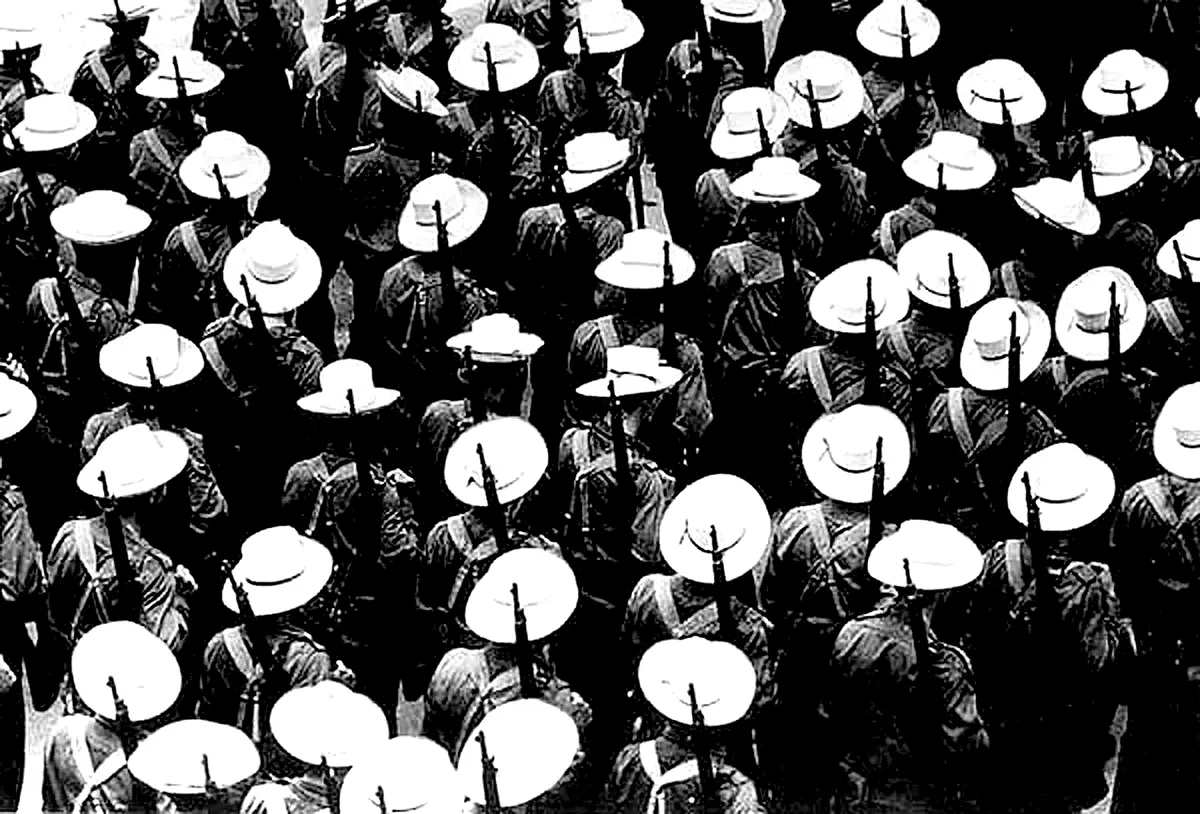
Then, almost abruptly, the tone and visual distance of the exhibition images change. Instead of seeing close-up details, the viewer witnesses spectacles. A bevy of historically important images capture throngs marching in uniform, arriving as cavalry, or assembling in crowds. Included is the renowned Primera Declaración de La Habana, 1960, which documents a gathering of thousands listening as Castro speaks. The photo, which was subsequently printed as the central image of the Cuban 10-peso bill, came to enjoy a populous circulation that even Andy Warhol would have envied. At the center of the gallery's back wall appears the show's leitmotif image, Caballería, 1960. While recalling French 19th-century Romantic paintings, the photo ironically documents a cavalry of mid-20th-century militiamen wearing straw hats and waving Cuban flags.
The exhibition's closing images profile the realities of post-revolutionary Cuba. One ironic shot features a couple in wedding attire posing in a fully tiled modern bathroom, dreaming for a moment of the type of luxury their ordinary existence will not afford. Whether capturing sweeping vistas or focusing on intimate details, this exhibition presents Corrales as a skilled photographer whose images capture the nuances of Cuban hopes, dreams, and delusions.
COLLETTE CHATTOPADHYAY