
Rubén Torres Llorca, usually so tidy and succinct, joined up this spring with the artist-run Locust Projects, a group that tends to be all over the place, but in a good way. Torres Llorca came up with a photographic installation that was quite the rampant outburst from this usually punctilious maker of art. Though his three works consisted simply of snapshots and small drawings that lined the gallery walls, they proffered an astonishing accumulation of detail. As always, the artist's somewhat veiled intentions seemed to well up out of a deep space of thought and emotion.
It was easy to see why the Locusts would invite an artist of Torres Llorca's stature into their stoutly fenced outpost. What was in it for Mr. Torres Llorca is a little hazier. Not that he would ever consider himself above exhibiting, shall we say, across the tracks. He has, in fact, demonstrated a fiercely democratic streak in the past, in Cuba in the 1980s, when such things mattered (and, anyway, the baby-faced Miami art scene, with its quaint can-do spirit, is still a bit promiscuous in matters of who shows where). Rather, Torres Llorca's works were themselves literally fogged up, as he had covered most of the snapshots with a translucent material, or, in a few cases, superimposed drawings on them.
Torres Llorca has always been a master of the conceptual swift kick, placing found, and sometimes trenchantly altered, quotations or oblique, eavesdropped phrases on small blackboards, and arranging these homely but inevitably upsetting fragments amidst harmless-looking toys, statuettes, medallions, and others whatnots. History Will Teach Us Nothing, a piece owned by the Miami Art Museum, consists of two rows of tiny schoolroom chairs facing a series of child blackboards on the wall which bear ostensible quotes from great dead artists who complained bitterly, in life, about their raggedy lot.
His drawings are as elemental as turn-of-the-nineteenth-century elixir illustrations and seem to be modeled directly on ads for toothache remedies, hernia trusses, common tools, and dry goods. An air of nostalgic, melancholic wit and an affection for the vagaries of language hang about these works, and one is always a little off-balance trying to determine exactly what they add up to. But watch out. They are often about as cozy as switchblade thrusts.
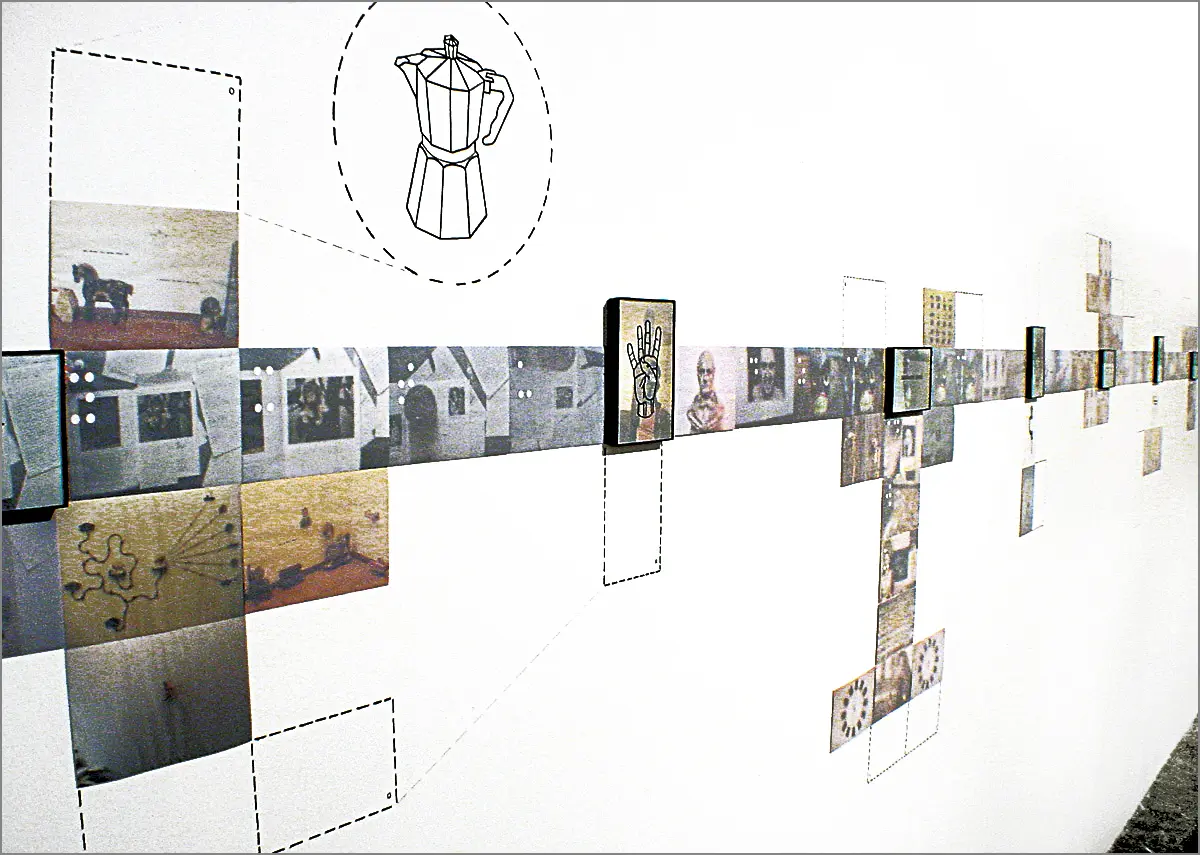
Torres Llorca's new works, Si pierdo la memoria que pureza, You Don't Know my Heroes, and So Quiet in Here, were at their familiar yet vexing best. The larger work, So Quiet in Here, was made largely of photographs of what appeared to be details of various artworks in the studio, alternating with lines from a poem that begins So quiet in here, and shots of a stove-top espresso maker, a messy desk, cabinets overflowing with Torres-Llorcan knickknacks, proffered fistfuls of dollars, a fugitive's ignominious moment on the five o'clock news, and seemingly random studies of bright, fleecy Florida skies. This was an artist's obsessive rumination on what he's done lately and what happened while he was twiddling his thumbs, and hooray for that. As they say, the unexamined life is not worth living.
The cliché is probably no more false than the kind of converse that the artist himself might serve up—an unlived life is not worth examining—and besides, Torres Llorca being who he is, the obvious thing was likely only a tiny, relatively unimportant part of the story, if any of it.
A closer look at So Quiet in Here revealed arrangements of dots on many of the photos, Braille, no doubt, since in the other room he provided a Braille chart. If you bothered to translate the Braille, it came out not as words, but as an alphabetical succession of lowercase letters—a, b, c, d, and so forth—in the fashion of footnoting. Visual art as annotated text. The metaphoric gives way to the didactic. But it was a didacticism whose lessons were lost on all but the artist. For the viewer, the dots were finally just a visual backbeat to the pictures. So on another level Si pierdo la memoria que pureza dealt with language and its perplexities, especially with translation, which is a very keen interest of Torres Llorca's, who has been known to painstakingly wrap models of hands and ears in random pieces of text cut from the daily newspaper. These were some of the things that any persistent gallery visitor could deduce. The exhibition was, to judge by its images and devices, a treatise on the life of an artist, a quiet, espresso-loving man, tempted by money, distracted, like all of us, by the false drama of television, a fool for clouds. The translucence of the pictures rendered even their jagged, baffling phrases indistinct, perhaps allowing Torres Llorca a kind of distance by which to judge them afresh and the viewer to see their purely, sometimes baroque, formal beauties.
But it is important not to confuse the private man, even the private artist, with his artifacts. To know a few secrets about this work is to experience it differently, having less to do with the heartstrings and more with a forceful intelligence.
The poem had appeared before, in a somewhat different form, in a piece that the artist had created at El Museo del Barrio in Manhattan in 1996, also entitled So Quiet in Here. The whole story behind that exhibition is lengthy, complicated, and enormously poignant, but you need only a few details to see how deeply reflective and filled with reproach the present-day So Quiet in Here was in its heart.
The earlier exhibition involved a story about a family of Africans put on display in a nineteenth-century European zoo, and it ended with the words "You don't know my gods; you don't know me". The story was largely true except that Torres Llorca had made up the ending, and it appeared only in Spanish, without translation. The artist says he conceived of this Spanish-only rendering as a critique of the museum in which it appeared.
It is not difficult to fathom the appeal of this story to an exile in a strange land, an intellectual in a society of numbskulls, an artist among philistines. But to withhold information and then create claims about a work is a bit of a trick, part creative invention, part self-fulfilling deceit. Of course, though its literal truth may be open to question, its subjective metaphorical truth is hard to deny. This is the sort of paradox one can see Torres Llorca enjoying enormously—indeed, it is the same kind of paradox it is meant to illustrate, which only doubles its paradoxical nature and deepens its mystery.
The poem's reappearance in Si pierdo la memoria que pureza tied the newer project to the previous one and all it implied about language, memory, and other chiefly literary concerns. The satisfactions of so subtle a strategy must be scant. One runs the risk of being misunderstood or not understood at all, like Bantus in Brussels in 1879. Which may be the point.
JOEL WEINSTEIN