
Walter Goldfarb's solo show at São Paulo's Thomas Cohn Gallery opened last May. The show gathered 11 of Goldfarb's most recent works, produced in the last two years. These are large-scale canvases in different formats; two of them resemble very large papyrus scrolls in which the painting is inscribed, while others are oval in shape and correspond to objects displayed in front of them as if emerging from the pictorial image, creating a dense symbolic field that the viewer is to interpret.
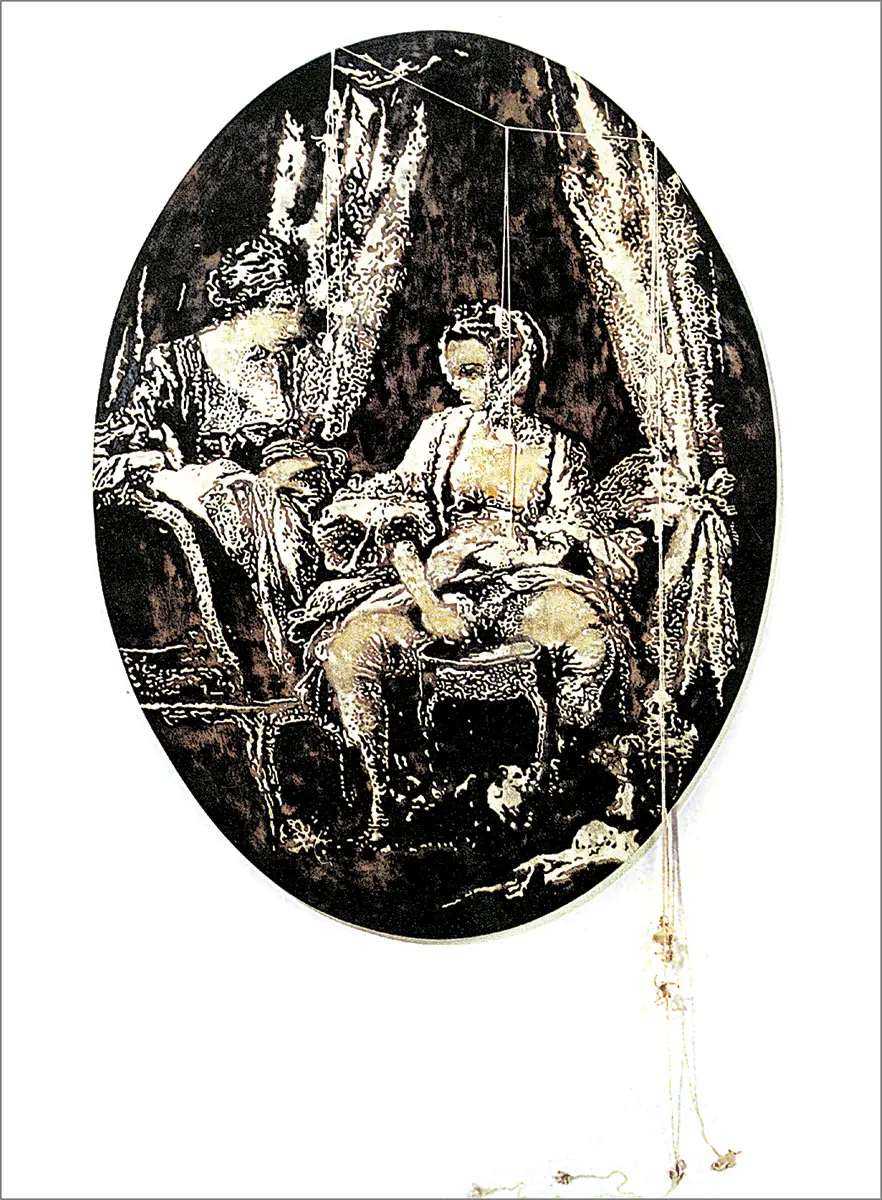
In Goldfarb's most recent work, the exploration of the uses of charcoal is preeminent. The artist develops several methods to transform this resource into material for painting and uses it as ink. Goldfarb creates effects of matter and color by subjecting charcoal to successive washings, making it possible to work and rework the same surface until the desired plastic look is achieved. Through a process he calls "organic combustion," Goldfarb's canvases become the result of working with thousands of charcoal sticks turned into ink and with several layers of veilings. Goldfarb uses a method of washing in vats of chlorine, where the canvas is taken to the limit of its resistance and charcoal reveals some of its organic qualities, generating varied colorations. The result is a mysterious, "worn" look, with the marks of passing time and lived life. Through this system, testing the material's potential, Goldfarb focuses on philosophical issues: the matter of painting as a language, with new semantics for its traditional procedures. Goldfarb "reinvents" the process of painting: charcoal, traditionally used in drawing and delineating the space in the canvas to be covered by ink, acquires now the pictorial function.
Goldfarb also enters the depth of the history of art history. His work quotes Hieronymus Bosch, Vermeer, Van Eyck, Rembrandt, and François Voucher, and uses their works as a (postmodern) glossary in his own personal search for new meanings.
Walter Goldfarb adds to his paintings embroideries and crochet made with threads from the same canvas used as support. This intervention generates a powerful effect, not only in plastic but also in terms of a semantic redefinition of the pictorial discourse. Vermeer's image of the Dentellière is embroidered in Goldfarb's Lição de corte e costura (The Sewing Lesson), which quotes Rembrandt's The Anatomy Lesson. In Enquanto seu lobo não vem (As Long as Mr. Wolf Doesn't Come), embroidery substitutes line in delineating a female figure. Threads taken from the work's own support, in crochet, are superimposed to the curtains in Amarelo, from the series Espelho, espelho meu (Mirror, My Mirror). As Goldfarb has put it, "All of my work is of cuts and sewing."1 With a gesture of the hand, the construction acquires new meaning, and a plastic object achieves a dimension of contemporaneity.
It should be noted, also, that Goldfarb's recent work reveals a level of intimacy with the female imagery and the universe of women. The show's works are charged with eroticism, sensuality, sexuality, maternal feelings, and images from the mythology of fairy tales. "I seek to explain social relations through the realm of the feminine," Goldfarb explains. In this instance, he takes as a point of reference the work of Louise Bourgeois and quotes her in one of his canvases by creating a crochet with woven spiders that resembles a spider's web.
With the contemporary practice of the artistic quotation, Goldfarb redefines the philosophy of painting. His work generates an intricate labyrinth from where the viewer will only emerge following Ariadne's strategy: by seeking out the communicating thread in the artist's complex thinking. Goldfarb's aesthetic practice is a continuum: "to deconstruct in order to reconstruct the pictorial image." This is a constant in his project, when he comments on painting in itself or on painting as an act of artistic communication, or when he alludes to the legacy of Western art.
There is yet another fundamental axis in Goldfarb's creative process: the artist's inscription in the realm of his own autobiographical experiences. Goldfarb explores the world that surrounds him, but, as the critic Reynaldo Roels, Jr. says in the show's catalog, he deploys all his resources in the attempt to make the final image speak for itself, offering a rich material on which the viewer will find abundant occasion for thinking.
NOTE
1. Personal communication to the author.
LISBETH REBOLLO