In little more than a decade, Xul Solar's fame has reached many surprising corners. Despite his 1977 retrospective at the Musée d'Art Moderne de la Ville de Paris (the first one outside the artist's native Argentina, and a rare, singular event), Xul Solar was practically unknown beyond the borders of his country. Only towards the end of the 1980s did the interest in his work begin to rise, and he was to be found on the roster of several important collective shows devoted to Latin American art (the first one was Art of Fantastic Latin America, an itinerant show in the US in 1987). In the 1990s, Solar was the subject of monographic shows in New York, Rio de Janeiro, Porto Alegre, and Stockholm. It has been Spain, however, where the most attention has been paid to his work, first with a show at the Guillermo de Osma Gallery in 1993, then a larger one, already institutional, in Malaga and Seville, and now in Madrid, with around 130 pieces exhibited at the city's premier modern art center.
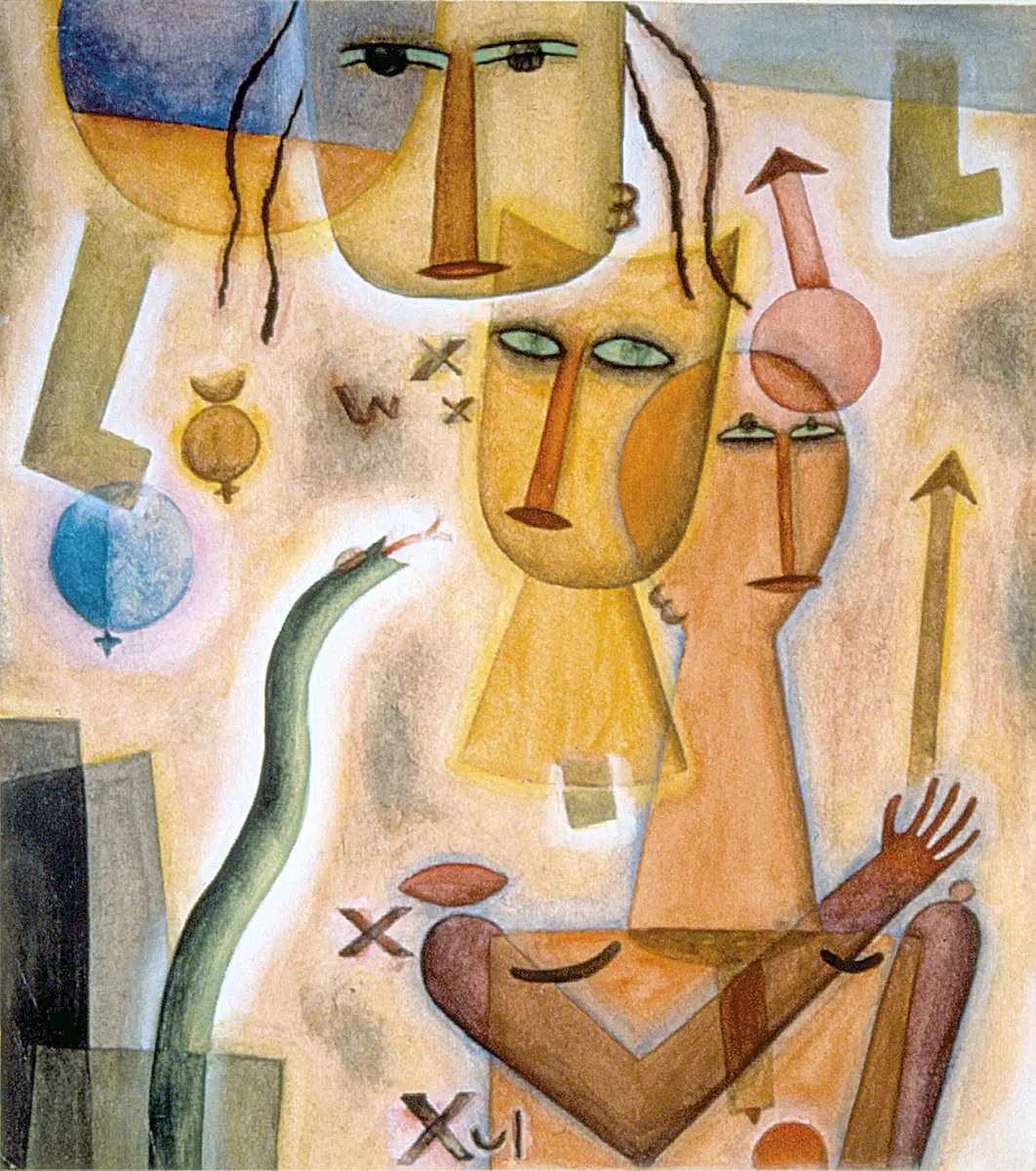
Alejandro Schulz Solari (1877-1963) is, without a doubt, a fundamental figure for the introduction of the avant-garde spirit to Buenos Aires in the 1920s. After spending 12 years in Europe, in contact with expressionist, cubist, and futurist artists, he returned to Argentina in 1924 with the stated purpose of contributing to the country's cultural renaissance. Associated with the influential publications Proa and Martín Fierro, a friend of Jorge Luis Borges, and a student of the Kabbalah, the I Ching, Tibetan Buddhism, alchemy, music, architecture, and, in particular, astrology, he was a peculiarly systematic "inventor." Solar created more than a dozen languages—the most accomplished of which were "neo-Creole" and "Panlingua"—a universal board game—the "panchess"—a modified piano that can be seen at the current show, and even some imaginary "anatomical reforms and new entities." It is probably his curiosity by temperament, his mystical but playful disposition, and his ample creativity in all areas, that brings us closer to Xul Solar today, even more than his work in painting. This consists of watercolors and tempera on paper, in small and medium formats, clearly influenced by Paul Klee and with some Orphic elements, some Cubism, some Futurism—this is to say, a free amalgam of those avant-garde movements he had encountered in Europe, which he carried through, already anachronistically, into the 1960s. Xul Solar's oeuvre is minor, but it possesses a rich, warm, and lustrous chromatism and a peculiar transparency; it appeals to us, principally, with a profusion of signs and symbols of a wide cultural provenance. Perhaps his best moment was in the early 1940s when Solar temporarily abandoned color and concentrated on the representation, in grays and beiges, of fantastic structures such as ruins, staircases, and mountains. These are his most attractive and original pieces. Also deserving of special attention are Solar's astral charts and his representations of the zodiac, as well as his anthropomorphic signs, the "pictorial writing" of his later years, and his toys, masks, and wood, wire, and papier maché sculptures.
Every one of Solar's creative periods is well represented in the vast exhibit at the Reina Sofía, which also offers a complete view of the artist's many fields of interest. None of this would have been possible without the support of the Pan Klub-Museo Xul Solar Foundation, the lender of the majority of the exhibited works and a major player in the current revival of an artist who didn't exhibit or sell much during his life. Also, it needs to be noted, as a major contributor to the realization of this show, Juan Manuel Bonet's, the current director of the MNCARS, interest in the historic avant-garde, particularly those marginal episodes that intermingle with the fields of literature and publishing. And, above all, the efforts of Marcos-Ricardo Barnatán, an Argentine poet and art critic, a Borges specialist, and a resident of Madrid, who was also a good friend of Solar (in fact, it is possible that the artist's posthumous fame owes a lot to this relationship). Perhaps Xul Solar's jump from anonymity to stardom has been somewhat too sudden; perhaps there is a risk of overpraising not as much the human figure as the artist. But these risks, so unfair to someone who opted for privacy over public life, are superseded by the charm and lightness of Solar's vision, of his private utopia.
ELENA VOZMEDIANO