The exhibit in New York of twelve sculptures and twelve drawings by the Afrocuban artist Agustín Cárdenas has been a vital point for the public at large and specialists alike since this master of sculpture shows irrevocably the presence of modernity and the strength of African heritages.
Both Latin America and Europe have shared Agustín Cárdenas (Cuba, 1927-2001), one of the 20th century’s greatest sculptors. In Cuba, he works on direct carving since his adolescence. In 1995, he travels to Paris on a government scholarship. Through exuberant feminine shapes, couples, and maternity, there he expands the sculptoric elegance and synthesis he began in Cuba.
These topics, carved on wood, plaster, stone, terracotta, and iron, and, later, on marble and bronze, will accompany him throughout his prolific life.
The exhibited drawings are vigorous. They’re treated carefully, not only as drafts for the sculptures but as independent works in their own right. Cárdenas worked tirelessly, and he drew with the same assiduousness. These twelve two-dimensional works are all untitled; they are well preserved, dated between 1975 and 1983. Almost all of them are done on handmade paper, and the materials used include ink, pen, pencil, and watercolor. The rounded shapes, rhythmic cadences, and stylization are present both in the sculptures and the drawings, though, on the plane, the line and the organic shapes require a more abstract reading, and they find themselves more in the territory of blotches and formed stains.
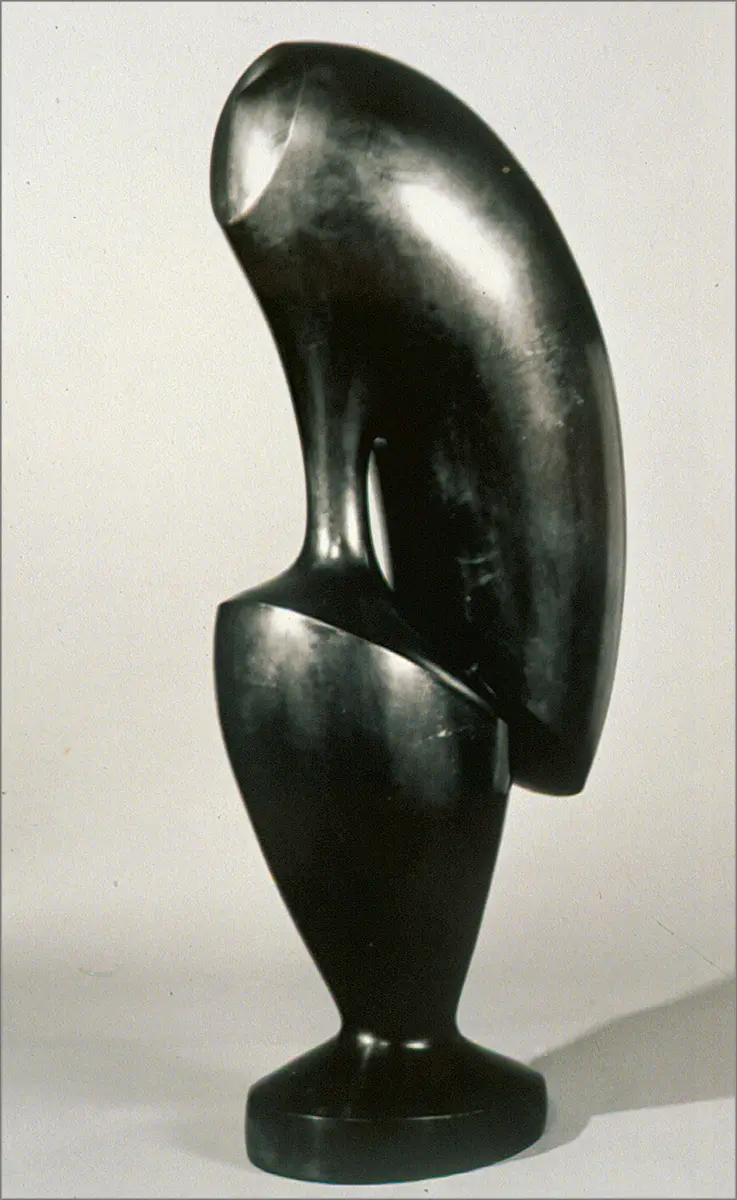
Cárdenas’ works bring together the symbiosis of three areas: African, Latin American, and European. Naissance (Birth), from 1975, takes on the themes of masks, breasts, concavity, maternity, elongated bodies, and their phallic similes. Whether they’re direct wood carvings or bronze casts, in the sculptures nothing is obvious. There are very few figurative references, and the predominance of the shape constitutes the artist’s personal touch. There is a relationship with both previous and contemporary masters, but the sculptures don’t ignore African sources, organic shapes, or ossa. The elongated shapes alternate with volumetric spheres in a sensual dialog between phalluses, breasts, and hips. There’s an undoubted presence of voluptuousness and African and Caribbean rhythms. The predominance of polished finishes is a European language the artist incorporates accordingly. In the compositions of communicating vessels with nuclei, Cárdenas’s work might remind us of molecular representations and certain spatial atomic structures, as in Le coq (The Rooster, 1974), Science and Family, and Le repos.
In his work, Cárdenas shows the strength of the black culture that conceived him, the Latin American culture that witnessed his birth, and the French culture that saw him develop. When we conceptualize the visual aspect of his work, we find that one of its constants is based on three elements: the sphere, the triangle, and the oval —this last one being an elastic derivate of the two first ones. As it can be observed in Iroco, “tension” is the term that could be used to describe the reach of his compositions. The shapes that can be quickly associated are the idea of the bow tensed by the arrow, the erect Stella, the rock’s solitary and powerful mass…
Soft shapes cannot be seen on the shiny surfaces, nor in the tiny pieces or the drawings. Continuing on with the composition analysis, we cannot fail to mention the theme of orifices and masses of material, which help identify themselves with one another with ceaseless continuity and sinuosity, signaling one of the artistic elements characterizing this artist’s work.
Cárdenas was interested in local materials. He had the opportunity to put them to practice in open-air sculptures. His wood carvings constitute a group of works characterized by the use of fire and color, as can be seen in My Shadow After Midnight, from 1963. The burnt areas and finishes achieved using such a technique refer to us and highlight the relationship with the primitive. As it can be seen in Engraved Butterfly, from 1989, wood is the one element that allows and incites textures. Exhibits such as this one, where we see a master of modern art, play an educational role, establish technical and creative parameters for younger generations, give us information about what has been done, and open the doors to collectors of classical modernity.
GRACIELA KARTOFEL