The Museo Arturo Michelena has organized an anthology of works by Ángel Luque, a Spanish artist who lived in Venezuela between the late 1950s and the first half of the 1960s. Organized with sobriety and intelligence, the exhibit brings together a total of 26 paintings, drawings, and prints done during that period. The proposal was coordinated by Douglas Monroy, with Francisco da Antonio’s museography, and Beatriz Sogbe’s text. It’s an effort worthy of praise because it has brought to the public this artist’s sure and rotund singularity.
Painter, draftsman, and designer, Luque arrived in Venezuela in 1956, with his friend Gabriel Morera. He inserted himself in the convulsed cultural and political panorama of the last years of the Pérez Jiménez regime and the first years of democracy. It was a time of confrontation, conflict, and violence. It had a profound impact on the world of art which, during those years, was the scenario where abstract, constructive, informalist, and neo-figurative tendencies clashed with one another. It was a stage where the role of art in society was debated. On one side were those who considered it above political circumstances, while on the other were those who, like Luque, proposed a socially committed art, conceived as a catalyst for social change.
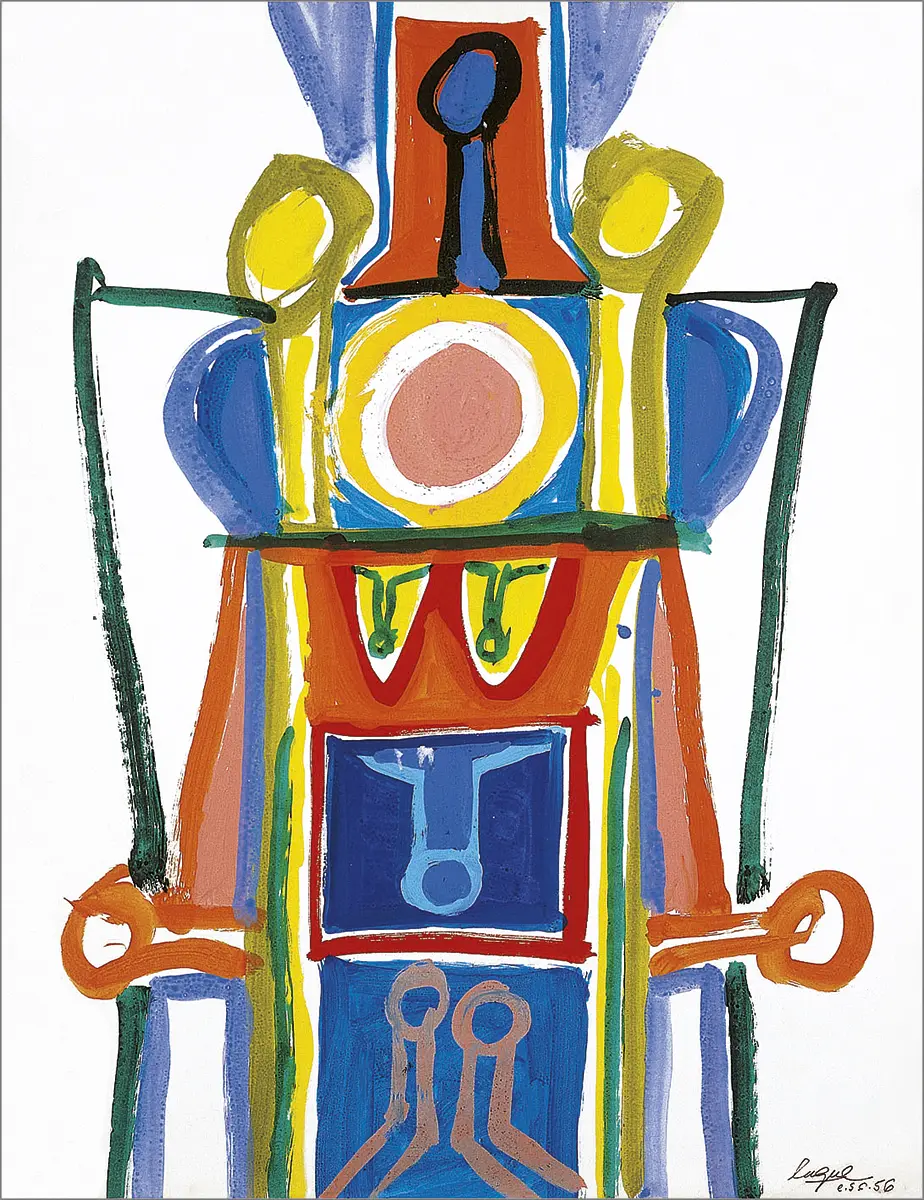
All these conflicts are present in the personality and work of Ángel Luque, who was linked with the most radical sectors of Venezuela’s cultural left and whose artistic creation had a noticeable impact on the national art circuit. His pictorial work ranges from the figurative to the abstract and, occasionally, to the informal, combining elements that tend to outline the figure and provide chromatically vigorous solutions to the universe of intuitiveness. An example of this is Poniéndole color (Giving It Color, 1956), a gouache on paper where symmetrical composition, simplification of form, and the use of pure colors prevail but are applied without violence.
His drawings and graphic arts production —the group of works best represented in this show— are expressionistic, and outstanding for their crudeness, incisive strokes, and caricaturesque deformations. Works such as Doña Fulana (Mrs. Such-and-such, 1961) and Don Fulano (Mr. Such-and-such, 1961) combine candor and aggressiveness by taking advantage of the ingenuous connotations of children’s art and “brutish” painting an lá Dubuffet. The “ingenuous” violence of these works marks a contrast with the series of caricatures and fantastic characters, revealing a more lyrical, spontaneous side, as it happens in Bicho (Bug, 1962). But the motives attracting Luque are various: In Manifestante 64 (Demonstrator 64, 1964) and Protesta 65 (Protest 65), he’s interested in social convulsions, while in Novio y TV (Boyfriend and TV, 1965) and ¡Qué fastidio! (What a Drag! 1965) he centers his attention around the increasingly frivolous human relations as the result of consumer society.
Luque stayed in the country for more than ten years. During that time he had several solo shows in some of the most important exhibit halls such as the Museo de Bellas Artes in Caracas, and the Fundación Eugenio Mendoza. He was also a member of El Techo de la Ballena (The Whale’s Roof), an artistic-literary group founded in 1961 that brought together painters, critics, and writers of the stature of Carlos Contramaestre, Juan Calzadilla, Perán Erminy, Edmundo Aray, Adriano González León, Salvador Garmendia, and others. As a member of the collective, Luque took part in several shows and worked as a graphic designer.
He left the country in 1967, after being imprisoned for his role in the kidnapping of the second in command of the US military mission in Venezuela. Luque left behind an artistic trajectory that was marked by non-conformity and redeeming praxis. His artistic interests shift around different topics, though most of them have a deep existential connotation. Like many other Iberian artists (Gabriel Morera, Antonio Moya, José María Cruxen) who arrived in Venezuela during the same time, Luque brought along the renewing and militant pulse of foreign currents such as El paso.
The exhibit is pertinent because it synthesizes Luque’s artistic excellence and social preoccupations. From the geometry of the paintings to the intricate lines of his drawings, from the fantastic characters to the creatures who gather indifferently around a television or are seduced by consumerism, the premise dominating this creator’s activity appears to be, “It’s urgent to live.” Writes Beatriz Sogbe’s in the show’s catalog: “Luque came, lived, and left. But his drawings and paintings have left tracks.”
FÉLIX SUAZO