Cristina Piffer appeared in the Argentine art circuit during the latter half of the 1990s. At the end of the last millennium and the beginning of this one, she constitutes an example of the discourse that marked the intention to substitute, by means of a particular and solid language, certain traditional paradigms, not only in art but in the broader culture as well. Although she has appeared in several collective exhibits, including the 2002 Lima Biennial, where she represented Argentina, Entripados (Tripe Works), held in Galería Luisa Pedrouzo this past April, is the first solo show for this artist with an eclectic background.
Each work done by the artist is formed not only by the finished piece itself but also by the long elaboration process that began with the selection of the essential material: organic matter —beef, entrails, and animal fat. Besides the powerful connotations that these materials have, we also have the fact that for a long time, and with some recent changes, beef and its derivates have been the staple in the Argentine diet. Her previous series was titled Perder la cabeza (Losing the Head).
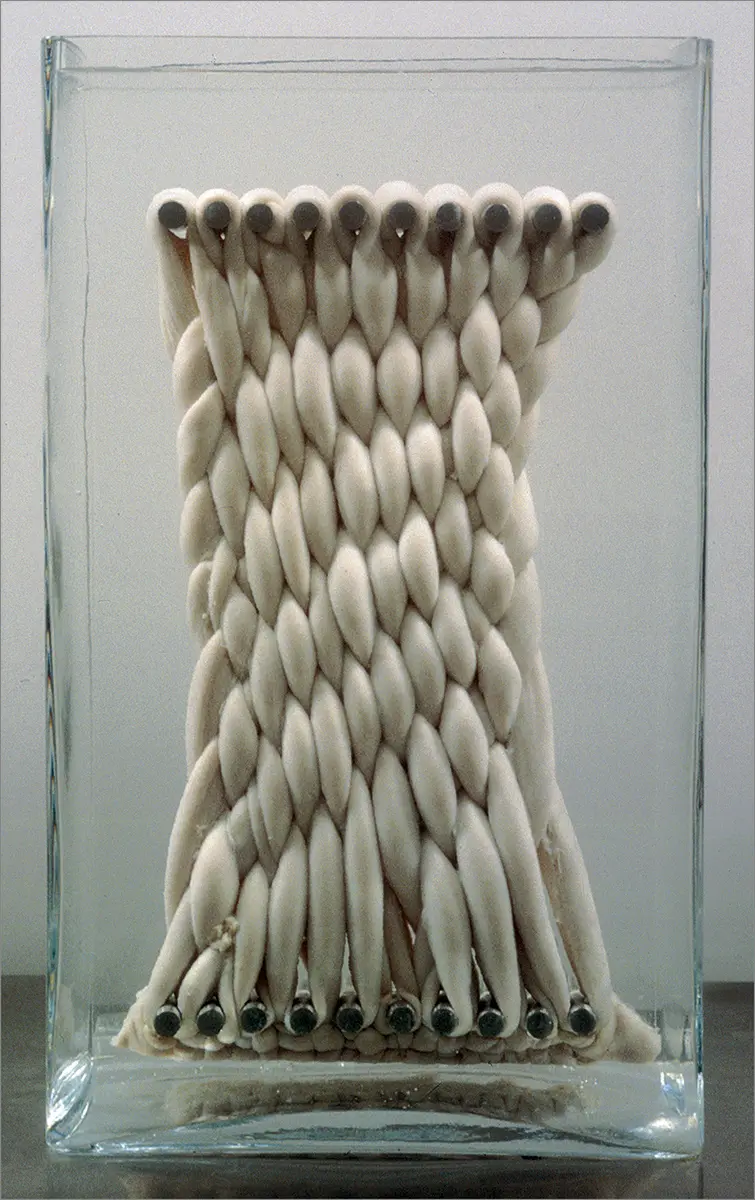
Entripados were made up of two groups: The first one, in which beef tripe or small intestines were the main element; and the other, where the artist used beef fat and shaped it as tapas de mesadas or extensions of kitchen tabletops.
At the root of the Entripados series are different levels of popular imagery in more than one sense. In the country’s traditional gastronomy, beef intestines are entwined and then cooked. Following the line of Piffer’s project, the analogy takes us to the idea of “entwining” (or weaving) which traditionally has been considered a feminine task. But Piffer decided for the opposite position, for in the tradition we also find entwining as a masculine task —the entwining of rawhide done by farmhands. The artist constructs her pieces following their instructions to the minutest detail. Finishing each piece we find steel screws and glass bottles with simple shapes. But each twine of chinchulines (the local word for tripe) is finally submerged in water and then presented to the spectator.
The other group of works has beef fat as the protagonist. Worked on stainless steel tables that have different connotations, the fat is then engraved with legible incisions according to each circumstance. Piffer creates an opposition of the organic matter with cold, rationalistic shapes that emerged from the 20th century’s functionalist architecture and Concrete Art and were re-evaluated by certain art trends of the 1990s and current environmental design. Text is another fundamental element used by the artist in order to create a link with the rest of the works. Some texts are taken from Trenzas gauchas. Instrucciones de trenzado (Gaucho Twines. Instructions), written by Mario López Osornio. It’s a book typically found in the national costumbrista bibliography, and it covers tanning techniques, especially how to handle rawhide. The author —not the worker, but the owner of the tannery— elaborated on these “simple instructions.” Used in conjunction with the objects and resignified by Piffer, the manual’s language provides a dense meaning that has been underlying in the Argentine collective unconscious since the period of national construction, in the 19th century.
For the mesadas, or tabletops, the text was taken from an account given by a survivor of the battle of Paso Largo, fought in 1839 between a provincial government and the Confederation. The phrases taken from the many accounts of throat-slittings and deaths are engraved on the smooth surface of the treated fat. They can be read under the dramatic effect of a certain type of lighting.
The gallery’s ambiance was both ascetic and aseptic. Non-color predominated. The “hard” materials —stainless steel, the hooks, the screws— served as mute witnesses, and the organic matter rested in “potential” quietness.
The tension between opposites, which is key in Piffer’s works, flies like a dagger into violence, a theme that’s traditional in Argentine literature. Violence here is not spontaneous; it has nurtured itself from history, from the periods of the national organization and the country’s "structural imbalances” that have “provoked the administration of violence,” to put the words of Juan José Saer when he tackled the problem. Most of the time violence has been accompanied by authoritarianism and the excessive handling of power. Piffer’s works function as symbols for an important strand of the Argentine temperament –one that has been singularly violent. They could be constitutive elements of Argentine history and idiosyncrasy, both past and present. But in the artistic tradition, its presence has been sporadic and uneven. Piffer builds an ethical construction. In the bulk of her metaphors, violence settles in the laboratory called flesh, the body, the protagonist that is frequently forgotten or raped. The body is a counterpart to reason in the Western tradition. And the invisible entrails are the ones that finally end up digesting the reality at hand.
MERCEDES CASANEGRA