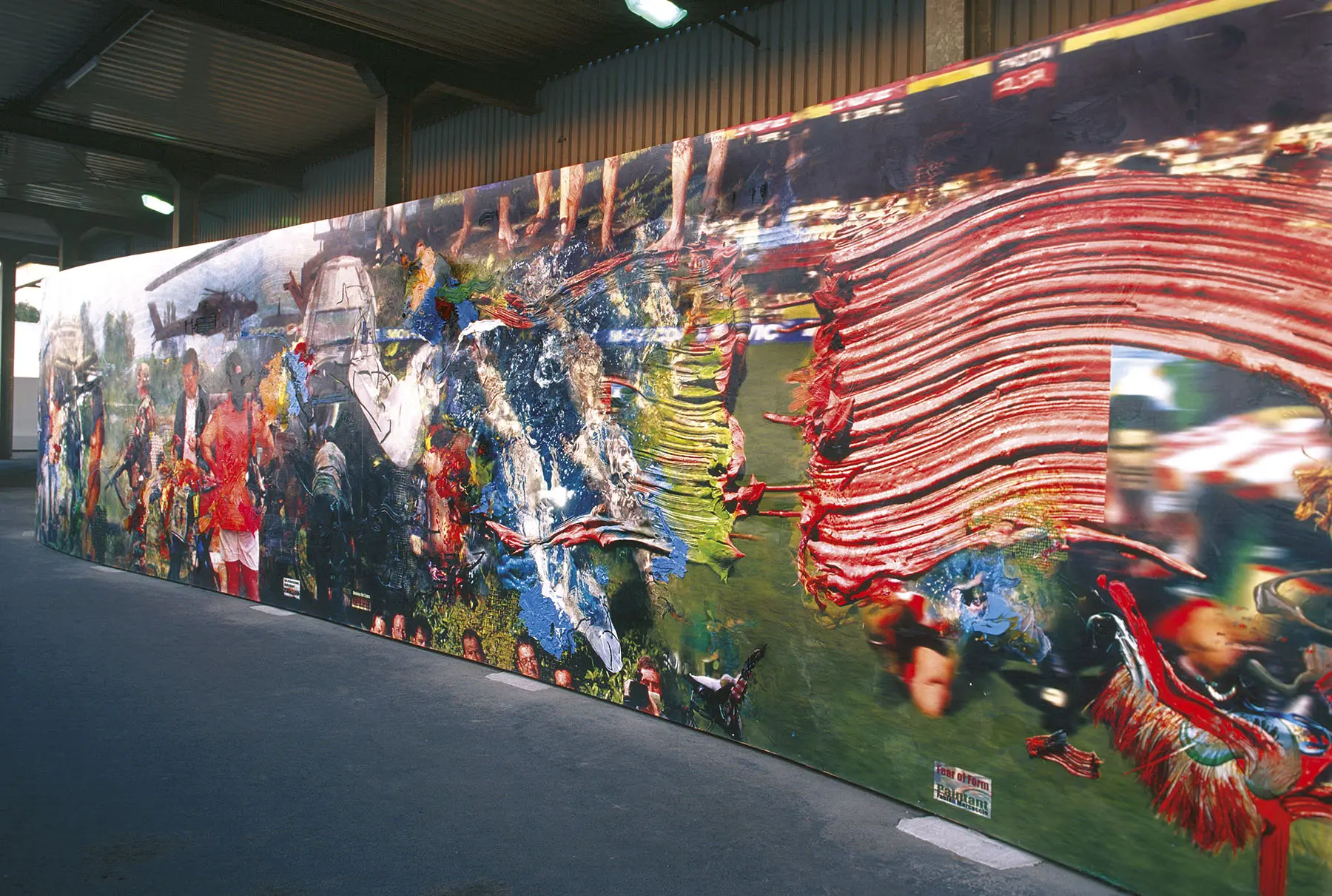
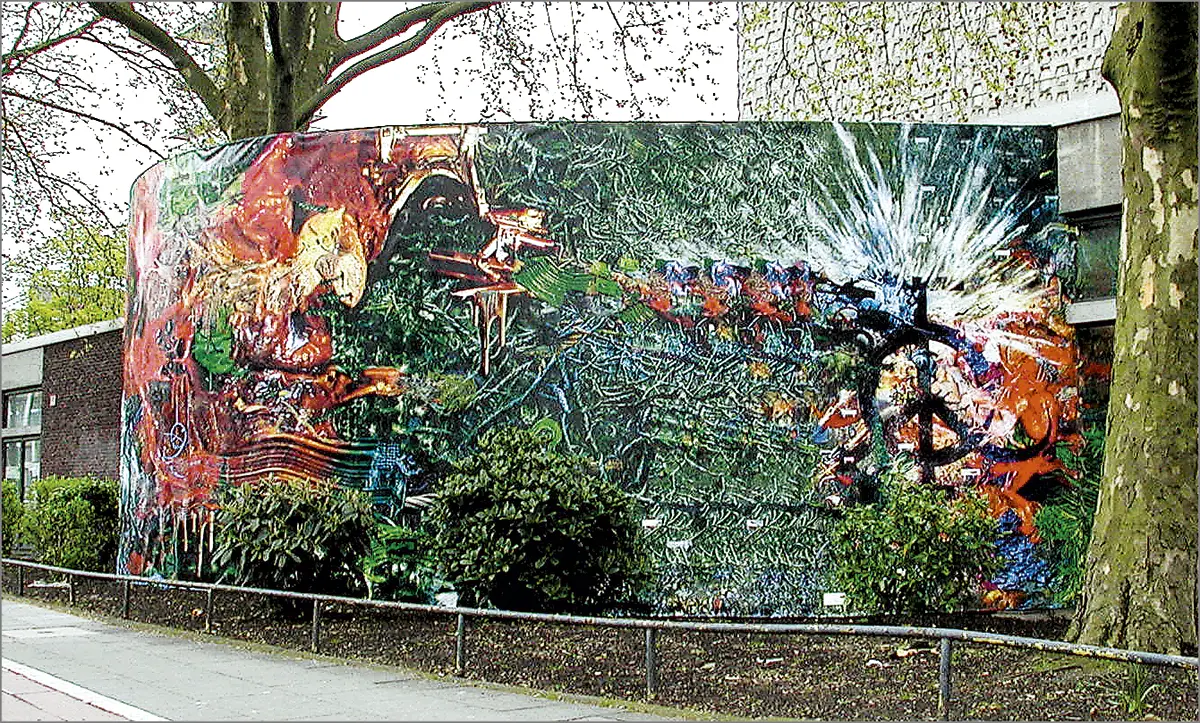
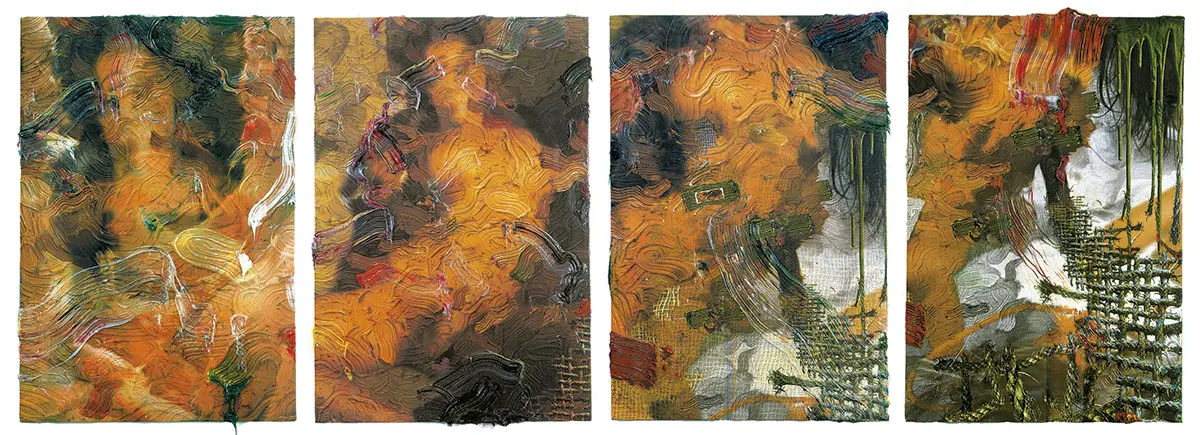
Fabián Marcaccio is perhaps one of the artists who’s working currently with a more original model of radicalism. In his paintings —or “paintants,” as he called his most recent works— there’s no frontality nor unity of image; instead, there’s an infinitely dense and labyrinthic tale that fuses digitally-printed photographic images with a sort of morbid outgrowth of history of abstraction. The piece that Marcaccio is presenting at Documenta’s XI edition in Kassel, Germany, constitutes a three-part pictorial installation that has been set up outdoors, under some eaves. Each of the three segments is mounted on a huge wooden easel that’s three meters high and undulated —a structure that can be seen from the front or the back as if it were a sculpture. The installation is presented as a series of hellish licks of images where painting, photography, architecture, history, and abstraction collapse together, interweaving sequences with strange creases and couplings.
In this interview, granted in New York, where Argentine Marcaccio has lived since the late 1980s, the artist talks about his work, including the one in Documenta. He also talks about Formalism and Conceptualism, and how his work’s complexity reflects the way we live.
Inés Katzenstein: The piece you presented at Documenta is titled Multiple Sites Paintings. What do you mean by "paintants"?
Fabián Marcaccio: I’ve used the term "paintants" since 1995 or 1996 when I began to feel the urge to better define what I was doing at the time: a sort of painting, pictorialism of sorts involving photographic material, digital painting, sculpture techniques such as casting; in a few words, whatever the piece needed. I wanted to verbalize that situation.
IK: Paintant seems to remind us of something “that paints” or “that’s painting.” It appears to be referring to a painting that’s continuously painting itself as if the work were more a mechanism than an object.
FM: Exactly. In this biennial, Yuko Hasegawa, curator at the 2001 Istanbul Biennial, introduced my work as a painting that’s engaged in making itself, swarming, dispersing, as if it had an automatic pilot.
IK: What’s the construction process of one of your pieces?
FM: That’s one of the most difficult things to explain. Sometimes I start with a photograph of a trail, and later I relate it to a pictorial background. Other times it is with a pictorial model that I digitize later. Some other times I begin with a concept for relief. It varies.
IK: Do you work with a large bank of digital images?
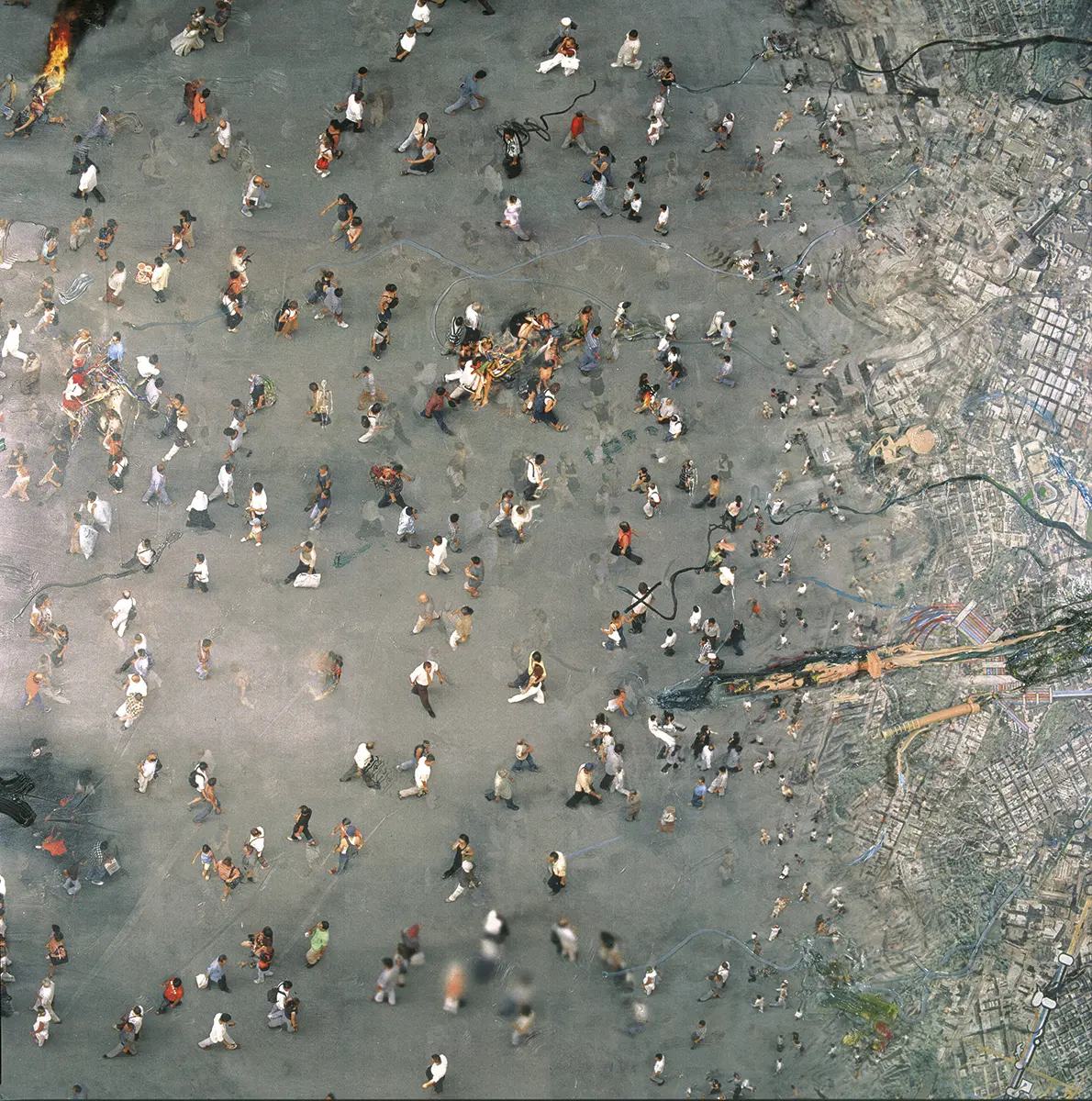
FM: Yes, it’s like a cast of images that act with one another. But the way in which the piece is done is never systematic, it’s more an empirical process. For example, what I call “field work” sometimes involves going out to the streets and taking photos, some other times it means taking pictures of a square centimeter of paint in my shop. This movement from the micro to the macro, from the shop to the world’s “site” —the idea of “multiple sites” on which these works are based— is important because I think we live in a reality that has multiple sites. The notion of unitary space of the 1970s went into crisis during the 1980s and 1990s. For example, Land Art began to need photography in order to document the site, and such photos have become the work’s peripheral nests. On any given morning, one gets up, drinks a cup of real coffee, checks e-mails, hears a honk, and watches TV. I want to make my work part of that virtual-real collage inside which we live today.
IK: What do you consider real in your work? After digitally printing the work’s surface and then going to the gallery’s concrete space and retouching that surface with painting?
FM: There’s a certain level of reality that has to do with photography, and then there’s another level, which is the one you’re referring to, that has to do with the paint’s basic materialness.
IK: Since the mid-1990s you have printed your works on the canvas used for public billboards. Then you hang them with a system of ropes that also remind us of them. You even sign and name your works through the “pseu–do-labels” that you have incorporated into the image in the same fashion that the names of advertising agencies appear on billboards. In the relationship between your work and advertising techniques, how do you view the tension between mimesis and criticism?
FM: There are fundamental differences. Advertisers take a photograph, manipulate it, and blow it up; they make Mexican muralism but without its ideology. I do the opposite equation; I create a (digital)
the file that’s as big as the street billboards, but I work at a micro-level. From afar, you would think that you could view it as a banal image, the same way you see an advertising sign, but in my work, there are so many elements to see, so many distances involved, that ins-
tead of relating to it synchronically and frontally, as it normally happens with painting, the end product is a situation that’s more related to the ways of watching a movie: zoom-in and zoom-out.
IK: This takes us to a discussion about the type of spectator painting versus the type that cinema, or advertising, has built. That’s a discussion that’s fundamental before we can talk about the “politics” of a work of art. In this regard, the fact that Multiple Sites Paintants is a very long, three-part painting that the spectator must walk through would seem to propose a specific model for contemplation…
FM: The multiplicity proposed by my work allows the spectator to edit the piece in real-time. Contrary to the movies or the “black box” of contemporary video space, he’s not forced or conditioned to see only a certain image. The piece can only be seen by zones, never in its totality. This idea has to do with the way we think nowadays. We never have two thoughts at the same time inside our heads. We always have to focus on something specific. At the turn of the last century, people would see a cubist painting and would not understand a thing; but today reality is cubistic.
The Media, Politics, Collages
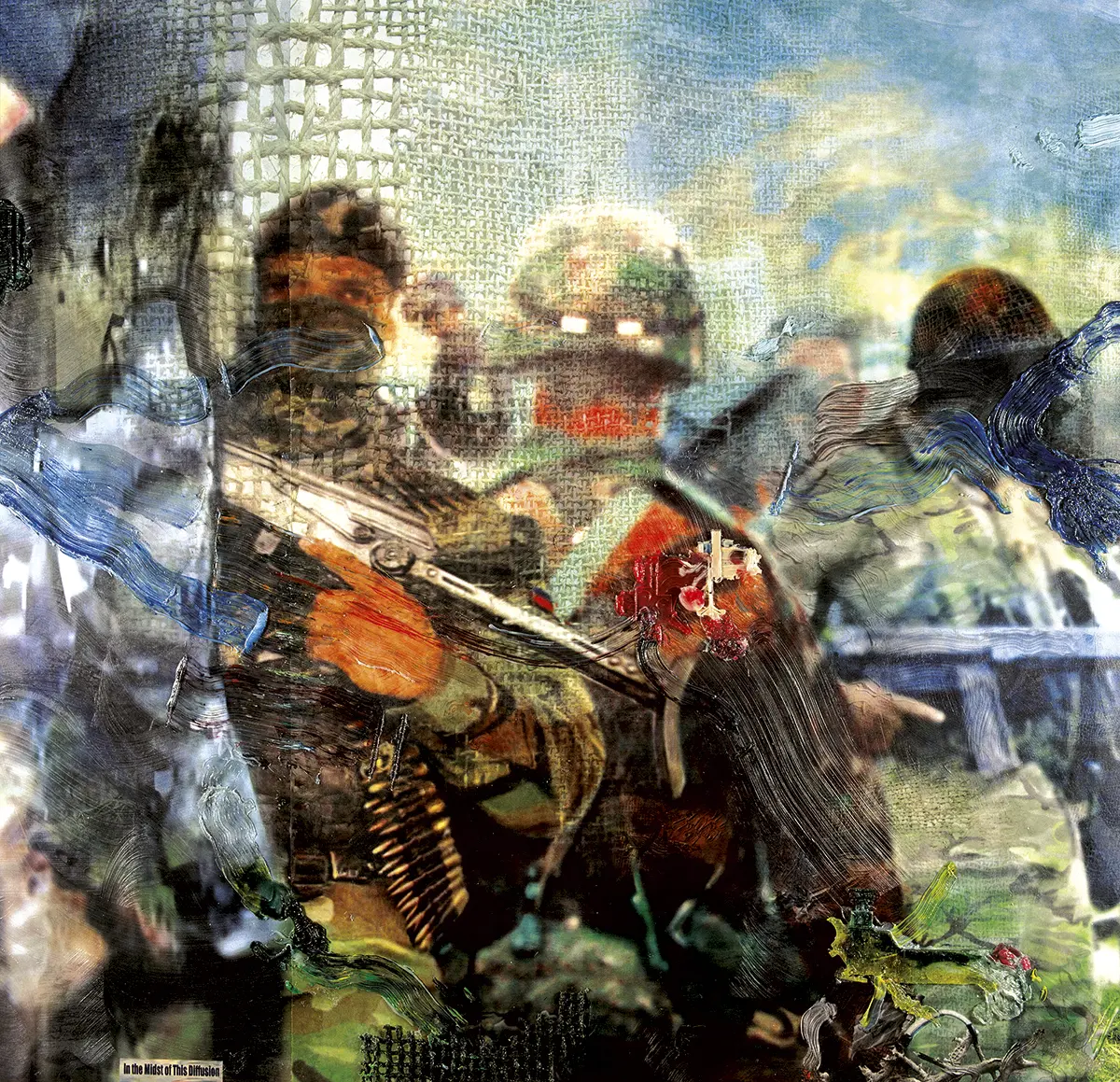
IK: The piece you presented at Documenta XI is based on a collage of different scenes —political rallies and characters, enigmatic scenes, war— that remind us of globalization in general, which is the subject defining the exhibit’s conceptual framework. (In fact, on one end of the piece we can see photographic images of an anti-globalization demonstration in New York). Multiple Sites Paintants appears to be your first “thematic” or “explicitly current” work, despite the fact that some years back you have incorporated figurative images and political symbols into your work. ¿How come the piece comes forth as being so closely adjusted to the exhibit’s profile?
FM: I started working on this material about a year and a half ago when I still didn’t know that I’d be invited to Documenta. It’s a sort of panorama that I consider critical to the media. I’m criticizing the media in terms of both techniques and mass communication. The piece is like an examination of these issues, but it also analyzes other issues such as globalization. I see globalization as a myth because at this moment the world’s problems are in certain regions. The notion of globalization helps businesses; in this regard, I think that in part it’s more important to explore the problem of focus —what mainstream media focuses on and what it leaves out in total invisibility.
IK: How does the idea or the possibility of facing a painting project that’s current or one that’s political come about?
FM: Many of the scenes or pictorial areas found in the piece at Documenta came from Paintant Stories, a show I had in Germany in 2000 [at the Stuttgart and Köln Kunstvereins]. I tried to say that it is impossible to make a historically new painting, but you can tell stories while, in terms of technique, you talk about how the painting is being made. In a perverse way, Multiple Sites Paintants works on showing not only how the media “makes representations,” but also how production itself currently works. In this sense, I use the same techniques of production as the system. Today you can design something on a computer in New York, have it reproduced in Taiwan, and finish it in Nicaragua. In this situation, we see that the techniques of collage have been absorbed by businesses, with money laundering and the loss of rights that this system promotes. We could say that collage equals the Mafia! At this moment, the production and consumption system are a collage capable of softening its boundaries. It’s such a sophisticated system that it leaves antiglobalization groups speechless. If the collages of the avant-gardes were extensive and incoherent, my project is to create a coherent intensity, complex pictorialism that has nothing to do with the pastiche or the collages from the 1980s or early 1990s. Going back to Documenta, I was quite interested to see that the exhibit’s context made my work be seen as a fictional documentary because I take elements of reality but without the neutrality usually found in the documentary.
Notions About Art: Formalism, Conceptualism, and Latin America
IK: Your work elicits opposite reactions —it either produces a strong attraction or a huge rejection.
FM: Love or hatred.
IK: Do you think that this division is produced by your work’s impact on issues related to taste?
FM: I think it has to do more with notions about art, with the way in which art history has been written during the last 30 years. My concept of abstract painting is not the same as the typical American one, nor is it the same concept as the ready-made.
IK: But those artistic models or paradigms imply very specific requirements of taste…
FM: Yes, and that’s why I think that in order to be able to digest my work, one has to “see” the work’s implicit concept. This issue of artistic notions interests me a great deal. For example, Duchamp the noisemaker —the one in Étant Donné and Reciprocal Ready-made— does not appear, he’s almost invisible. The reinterpretation of Duchamp that can be seen today is Robert Gober’s Disneyland-Ready-made, or the folkloric ready-made done by artists such as Gabriel Orozco. This last case is interesting, no? Think about it: no one has ever known what to do with Latin American artists; the solution has been to “sift” them through the post-minimalist filter so they look elegant inside a gallery. The perfect example of this is Félix González-Torres, a tremendously generous artist who did it quite well.
IK: Taking as reference the Latin American art you’re alluding to, how did the notion of your work that you defined a few minutes ago as being neither Formalist nor Conceptualist was formed? Where and how did you acquire the vocabulary you have been using since the 1990s that has the tendency to associate itself with the history of abstract painting in the United States?
FM: I’d say it came about when I arrived in New York, in 1986. At that moment I was curious about two things: what was being said as far as criticizing the media, and what was happening in the world of abstract painting. Immediately after landing in the city, I got in touch with artists such as Peter Halley and Jonathan Lasker, whose works helped me establish a dialog, ignore the conceptual apparatuses, and find out what I could get out of painting. In terms of my own work, I see a total continuity from what I was doing back in Argentina and what I began to do in the U.S. Two artists with whom I grew together are Antonio Berni and Lucio Fontana. They’re hardened, brutal artists, and their notions were quite different from the Europeans or the Americans. What’s more, in the case of the most unitarian Argentine art —Carmelo Arden Quin, the art by Madí, concrete art— we find that it has an incredible rarity and that it’s far more brutal than any other geometrical art anywhere else in the world. It’s discordant at the level of color, geometrically confused. Remember that they were the first ones to cut the frames… And that happens because our struggles are far more confused. As an artist, one knows that he is not being read…
Abstraction, Structure, and the Image of the World
IK: How did you project the relationship between the Documenta piece and architecture?
FM: My initial proposal was to install the work’s different “areas” in several places in the exhibit hall and the city. But in large shows such as this one, it’s very difficult to organize this type of installation. At the same time, the piece began to show more and more coherence within itself, it began to form as a total passage. It occurred to me that the piece could be a passage entering and leaving a building. Finally, after many proposals, I was able to have the piece installed in that ambiguous space, outdoors but protected, which made it be seen in a particular fashion due to the contrast between the digital images and natural light. It was like a digital plein air, a paralyzed drive-in movie theatre.
IK: If we take into account your work’s history, from the early and mid-1990s you’ve been working with a vocabulary of brush strokes and drips that comes straight from Abstract Expressionism —what you call “trans-formalism.” Later, the language of reality —to give it a name— begins to make pressure and push, to mingle with that repertoire of abstract situations, finally entering the piece. How does that transition come about?
FM: The transition occurs as an evolution of my post-formal pictorial compounds. It was an evolution through which these compounds began to work as sign systems —crosses, swastikas, etc. But I want to emphasize that brushstrokes in my work never stood alone, they were always related to something else: the way it infiltrates into the line, their dependence on the support, and their infectious relationship with the frame. They are the same operation I’m using currently.
IK: Structurally, as a strategy, there’s no doubt of the continuity of that moment and the present day. But in your work of the last six or seven years that stroke, besides relating to the pictorial elements,s also relates to images from the streets. The world enters the painting, swastikas appear, also peace signs, photos of people and places, and bodies.
FM: The model of contamination, which is the active model I work with, that sort of projection of form freed from its content, was what produced the hybridization that began to dialog with signs. On the one hand, one of the images that “entered,” as you said, the painting was the passage from the English term "social fabric" to the term "pictorial fabric." That was in 1994 and is translated as the passage between the image of a crowd and the image of a cloth.
IK: The first works of yours that I know are a series of paintings and drawings done in the mid-1980s in Argentina. They are landscapes in which typically we see a man with his back toward us painting a catastrophic landscape where there are some explosions on the horizon. There is even some sort of men-apes crossing the landscape. Multiple Sites Paintants appears to go back to those themes, not only because the piece is a panorama or a sequence of scenes of conflict, of multiple quotidian wars, but because it includes the image of a painter with his back toward us, who are either watching or painting the landscape. Is that return to the origins of your work a conscious strategy?
FM: It’s true, somehow I’m revisiting those works. The image you point out interests me because it creates problems for the legacy of abstraction, but figuratively. The idea of being outside the frame, for example. But the idea of the battle paintings is a continuum from those first paintings I did back in the 1980s. In the 1990s, they transformed into pictorial battles, which I consider my first true work. Think that one of my first shows was named after the title of a thriller, Mutual Betrayal. In those works of the 1990s, I took the idea of a battle in which the paint fought itself in order to produce paradoxes. Then, a sort of reciprocal surrealism emerged: instead of using strange images, as the surrealists did, the objective was to rarify the pictorial system and see what happened.
IK: To what extent do you think we can continue talking about painting, or when is it worth extending the term?
FM: That’s a good question. The fact that I call my works paintants has to do with that. I changed the word because it seemed to be a new way of painting. There’s no doubt that painting is going through a major crisis and it’s trying to redefine itself. In this context, I’m interested in exploring the question of why painting continues to be so interesting. To take painting as a constant reinvention, as if one has to continue despite the fact that he knows that it is impossible to do so.
INÉS KATZENSTEIN
Art critic living in New York. She received a Masters degree from the Center for Curatorial Studies, Bard College.