
Since Harry Abend began carving wood during the 1950s, many felled trees have acquired a new life through the compositions the artist has been depurating through the years. This is evidenced by the latest reliefs, shown in Galería Félix between May 25 and June 30, along with drawings, woodcuts, and sculptures done in previous years. The continuity of a discourse developed through different stages and techniques hasn’t abandoned its Constructivist reminiscence based on modular conception and research into relief. Such is the case of the projects he integrated into the architecture, and the individual creations as well, done during the 1960s. Here, the geometric and the organic, the linear and the casual, chaos and order, seem to conjugate hidden tensions balanced invisibly by the artist’s compositive juggle –hence their potentiality and dynamics.
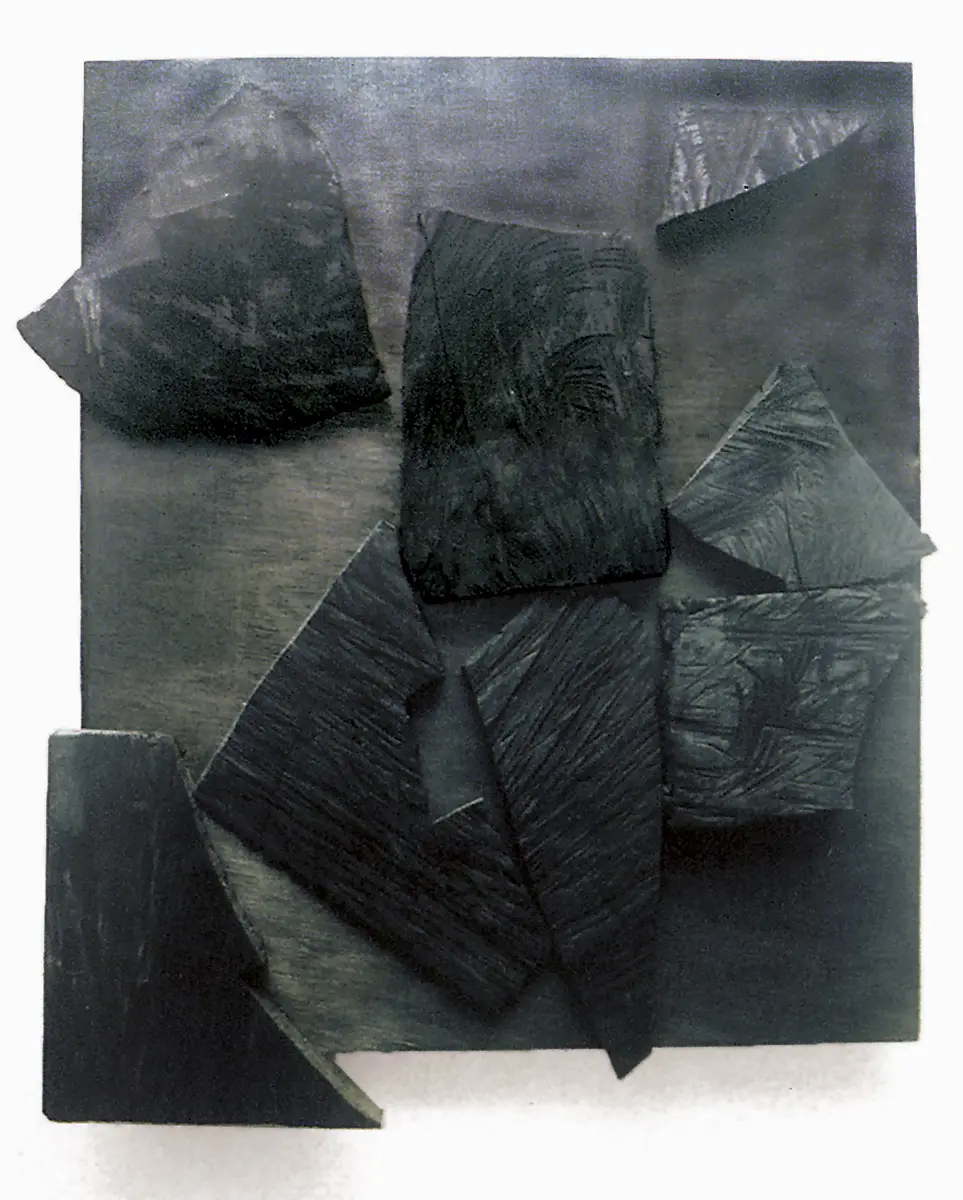
The series of reliefs (wood and black-tinted supports, 2001 and 2002), a group of works with rectangular, round, or square bases, support wood shavings, wooden plugs, tree trunk wheels, or pieces of hacked wood distributed rationally or randomly over the smooth format. The contrasts between light and shadow, empty and filled spaces, protrusions and depressions, are achieved by the superimposition of the elements over the plane, which are subtly differentiated by the black-matte tint that gives unity to the show, avoiding visual divagations while sharpening our perception for a silent and detailed reading. In pieces like Una caminata más por el parque (One More Walk Through the Park) and No pienso más en Ti (I No Longer Think of You) (both from 2001), the irregular shapes seem to have been frozen by the absolutely geometrical supports. In other compositions, like Cualquier momento puede ser bueno (Any Moment is as Good, 2002), the abstract shapes and vertical wooden strips create clashes between the different shapes and the fibrous materials, trapping the spectators’ gaze as they walk by them. In sculptures such as 2da. Serie de las hachas (Second Series of Axes, 2002), we note wooden fragments aligned over a straight base. By constructing rhythmical sequences to take advantage of visual accidents, Abend reaffirms his interest in organizing space, undoing and redoing volumes, and shaping matter. The artist’s proposal on relief is consistent (Hotel Caracas Hilton, 1969; Sala Plenaria, 1974; Teatro Teresa Carreño, 1980-1982; etc.), including sculptures such as Serie de Bongo Grande (Large Bongo Series, 1994) or Instalación (Siete piezas) (Installation [Seven Pieces], 1998), where relief is minimized to give room to shape, volume, and space activation. The consecutive chisel strikes on the wood can be found in an embryonic or potential state in the drawings done in 1983. The powerful strokes —straight or gestual in some cases, but decidedly repetitive in all the pieces, as can be seen in Sin título (Untitled), oil-stick on paper (1983)— show a strong opposition between the black pigment and the white background, creating groups, both saturated and degraded, of lines and stains that seem to herald his later carvings and reliefs. Abend knows and masters space, matter, and shape, that’s why he acts with such freedom. With a trajectory spanning 44 years of uninterrupted work, Harry Abend’s current work, as stated by Juan Carlos Palenzuela, “sustains itself on the premise of freedom understood as ease, honesty, and nerve… The artist’s current production moves freely among the time-loaded shavings and hacked pieces of wood.”
GLADYS YUNES