The young, self-taught artist Jorge Caunedo exhibited several pieces in which he alternated painting, prints, objects, and sculptures grouped together in three areas corresponding to man, insularity, and the immediate surroundings. Running from April to May 2002, the show was titled Área semi-restringida (Semi-Restricted Area). It was held in three adjoining halls (awaiting restoration) inside an important colonial building located at one end of the Plaza de La Catedral (Marqués de Arcos’s old house in Havana’s Historical Center.)
For the first time (and perhaps due to his background as an architect), Caunedo dared to intervene in spaces, in this case in poor condition (not too favorable for the conventional art show). He did so with total freedom as if anxious to confront a heterogeneous public familiar with the legitimized and institutionalized places used to promote Cuban art in the capital and the countryside. Precisely, one of his objectives was to show several pieces and the space itself as the elements of the same group, daring to appear as unfinished, undecided, though prepared to give the spectator more than a few surprises.
What one remembered of these spaces is that for many years they housed the Taller Experimental de La Habana, and then were abandoned. On these dank remains, broken floors, half-collapsed windows, missing doors, and exposed brick and mortar, the artist organized his own montage and “cleaned” up some of the archeological “evidence” that time eroded, complementing his ideas regarding the three areas mentioned before. On the one hand, he was a sort of Robinson Crusoe, building everything from scratch (without external resources, monetary or otherwise). And on the other, he developed his own notion regarding the viability of showing works of art outside the general model used by Cuban art institutions. All this to somehow measure capacities, the vulnerability of certain limits, and the artist’s own spirit of resistance before any adversity.
Caunedo also tried to relate art and architecture at the level of spatial sensation and human effort. With the exception of Espacio Aglutinador, developed by Sandra Ceballos and Ezequiel Suárez in the early 1990s, this sort of effort hadn’t been seen before in Havana. In this, his fourth solo exhibit, Caunedo aimed his talent in different directions: photography, drawing, painting, collage, objects, sculpture, prints, and mixed media techniques. He is unexpectedly insolent and daring, and he successfully completes the test in which he juxtaposes the drama of homelessness, migration, war, and economic strife.
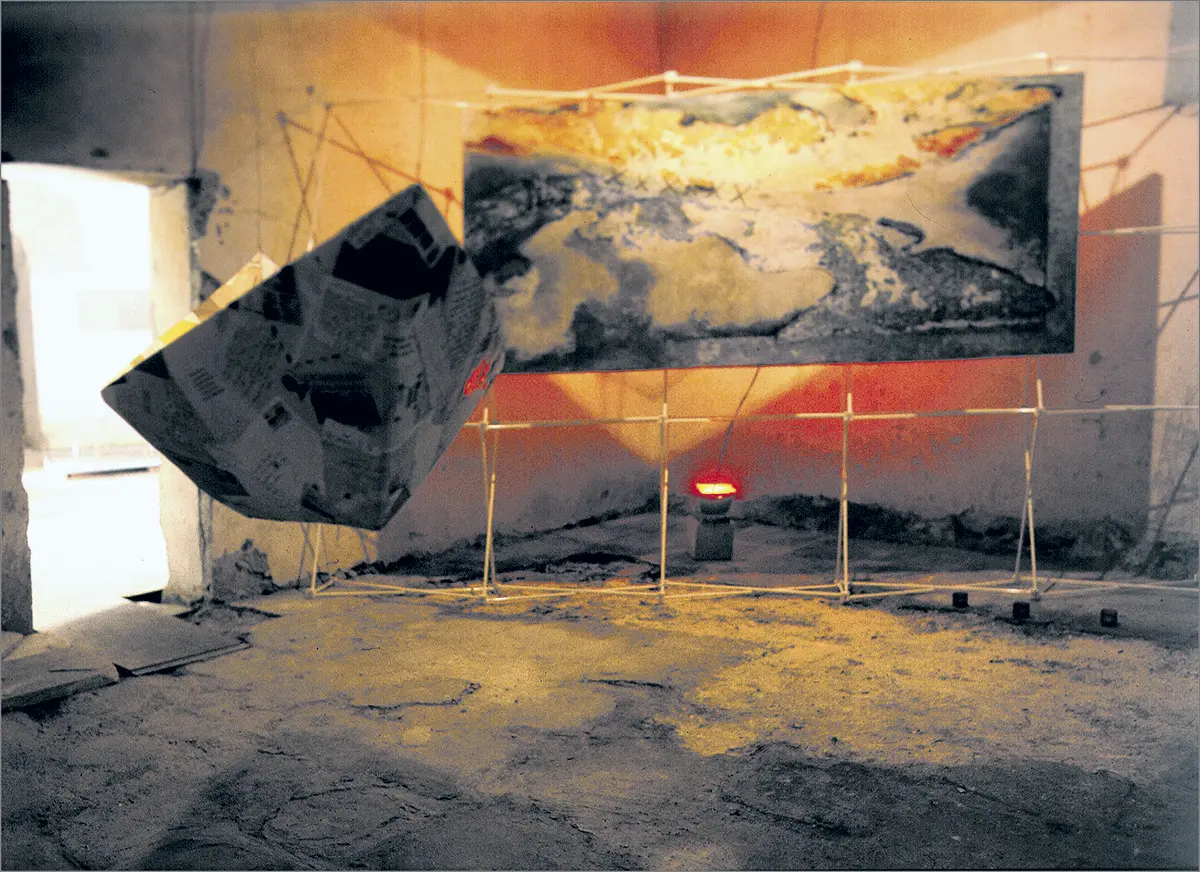
The different pieces are threaded by their power of synthesis, as well as their economy of means, giving them an aura that’s closer to posters than painting or any other expression. There is not the slightest hint of self-indulgence, nor do they try to denounce the important concessions the art market has made, thus contributing to the country’s delicate economic situation. Caunedo is not interested in trying to legitimize what has been established or approved. There are, of course, juxtaposed emotions, since most of his topics and quite sensitive within the collective imagination of a society that’s engaged in an endless fight with them.
His use of materials as diverse as flour, oil, eggs, fire, polymers, wires, acrylic paint, thread, paper, plastic bags, tiles, official stamped paper, letter envelopes, mail stamps, newspapers, tickets, stuffed animals, confer on the pieces a special sense of precariousness and urgency. At the same time, they end up being a warm homage to the cultures of recycling that have emerged in countries whose economies are subjected to the constant, periodical crisis. In his case, the use of such materials is not a choice, but an unquestionable need. Caunedo is not one of those artists whose money has helped them create works without any hardship (there are so many of them in Cuba). On the contrary, he reminds us of those Spaniards known as los espontáneos (“the spontaneous ones”), those who jump into the arena during bullfights. Without being invited and with no advance notice, they are ready to engage the bulls in front of an excited public that applauds such risqué and courage.
The artist’s best works are within the mixed media techniques and the object, and in the masterful handling of drawing on non-traditional supports (such as the use of wire to delimit figures and then printing on construction paper). Caunedo is simultaneously an artist, artisan, and specialist, with an evident mastery in each category. Despite alluding once more to the theme of insularity, he does so from a different perspective. He emphasizes social and psychological duality—a disjunctive we’re all subjected to—as clearly evidenced by one of the show’s most notable pieces, Cuba doble (Double Cuba).
The remaining topics that interest him are treated lyrically, without any affected stridency. He tries to strike a chord that has not yet sounded in Cuban visual arts—not an easy feat by any measure. Caunedo achieves it while keeping a low profile and from a conceptual modesty that’s different from what we habitually find in our environment. We are keenly interested in seeing his new incursion into our institutions’ borders.
NELSON HERRERA YSLA