From the beginnings of the universe, travels and journeys have marked human beings. Even when confronted with the unknown, such travels have an implicit dream. For Karina and Marcelo Chechik, their journey to the United States has left a deep imprint in their work, not only for the meaning itself of confronting a new culture (so frequently sublimated) but also for the uprooting and abandonment implied in it. Taking into account all the places, images, smells, etc., it has accumulated with experience, the brain finds parallels almost as an obligation and an unconscious task. To this add the knowledge gained by means of reading literature, and you have described the life of these two creators.
Based on the literary word, one can find images that will be represented on canvas or paper. To develop their poetics, these two artists have used as inspiration Jorge Luis Borges’ and Julio Cortázar’s philosophical bases regarding experience and human relations.
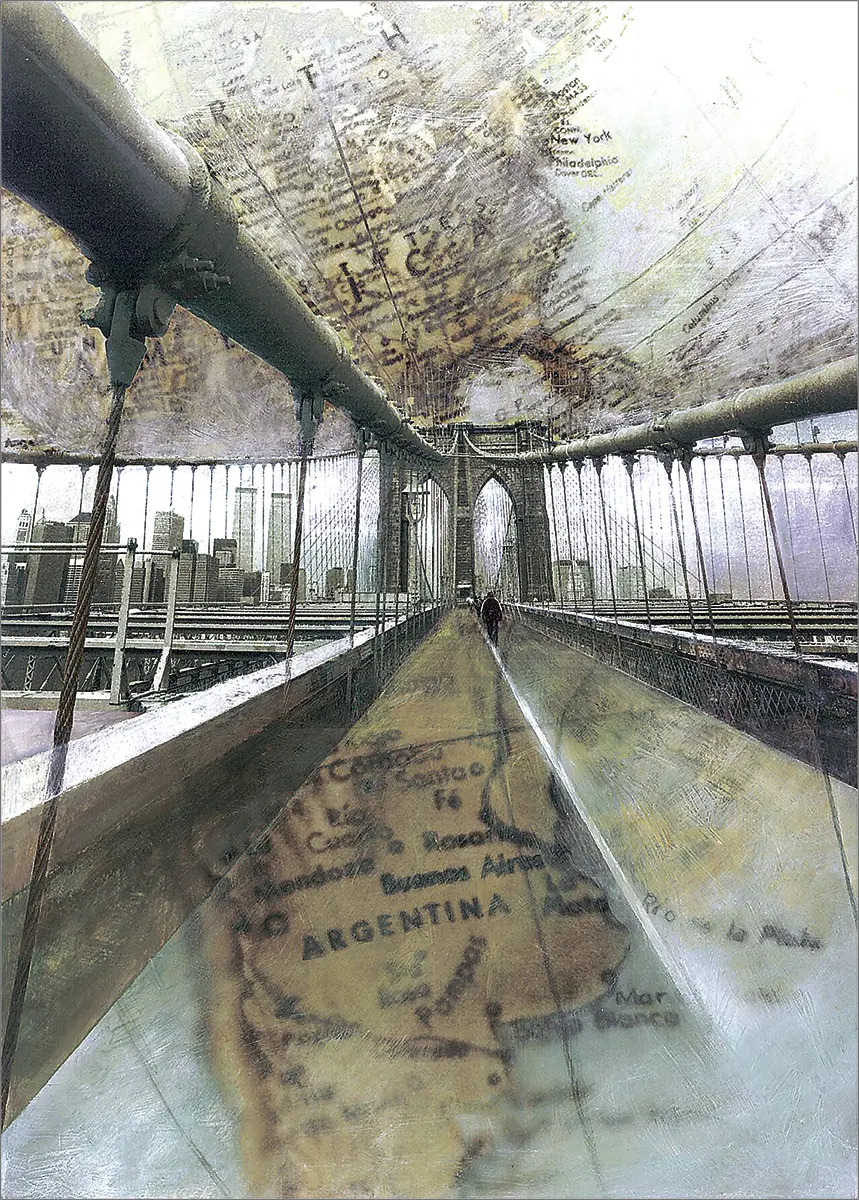
For their recent show, held at the Bernice Staimbaum Gallery in Miami’s Design District, Karina and Marcelo Chechik began to study American thinkers. Martin Luther King, Jr., Abraham Lincoln, and John F. Kennedy were the three chosen by using their famous phrases that speak of and are part of this country’s development. Flooding the gallery’s walls as the works’ protagonists were icons and images identifying the United States, views from New York and Washington, railroad tracks, and typical logos of famous US transnational companies. Photography, painting, and installations alternate with each other to form a mosaic that speaks of everything that’s part of this nation. Phrases such as “Ask not what your country can do for you, ask what you can do for your country,” uttered by President Kennedy in one of his speeches as a rallying cry to generate a concerted effort to push the United States ahead, are part of a project that aims to show us a country from the perspective of those who have to lead it and those who have arrived at its shores and have become part of it.
It’s inevitable to find common points with the individual reality immigrants come from. That’s why some of Marcelo’s photographs turn the Vietnam monument into the protagonist of his work –to establish a parallel with the obelisk dedicated to the soldiers fallen in the Malvinas (Falkland Islands) war. In his photographs, Marcelo seeks to reflect the spontaneous and ephemeral reality using the richness offered by the image at the very moment it has been shot, without manipulating it. Karina, on the other hand, uses photos of her brother or the meticulous reading of the texts, to culminate in a reinterpretation that doesn’t seek to support the phrases or the literary discourse, but to offer a more personal focus, a new reading.
The show can be classified as autobiographical. It’s the vision that the creators confront and have assumed using tools such as knowledge and experience. At the same time, they have become part of and have made their contribution to a country that has been shaped by the endless arrival of thousands of persons who, like them, offer their best. For Karina and Marcelo, the trip has not ended, though they have reached their farthest northward point yet. They continue their journey by researching and getting to know a circumstance that has become an essential part of their lives, just as essential as the one they left behind.
MARISOL MARTELL