In its brand new installation, the Jersey City Museum started this year an ambitious series of new projects by contemporary artists, among whom we find Manuel Acevedo. Acevedo (Newark, New Jersey, 1964) has reflected and worked for more than a decade on the landscape and its changes and cultural aspects. He has exhibited in P.S.1, The Drawing Center, Bard College, and The Barrio Museum. For a recent residence spent at Harlem’s Studio Museum, Acevedo began to work on “flipbooks.” In his last project, Acevedo used this alternative visual poetic narrative to cover themes that are both personal and collective. This interest continues with his Jersey City Museum project, curated by Rocío Aranda. Titled The Albizu Project, the exhibit is the result of the long research that Acevedo has done on Pedro Albizu Campos, the Puerto Rican thinker and political leader who is an essential figure in 20th century Puerto Rican history and was one of the most fervent advocates for the island’s independence.
The project consists of a series of “flipbooks” with poems to be manipulated by the public. There are also related photographs and a video with the books’ poetic texts along with historical and fragmentary images of Puerto Rico. When choosing a personality with such a political weight for an entire community, Acevedo is entering a mined field, revisiting set notions on Albizu’s life and work, in this case, to reflect on the Puerto Rican identity and other current topics regarding the conflictive relationship between the island and the United States. For this, Acevedo makes us of his books’ poetry as a generator of images juxtaposed with the images from the video, making reference to fictional characters such as Uncle Sam and the jíbaro, Puerto Rico’s peasant figure. The poetic texts succeed at being the bridge between the narration of Albizu’s apparently biographical facts and the island’s present dilemmas regarding its independence.
Perhaps one of the project’s most interesting aspects is that the artist shows his sketchbook, giving us a glimpse of the development of his research, along with other, unfinished projects, evolving ideas, and the sketches of some of the works included in this exhibit.
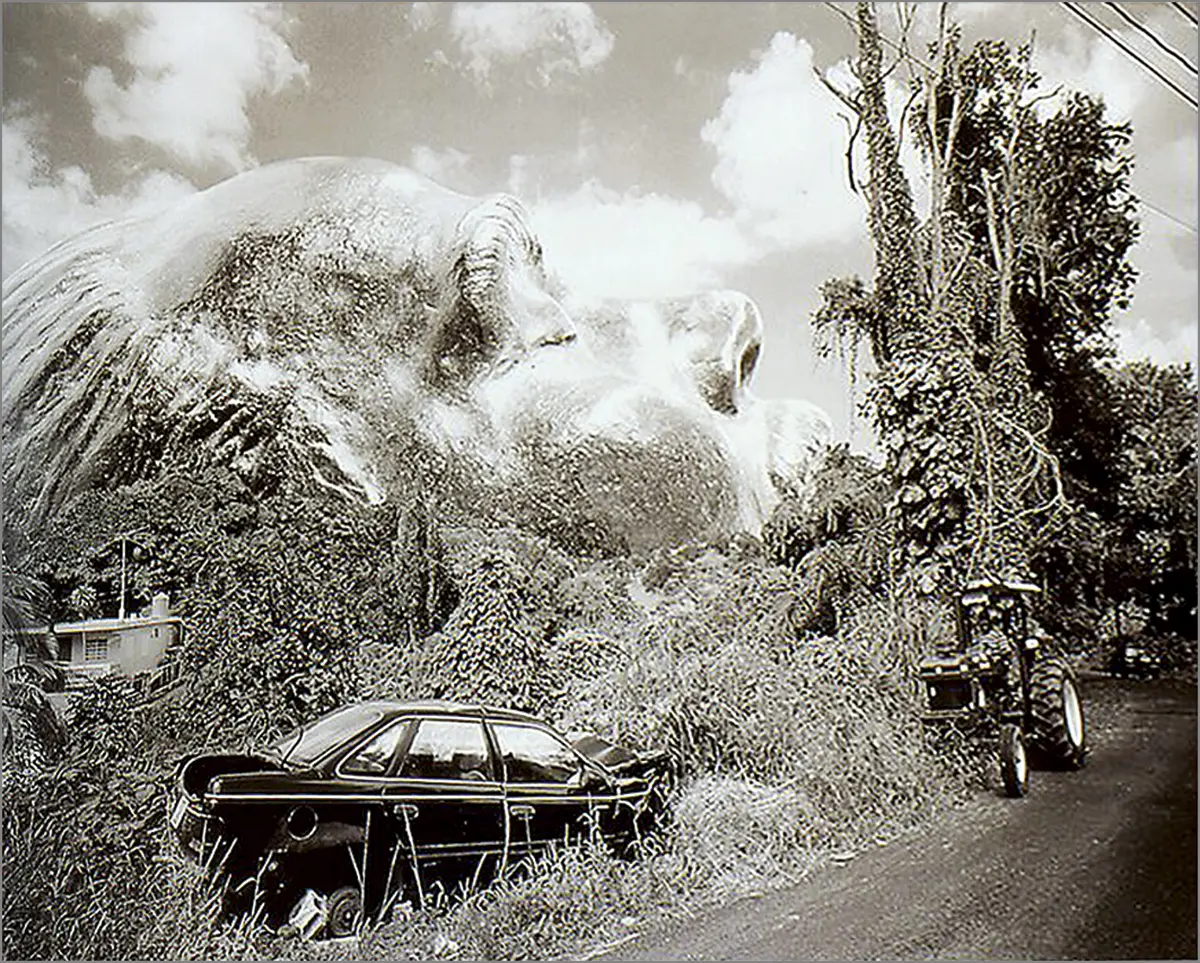
The digital prints integrated into some of the works are examples of how Acevedo invents ghost-like apparitions of Albizu’s image (using an image of the patriot’s death mask). For example, the image emerges, almost unbelievably, suspended in the air through an airport window. In other pieces, Albizu’s face appears in a landscape’s background as if it were an Edenic, snow-capped mountain, the unreachable utopia. In the foreground, there are a car and a tractor, both ruined, lifeless testimonies of the fruitless efforts of the Puerto Rican economy to achieve economic independence in the city and the countryside.
Acevedo’s exhibit is a constant juxtaposition of utopias and distopias. The artist appears to be confronting the public —especially the Puerto Rican public— with the meaning of Albizu Campos’ legacy for future generations. In the way that Acevedo distances himself from the romantic aura surrounding the hero’s figure, he invites the spectator to engage in a reflection that goes beyond the mere adoration of a historical figure. Instead of being a rigid homage or a tired repetition of Albizu’s historical value, Acevedo’s works help stimulate a debate about the real problems plaguing society.
PABLO HELGUERA