Through her photographs, Maria Martínez-Cañas “constantly confronts herself with personal issues like belonging, alienation, and her position in the outside world.” For the past twenty years of an extraordinarily successful career, she has created unique photomontages that combine experimental technical processes with a complex of image fragments. The images are collected from archival research, maps, books, paintings, travel experiences, and other socio-cultural icons ranging from postcards to stamps to cigar labels; all of which relate to her Cuban heritage. Most recently, she has collected her images from her garden and embarked upon new avenues of visual exploration that are based on new media and issues of personal identity and physicality while never losing the distinctive aesthetic that informs this exhibition.
This retrospective, the artist’s first in South Florida where she resides, includes an early video (that already hints at her search for self-identity) and over 100 photographic works that document her experimentation and mastery of the distinctive technique that is based on drawing and cutting out of a graphic-arts material called Rubylith, adding photographic negatives, and stripping the material to reveal its clear Mylar base. The result is a large-scale negative that she prints onto photo paper, converting negative collages into positive photomontages. Beginning with rather simplified island shapes and patterns that provide glimpses of cities and countryside, her work becomes more technically complex over the years as she experiences a range of influences, works in series, and explores the potential of the computer, scanner, and video to enhance the basic working of the camera.
The early works in the exhibition not only establish Martínez-Cañas’ direction but also reveal the influences that would inform her work for years to come. Even for those familiar with her career, the early photographs probably come as a revelation that her work is not only about her Cuban heritage and search for that identity, but about the history of photography itself and her place within it, technically and physically. The very same approach to photography that is evident in works from the 1980s, such as Untitled Black Series, 1980-1981 and Dos Huelos, 1989 is represented in the minimalist Bauhaus aesthetic of American photography of the 1970s. The idea of creating a reality out of something that does not exist has fascinated her since and there is no doubt that the latest works in the exhibition that are based on nature signify a return to the same ideas with new media. They also reveal her consistent use of photography to recreate her own reality and search for identity that has manifested itself through different series over the years. This is also evident in the video of 1984, another revelation. Martínez-Cañas has been working in film and video for many years and is now focusing on that media for her new work.
The intricacy of drawing and photographic collages that inform much of her work of the 80s and early 90s and establish her recognizable aesthetic convey to the viewer her interest in many subjects gleaned from years of research. These include elements taken from the paintings of Cuban masters Wifredo Lam and Amelia Pelaez reconstructed with a critical understanding of the symbolism of Cuba’s artistic and ritual traditions. In Tierra, 1990, a jungle of thorns and birds is situated in a tall totem-like construction layered with meaning and emotion.
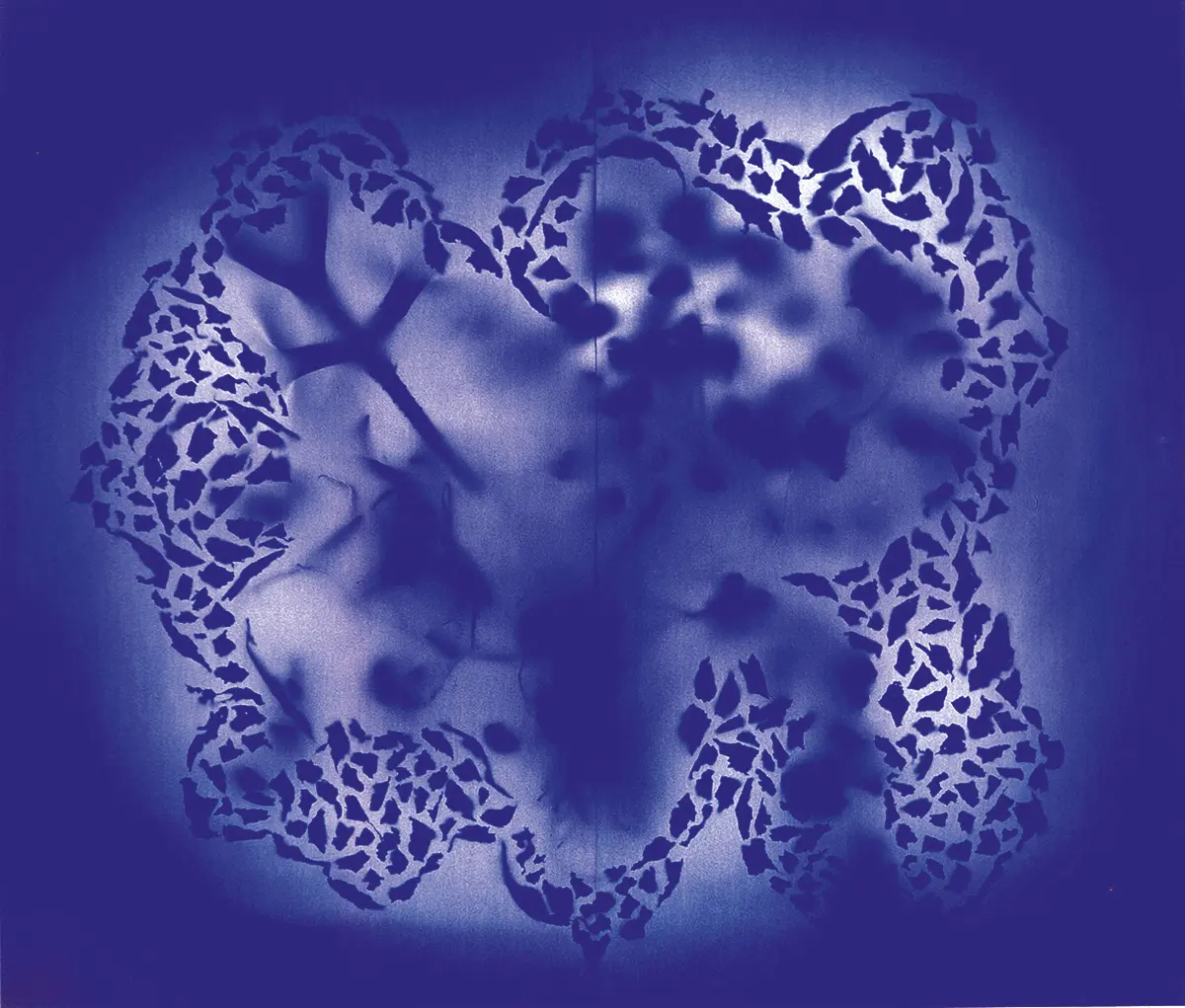
By the mid-1990s, there is a change in her work marked by the completion of Años Continuos, a major commission for the Miami International Airport. The complex photomontages give way to new photographic experiments and new subjects. Issues of mortality transcend the personal with fragile images of nature that include stones, fossils, leaf veins, and other organic forms, including that of her own body, and there is a new spontaneity and freedom to her creative process. Now there are transparent and sensual prints exposed onto a variety of materials in some of the most elegant works in the exhibition. In Flight (Hospital Bed), 1998, she superimposes her own figure upon botanical book images that are exposed on cloth (a hospital bedsheet); a poignant commemoration of the death of a dear friend that is as much magical performance as a photographic image. Garden (Change), 1998, and Metamorphosis IV, 1998, are gelatin silver prints and photograms–camera-less images–of specimens drawn from nature that also seem to be harbingers for her most recent works, Traces of Nature; Lost Nature; Disappearance, Regeneration, and Chance, 1999-2000. Some of the most compelling images in the exhibition are diazo photograms or blueprints, camera-less records of natural objects placed on or near sensitized, and architectural paper that turns blue when exposed to light. The resultant shadowy after-images on large brilliant blue surfaces are as ambiguous as they are beautiful. Once again, as remarkable and original as these images appear to be, Maria Martínez-Cañas has pointed out that the inspiration for such work has its precedent in the 19th-century Victorian Cyanotypes of Anna Atkins, and that she remains committed to bringing a historical context to her work, within a contemporary context.
This retrospective exhibition clearly reveals how the work of María Martínez-Cañas has evolved and that she continues her intense exploration of the world of the past and the present, her own legacy, and her place in its future.
CAROL DAMIAN