
When Colombian art of the last several decades is observed carefully observed and without bias, it is clear that it has not only an admirable vitality but also a surprising diversity which makes it, by all measures, a peer in international art. This diversity prevents a clear appreciation of what’s currently happening, to say the least, and, much less, of what’s yet to come. In any case, each day sees more and more artists. Even if many are making experimental art that goes beyond traditional media, there are also a good number of them who practice "pedestrian" crafts such as painting and sculpture, having proven that they are still valid as media.
Among these last artists, we have Mónica Meira (1949), whose works date back to the late 1970s. Beginning with the representation of diverse objects such as purses, wallets, hats, cloth, and furniture, and then, in the early 1990s, reaching the landscapes that she still makes today, this painter, draftswoman, and printmaker has developed a careful production, achieving her mature stage based on discipline, lots of work, and by confronting the great masters in museums and galleries.
Her current landscapes (populated with small-scale characters, as always) have as background the bathers’ paintings she did during the late 1980s and early 1990s. In these pieces, mostly pastel drawings and oil paintings, the main topic is obviously the human figure –synthetic, elongated and svelte characters, female and male, whose poses and attitudes remind us of figures by Degas, Burne-Jones, Seurat, and Lautrec. The first bathers appeared before neutral, sometimes golden backgrounds. Soon they found themselves living in shallow, aqueous, or even maritime spaces, although in many cases the spaces were almost abstract, with only a faint reference to the horizon. It was, nevertheless, the artist’s first contact with landscape art. But it is the presence of anthropomorphic figures that gave those first works an intention. The artist exalted the young human body, she spoke of life, freshness, and well-being. And she insinuated a calm place, a brief landscape near the sea, where the sun shines brightly (Sin título [Untitled], oil, 1989; Mediodía [Midday], oil, 1992).
Before delving into Mónica Meira’s landscape, and to show her true importance, we need to briefly visit Colombian art during the last century. The list of landscape artists is long and includes some interesting names, both from academicians and those who knew Impressionism first-hand: Roberto Páramo (1859-1939), Andrés de Santa María (1860-1945), Ricardo Borrero (1874-1931), Alfonso Gónzalez Camargo (1883-1941), Guillermo Wiedeman (1905-1969), Gonzalo Ariza (1912-1995), Alejandro Obregón (1920-1992), Juan Antonio Roda (1921), Fernando Botero (1932), Juan Cárdenas (1939), Antonio Barrera (1948-1990), María Cristina Cortés (1949), and Mónica Meira (1949).
From those names, we can trace a brief history of representation in painting during the 20th century. From Naturalism –the characteristic art during the first part of the century there’s a jump into a more or less free interpretation of nature, sometimes bordering on abstraction. A creation finally appears as trying to have several contacts with contemporary art while continuing to be formalist and showing its independence from the way the natural world looks. Of the outstanding landscape artists mentioned above, we have three that can serve as models of such an approach to representation: Gonzalo Ariza, Alejandro Obregón, and Mónica Meira.
Ariza’s work is related to the millenary tradition claiming that painting should obediently follow objective reality. After studying in Japan, the artist concentrated on the detailed description of central Colombia’s natural world. Ariza worked a great deal in the Bogota savannah and neighboring areas of El Colegio and La Mesa, both mildly weathered. On the ample panoramas, usually seen from a distance or from above, sweeping the landscape from top to bottom, the artist faithfully represented mountains, rocks, clouds, fog, rain, and light at different times of the day. Observed both individually and as a group, he included a wide variety of trees and plants (eucalyptus, willows, pines, ocobos, chicalás, frailejones, geraniums, coffee), along with man-made works: trails, walls, towns, etc. While showing a singular sensitivity and quite a personal taste, Ariza’s landscapes alter nothing at all, they don’t impose their personality. On the contrary, they present the appearance of things as they are and are seen.
Many of Obregón’s best works, done from the 1950s to the 1970s, were landscapes. Colorful compositions where the artist simply alluded to physical reality based on brush strokes, pastes, and color. Seen closely, it is evident that the artist’s works don’t describe nature; instead, they are gathered as formal elements composing an autonomous pictorial fact. Highly inventive and passionate, Obregón worked with great spaces: storms, shipwrecks, birds falling to the sea, underwater volcanic eruptions, and the birth of the Andes. Or he constructed animals, plants, flowers, and baroque gardens with visible intensity. As Marta Traba wrote: "...Obregón’s landscapes express, completely and with originality, all the problems of modern art."1 Even though Obregón’s paintings could be linked with Abstract Expressionism (the 1950s-1960s), some of his best canvases he reminds us of 20th century Romanticism, especially to Turner and his formidable reference to nature’s powerful and destructive forces.
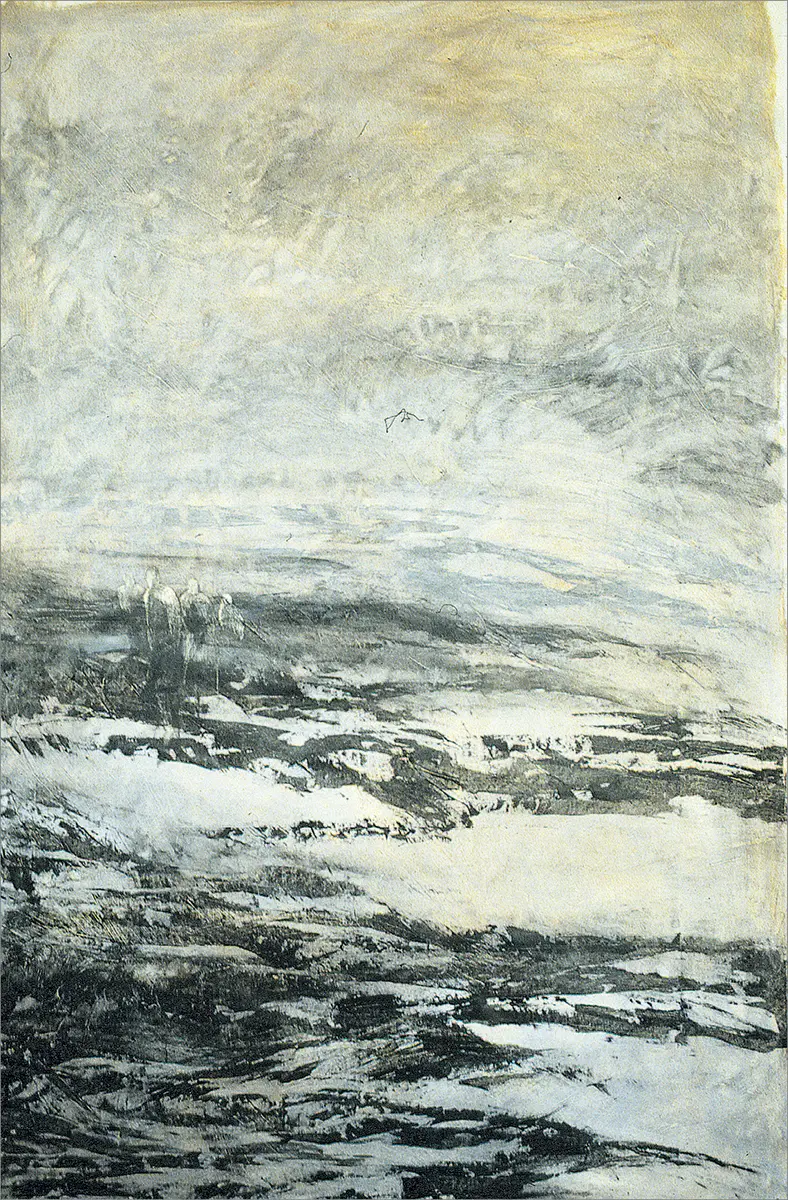
During the mid-1990s, Mónica Meira’s landscapes with tiny figures become the best example of Colombian art made on its own notions of modern art, that is, avoiding naturalism and simple equivalents of the visible. At the same time, they show a clear intention to talk about some present-day problems. Acrylic paintings from 1995 such as En el exterior (Abroad), Inmigrantes (Immigrants), and Refugiados (Refugees) are sufficient evidence for this claim. On the three of them, we observe an angry, whitish sea covering the whole canvas. The sea could overflow onto either side of the canvas. Tiny characters frozen in expectancy can be seen in the water, though in Inmigrantes they are almost imperceptible. From the shallow, Edenic bather landscapes, the artist has moved to an undefined, aqueous space where the anonymous figures appear wandering about at loss. Then come the many metal engravings of various techniques, some in color, where the characters are larger, and in many cases, they remind us again of the bathers’ poses. These works were done while she was studying at New York University’s Color Print Shop. Distancing herself a bit from the immigrants, it’s possible that in these prints the artist was amusing herself with the medium’s processes and random results.
Between 1996 and 1997, Meira returns to the same watery scenarios and the anonymous characters. Color resurfaces, sometimes contrasted, other times bordering on monochrome. Most of these paintings are particularly blurred, filled with blotches and open strokes. They give definition only to the small human figures, which are drawn perfectly in black lines or colored differently from the background. Although the work titles don’t make reference to disoriented travelers who have landed in strange lands, the compositions are presented so as to create a disquieting image. The landscape surrounds the characters, but we don’t know its limits. And then, the characters are too small or their movements are unclear. What are they really doing? Where are they? Some appear to be searching for something, they’re even leaning forward; others seem to be resting or thinking, and there’s the one who runs like a real athlete, or the one bathing, or the one fishing although he could very well be playing.
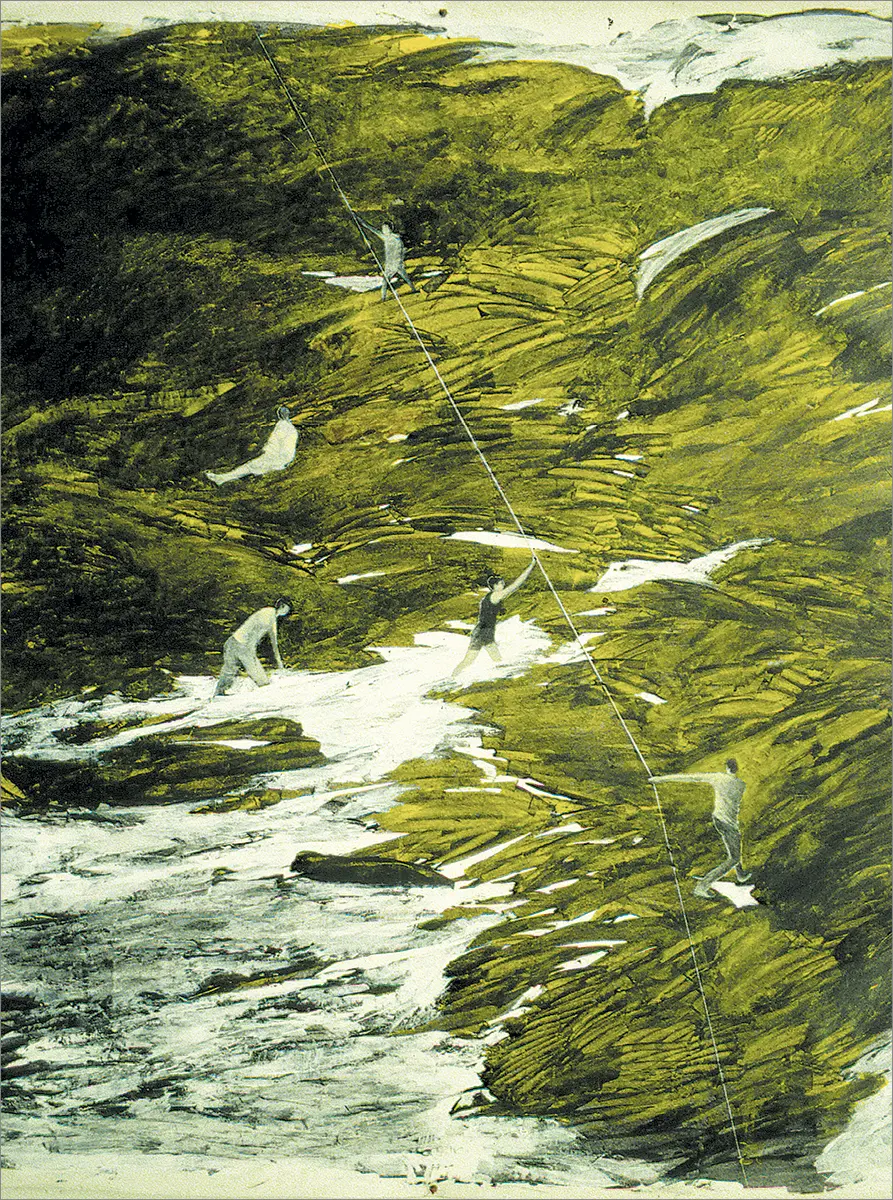
The acrylic Cascada (Cascade) dates back to 1998. It is one of the first works where the scenario ceases to be exclusively coastal. For its dry green color, worked with pasty, well-visible strokes, one could think that he’s before a land panorama, even if the cascade’s water can be seen in white and stained strokes. A good number of acrylic paintings follow in 1998 and early 1999, some relatively large. On the thick, mixed-colored backgrounds we can see the figures, but now they seem more active. They carry white signs with no lettering, they climb up a ladder to work on a painting that’s floating in mid-air (or is it a simple pink plane that’s being touched up?), or they hold unknown objects resembling large metal strips with clouds on them, or huge, transparent planes. The background of this last painting –Muro (Wall), 1998 is almost completely devoid of pastiness, and it has been divided into geometric planes arranged diagonally. Yellow dominates the composition, and then it mixes with grey and dark-green spots toward the lower part of the canvas. Besides the characters who are barely holding on to the wall, in this sort of abstract scenography we find two main characters, one static, and the other walking.
Again, we are before strange paintings. To link them to Surrealism’s imagery would be senseless since these intriguing representations are neither dream images nor hot nightmares. Here everything appears as normal, common, ordinary. But after a second reading, when the quality of the painting –its style, color combination, the relationship between the figures and the background has been appreciated, new questions and assumptions arise, and perhaps the certainty that what the artist shows us is allegories of human follies.
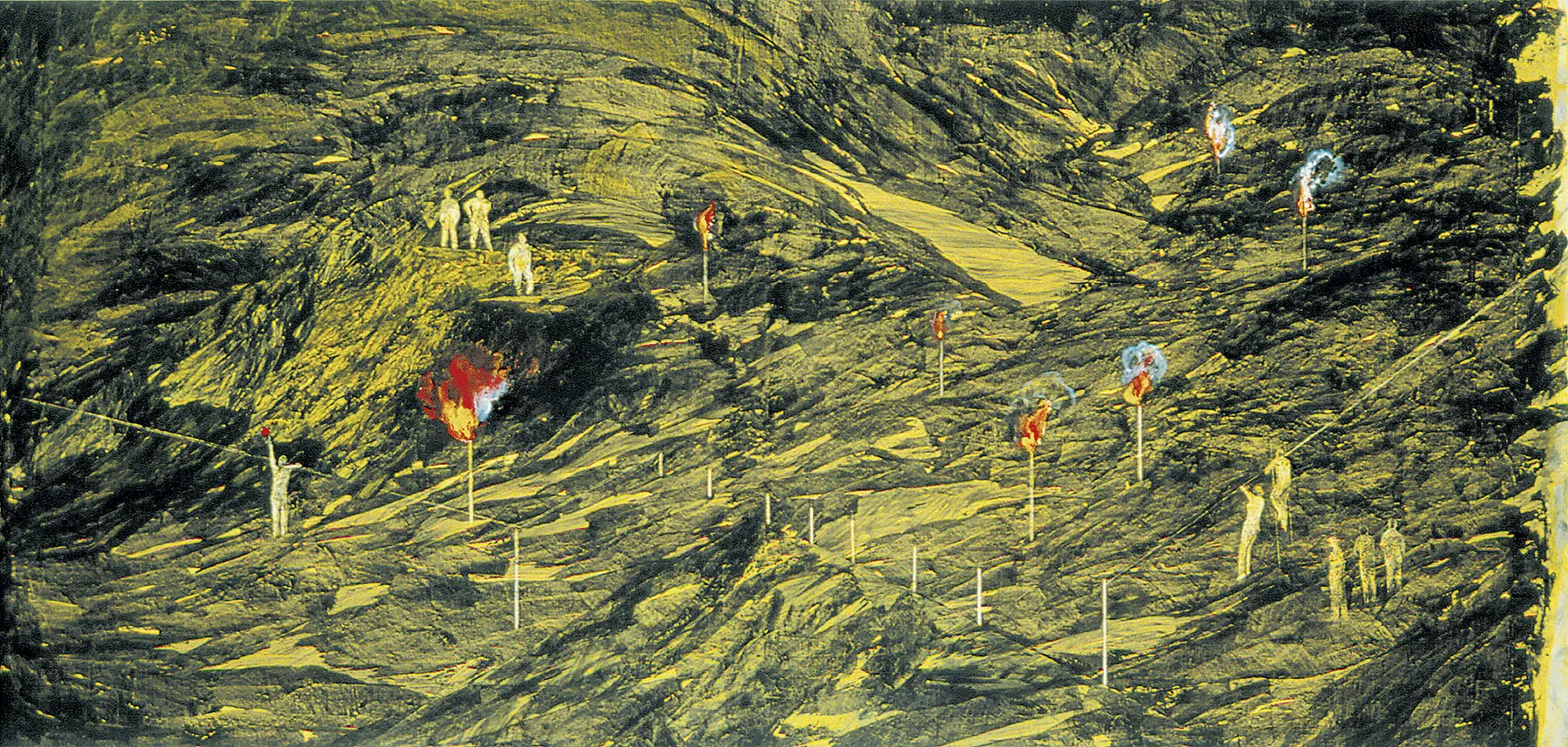
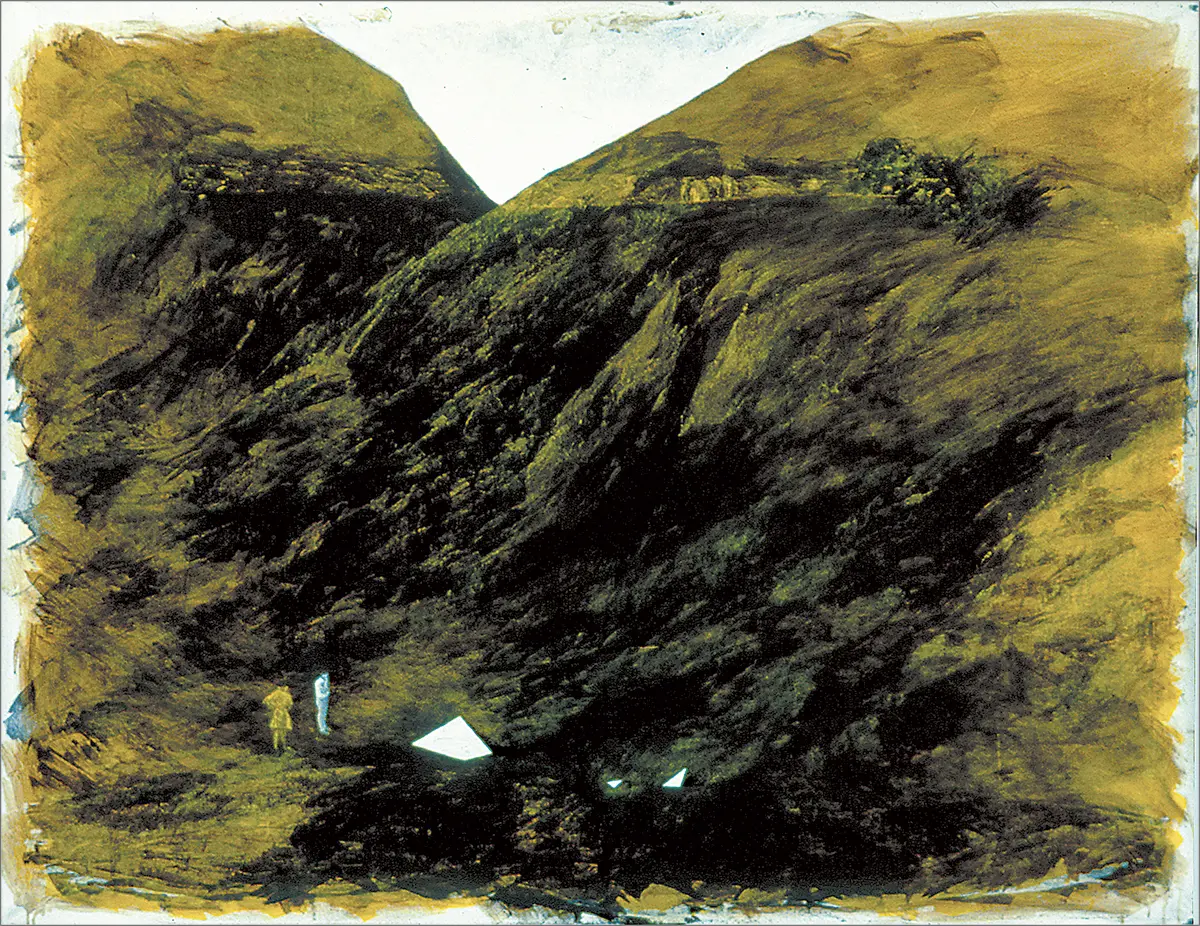
In the last three years the acrylics of Mónica Meira are painted each time more carelessly. If a painting like Three Pieces (2000) is compared with the large format canvas Slope with two figures (2002), it is obvious that while the first is contained, with visible but carefully placed and intertwined strokes, the second is almost violent, painted with disorderly and rough impastos. Also noticeable is that the pieces of the first pieza, while being apparently seen by a man and a woman, are white planes with straight borders; while the figures on the second pieza are holding an undefined object that is more than a banner or large piece of cloth, it resembles an elongated orange stain, pasty and barely regular. Her most recent canvases look intense, and restless. And this is not only due to their cleanness and ease, but also a desire to unsettle and raise doubts. Important are those paintings where the solitary character appears lost in the mountains (where we finally see some mountain tops), or a figure with his back toward us hangs precariously from a steep mountain. And the impacting Montaña negra con llamas (Black Mountain with Flames) (2002), where we see two figures –acrobats, perhaps together in a steep and wild location, surrounding several poles that have been set ablaze. It’s not difficult to guess the scene’s meaning. Of course, there are other interpretations; put them aside and the painting in itself remains outstanding. With very few formal elements, starting with the countless yellow and black stains and finishing with the blues, yellows, and reds in the flames, one could easily say that something there is not quite right.
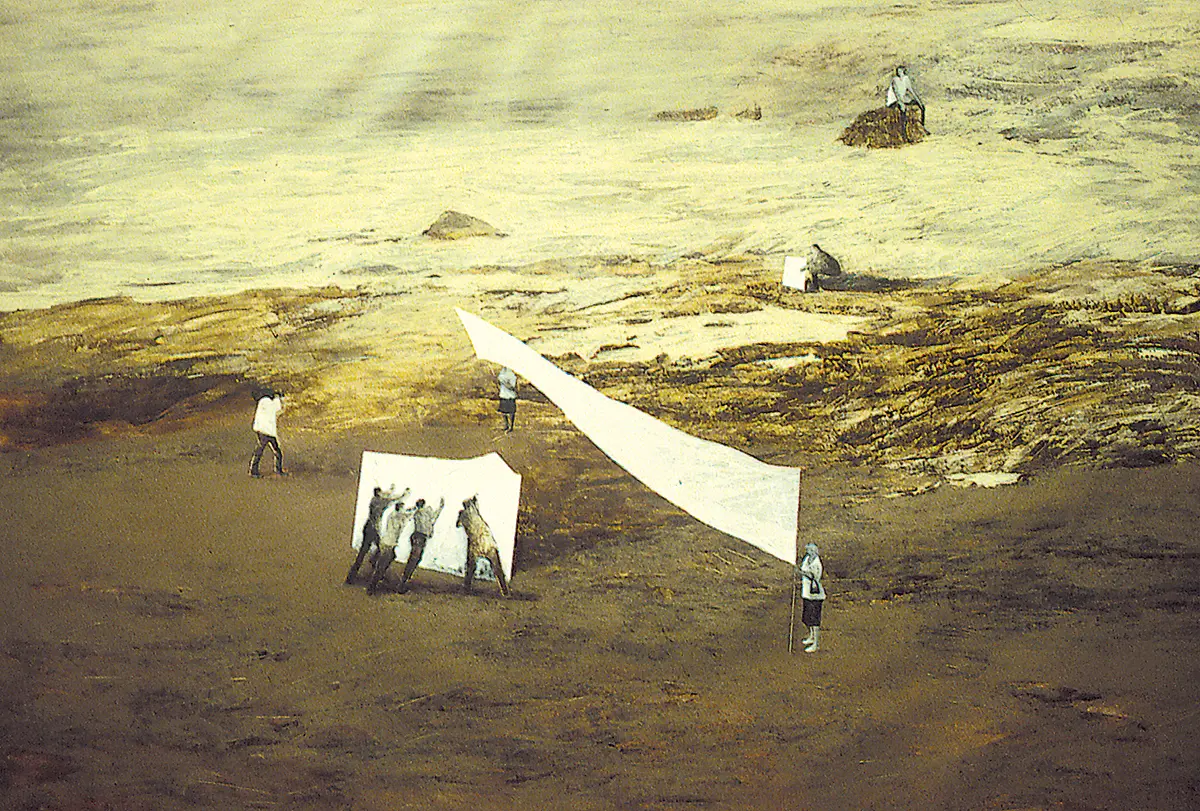
Mónica Meira’s most recent landscapes without a doubt arise from her personal uneasiness. But in the long run, they aren’t extravagant, they coincide with the fears and somber premonitions of her peers. In Meira’s same generation are several Latin American artists whose works, while done in different styles, have the same emotional load and interest in scrutinizing current affairs. This is the case of Cuban Tomás Sánchez (1948), of Venezuelans Víctor Hugo Irazabal (1945) and Octavio Russo (1949), of Brazilians Sirón Franco (1947) and Luis Zerbini (1959), of Argentinean Armando Rearte (1945) and of Chileans Roberto Geisse (1954) and Sergio Lay (1957). Among these artists, Mónica Meira is frankly outstanding.
NOTE
1. Traba, Marta, Historia abierta del arte colombiano (The Open History of Colombian Art), Museo La Tertulia. Cali: 1974
GERMÁN RUBIANO CABALLERO
Art historian and critic.