Literature and the visual arts have had a historically eclectic relationship. Think, for instance, of the ancient Greek rhetorical exercise of ekphrasis which is a kind of art criticism avant la lettre, where the lyric poet attempts to make concrete through language his or her emotive responses to a work of art. The inverse of ekphrasis has appeared in other forms of artistic inquiry, one being exhibition practices such as the Garden of Forking Paths with its Borgesian allusions or the Accelerated Grimace and its curatorial graphing of Ezra Pound. It’s artists, however, who seem to have successfully mined this field with the greatest aplomb. Yet it seems that the most convincing confluence between literature and art is coupled with disparity, historical or otherwise.
The interaction between the Cuban poet Julian Del Casal and Gustave Moreau was an interesting example of converging transatlantic modernism. The enterprise between Abstract Expressionism and its concomitant poets was less than desirable, however, and Fluxus and Buddhist texts are compatible because the latter’s propensity for the philosophical conundrum that questions Western epistemology is akin to the absurdist, artistic strategies of the former. What is equally interesting is when artists fuse the broadest of sources amounting to a gambler’s take–or lose-all mentality that ups the ante in the process. And this is certainly the case with Monika Bravo’s multi-sensorial installation titled A_Maze, and its use of a Borges poem titled Ars Poetica as a formal and thematic point of departure.
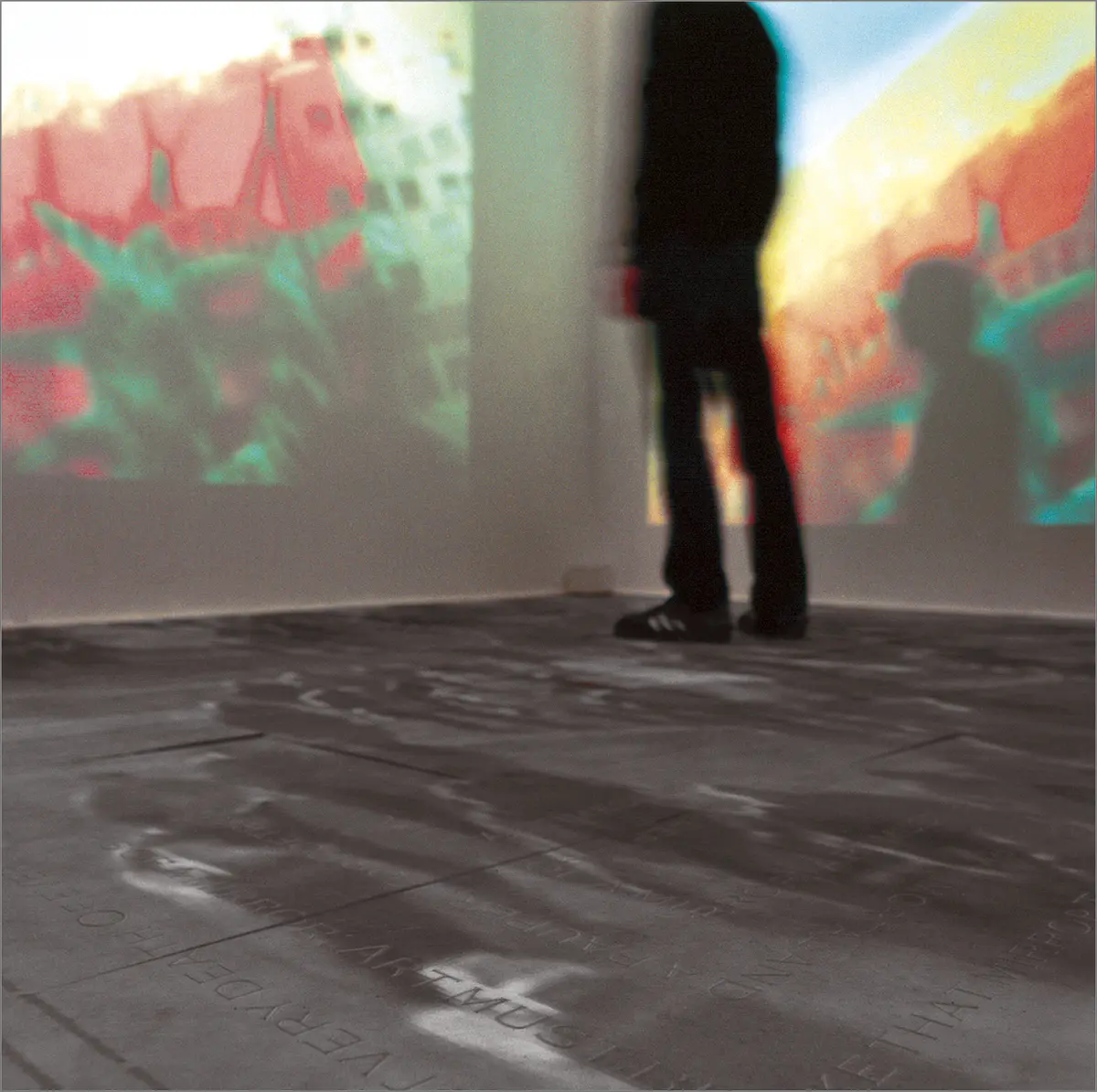
As its title implies, A_Maze revolved around a viewer-activated video/sound installation that was configured to resemble a labyrinth, which may be one of the most recognizable Borgesean tropes. The labyrinth, for Borges, was a multifaceted metaphor that was a formal device as it was an occasional leitmotif. Bravo seems to understand this quite well in that the Borges poem is inscribed on a giant square in a labyrinth-like schema that triggers a series of video sequences of landscapes and a host of other imagery filmed around the world: One moment we are in Manhattan; then, in a blink of an eye, we are in Milan, Vietnam, Thailand, Tokyo.
The poem, however, becomes supplementary to the rest of the work and almost undermines itself for it is nearly impossible to read; for in order to activate the video sequence one must walk on the squares where the poem is written. It is precisely at this level of contradiction that partially gives the installation its strength. The hallucinatory effect of the installation is more than just an exercise in perception or an aesthetic pleasure bordering on visual intoxication, however. It serves to underscore the social dimension of how we perceive the world as it generally taps into what Walter Benjamin called modernism’s “optical unconscious”. Whereas this term conflates Bergsonian social theories of perception with Freudian psychology, Bravo proposes a different dialectical exchange between the eye and body by virtue of the interactive quality of the installation predicated on corporeal engagement. Bravo pushes the phenomenological in interesting directions that invoke the sublime and a host of other theoretical and philosophical questions. The manifestation of the sublime in A_Maze is in stark contrast to its art historical antecedents. With Barnett Newman and Jackson Pollack, for example, the sublime operates by engulfing and subordinating the viewer. Ditto for videos from the likes of Bill Viola. Bravo undermines this by shifting the work’s activation to the viewer. Such high-brow ideas concerning the sublime etc. were not at all heavy-handed, for the installation was elegantly executed and punctuated by a soundtrack that conveyed the impression that one was in some sort of rave with a dizzying array of images and sound, of Borgesean proportions perhaps.
RAÚL ZAMUDIO