
On the morning of March 6, 2002, 18 women are ushered inside San Mateo, a medieval church located in the heart of Lucca. The now-profane church is ample; it’s empty, devastated, and light seeps in through a rosette and neo-Gothic windows. Most of the girls entering the church come from Eastern Europe. Some of them are Russian, Siberian, and Slovak; there’s one Croatian, one Estonian, and several from Bulgaria –two of these are mother and daughter. Also, there’s a girl from Nigeria.
The girls have been recruited from local nightclubs by intermediaries in this Tuscany region. These 18 women were enrolled to take part in action behind closed doors. Under the direction of the artist Santiago Sierra, the action was organized by the Claudio Poleschi Arte Contemporanea Gallery, in collaboration with Lucca’s Prometheus Cultural Association.
The action lasted 5 hours. For their participation, the girls were paid 105 Euros each. The action’s title was Rociado de poliuretano sobre 18 personas (Polyurethane Douse on 18 Persons).
They were first asked to strip down to their underwear and shoes. At first, there’s tension, intensified by the noise made by the gas heaters. These gas heaters have been warming up the chapel since the morning. They have been placed against the wall, and their continuous noise serves as background to the voices.
As soon as they undress, the women are called one by one toward the center of the church. Inside the church are woolen blankets ready for them, which they use to cover themselves. In the middle of the central nave, there’s a military blanket. Each girl must place herself in two postures: on all fours, then sitting down with their legs spread apart. Armed with spray cylinders, two workers have the task of dousing polyurethane on the women’s private parts while they remain in those two postures. The women are protected by the blankets, and by a sheet of black plastic, similar to the ones used to make garbage bags. Before each spray, the artist makes sure to cover the bodies with the black plastic, using his hands to keep it clung to their bodies. It is understood that polyurethane’s function is not to preserve women’s figures. After each spray, the workers take the plastic and throw it on the floor. The floor ends up resembling a puddle on which the residue of black plastic and the dry, yellowish foam are floating.
The workers’ tasks repeat themselves mechanically, obsessively, one posture after the other, one girl at a time, until they reach the eighteenth one in a sort of repetitive coercion.
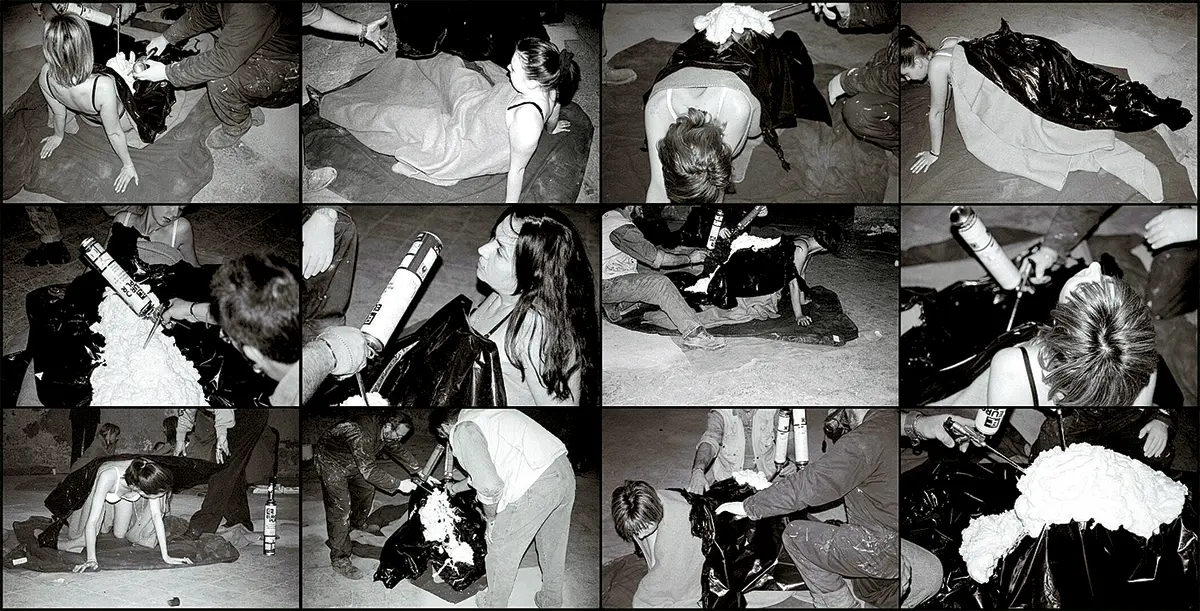
Toward the end of the action, the women are aligned in front of the presbytery. The artist calls each one and pays her. Not until then can they dress up and leave. Hours later, the girls go back to their night job as escorts in the dark locales of the Tuscany region.
In this action, the chapel turns into a sort of gothic space, a closed place where a vertical relationship is installed between the one who has power and the one who obeys it. Just like in certain of de Sade’s romances, or Passolini’s Saló, we have a relationship between victims and henchmen that can only be resolved by fleeing. But here there’s neither fiction nor flight. The girls have firsthand participation in an experience that’s both true and humiliating. The artistic mechanism is geared into action when there’s the authentic working relation that, nevertheless, becomes a mechanism of power.
In the two postures demanded, the half-naked girls offer their bodies and passively subject themselves to the external, masculine action performed by the workers and the artist, who’s hashing out the orders.
There are no reasons given for the girls’ consent to participate in these actions that apparently are useless and nonsensical. The association of the different details allows us to read the girls’ two postures. On the one hand, we have the workers’ task with the white polyurethane, which is an allusion to sexual intercourse and ejaculation. On the other, we have the women, who aren’t completely aware of the role that polyurethane plays in their bodies. The action proves itself to be humiliating and, surreptitiously with this economic relationship, inserts the women into the context of prostitution.
Ejaculation as the final act of the male sexual act is done as an instant of annulment of desire that has reached peak pleasure. Consequently, the object of desire also loses any interest. That’s why in the ejaculation, symbolized by the polyurethane, we see, besides the loss of desire, the post-coital disinterest related to the very object of pleasure.
In Salamanca, Sierra worked with drug-addicted prostitutes that in real life are forced to whore themselves in order to get their fix. In exchange for monetary compensation to get their daily fix, they lent themselves to have tattooed a straight line on their backs. A single line on four women aligned, sitting with their backs and breasts erect. It’s a wound that hurts, it produces pain, an indelible mark on their bodies. In this work, the straight line, an essential element in the Minimalist grammar, literally becomes an in-grown line, almost an internal advent of the sign, a reality larger than the Minimalist esthetic. But the horizontal sign crossing the vertical bodies is like an annulment line, a line of cancellation, just like the ones prisoners carve on the prison walls after another week has passed.
Using different means, the work done by Sierra for the Claudio Poleschi Gallery achieves the same result. The polyurethane douse, associated with ejaculation —zero degree, the instant that annihilates desire— becomes a game of domination, the symbolic act in which the women annul themselves as persons by the mere fact of being prostitutes and getting paid for it. The remuneration burns any responsibility toward them. That’s why they can be fired at any moment.
The one who pays establishes and enforces the rules. The one who’s getting paid must be subject to that mechanism. The one who conceives the rules uses the necessary time in the invention (in the Latin sense of "finding a reality”) of such mechanism, which is useless and it satisfies only pleasure itself.
Through this game, the artist also exercises a power that’s executed through his intermediaries, alienating him. They always intervene between him and the hired women.
Sierra limits himself to coldly measuring the results of his project. He doesn’t finish his role as conceptual creator, nor does he engage in the practical counterpart of the project’s realization. He participates as an alienated witness, as someone who watches the machine he has projected as carrying out the job and indeed does it, but independently from his initial idea —a process which verifies itself autonomously while alienating its author. The work then becomes a complete event, including the selected documentation —photos, video, refuse. In this process, nothing is hidden.
Sierra doesn’t explain explicitly the reason why the women accepted this job. He doesn’t even tell us the job they perform at night. He doesn’t criticize directly any economic or political system. He doesn’t engage in his work to create a polemic or to prove a point. He just wants to show the reality to the public, and he doesn’t hide anything while doing it. His work is always on the razor’s edge. It’s a work without catharsis, it’s political, and it’s deeply dramatic.
Sierra fills an empty space in art with a space filled with reality. The amount of foam used, the polyurethane remains strewn on the floor, and the emphatic act documented for 45 minutes by the video, all become a sort of triumph over nothingness.
PABLO EMILIO ANTOGNOLI